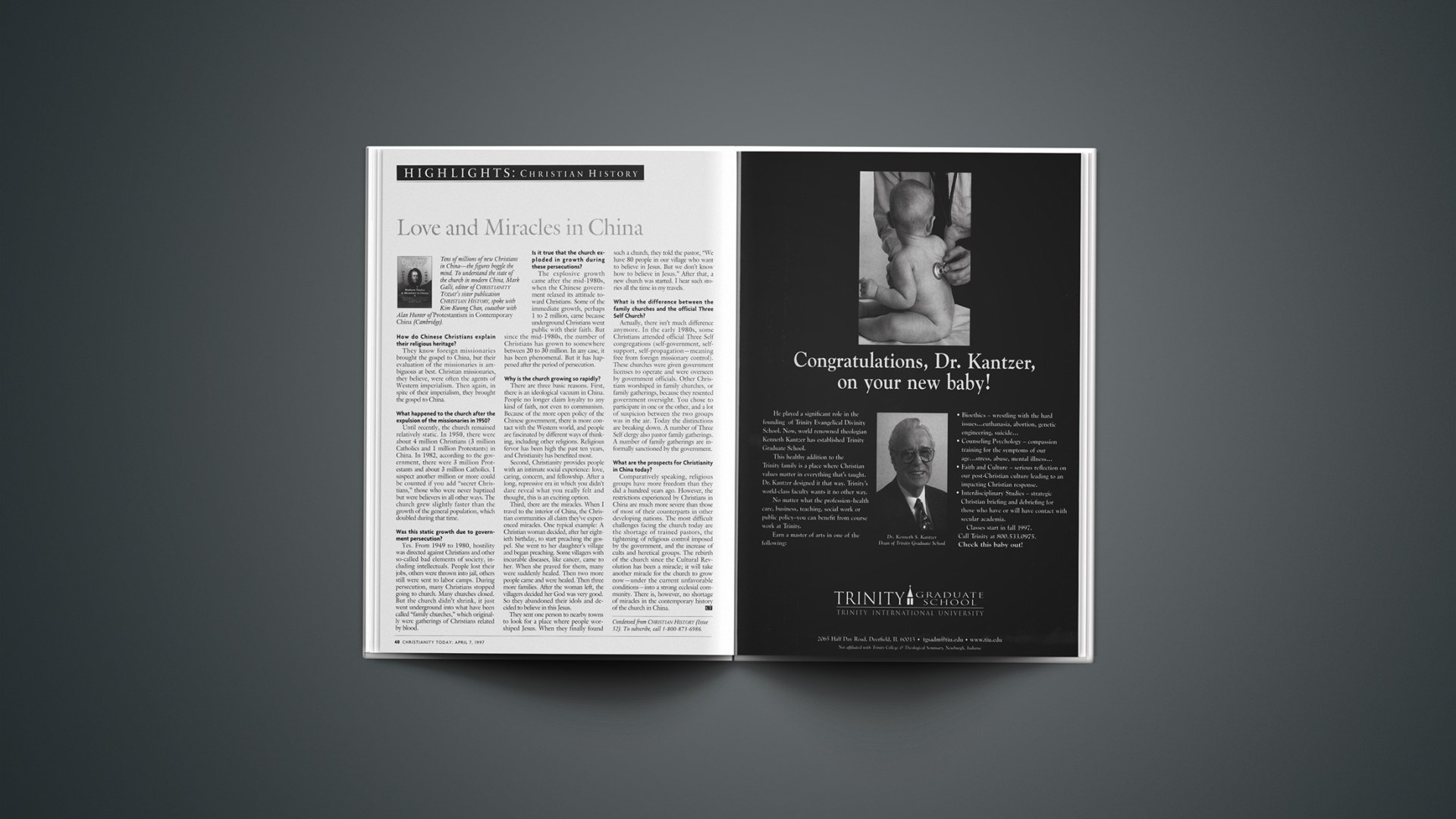

Tens of millions of new Christians in China—the figures boggle the mind. To understand the state of the church in modern China, Mark Galli, editor of CHRISTIANITY TODAY’s sister publication CHRISTIAN HISTORY, spoke with Kim-Kwong Chan, coauthor with Alan Hunter of Protestantism in Contemporary China (Cambridge).
How do Chinese Christians explain their religious heritage? They know foreign missionaries brought the gospel to China, but their evaluation of the missionaries is ambiguous at best. Christian missionaries, they believe, were often the agents of Western imperialism. Then again, in spite of their imperialism, they brought the gospel to China.
What happened to the church after the expulsion of the missionaries in 1950? Until recently, the church remained relatively static. In 1950, there were about 4 million Christians (3 million Catholics and 1 million Protestants) in China. In 1982, according to the government, there were 3 million Protestants and about 3 million Catholics. I suspect another million or more could be counted if you add “secret Christians,” those who were never baptized but were believers in all other ways. The church grew slightly faster than the growth of the general population, which doubled during that time.
Was this static growth due to government persecution? Yes. From 1949 to 1980, hostility was directed against Christians and other so-called bad elements of society, including intellectuals. People lost their jobs, others were thrown into jail, others still were sent to labor camps. During persecution, many Christians stopped going to church. Many churches closed. But the church didn’t shrink, it just went underground into what have been called “family churches,” which originally were gatherings of Christians related by blood.
Is it true that the church exploded in growth during these persecutions? The explosive growth came after the mid-1980s, when the Chinese government relaxed its attitude toward Christians. Some of the immediate growth, perhaps 1 to 2 million, came because underground Christians went public with their faith. But since the mid-1980s, the number of Christians has grown to somewhere between 20 to 30 million. In any case, it has been phenomenal. But it has happened after the period of persecution.
Why is the church growing so rapidly? There are three basic reasons. First, there is an ideological vacuum in China. People no longer claim loyalty to any kind of faith, not even to communism. Because of the more open policy of the Chinese government, there is more contact with the Western world, and people are fascinated by different ways of thinking, including other religions. Religious fervor has been high the past ten years, and Christianity has benefited most.
Second, Christianity provides people with an intimate social experience: love, caring, concern, and fellowship. After a long, repressive era in which you didn’t dare reveal what you really felt and thought, this is an exciting option.
Third, there are the miracles. When I travel to the interior of China, the Christian communities all claim they’ve experienced miracles. One typical example: A Christian woman decided, after her eightieth birthday, to start preaching the gospel. She went to her daughter’s village and began preaching. Some villagers with incurable diseases, like cancer, came to her. When she prayed for them, many were suddenly healed. Then two more people came and were healed. Then three more families. After the woman left, the villagers decided her God was very good. So they abandoned their idols and decided to believe in this Jesus.
They sent one person to nearby towns to look for a place where people worshiped Jesus. When they finally found such a church, they told the pastor, “We have 80 people in our village who want to believe in Jesus. But we don’t know how to believe in Jesus.” After that, a new church was started. I hear such stories all the time in my travels.
What is the difference between the family churches and the official Three Self Church? Actually, there isn’t much difference anymore. In the early 1980s, some Christians attended official Three Self congregations (self-government, self-support, self-propagation—meaning free from foreign missionary control). These churches were given government licenses to operate and were overseen by government officials. Other Christians worshiped in family churches, or family gatherings, because they resented government oversight. You chose to participate in one or the other, and a lot of suspicion between the two groups was in the air. Today the distinctions are breaking down. A number of Three Self clergy also pastor family gatherings. A number of family gatherings are informally sanctioned by the government.
What are the prospects for Christianity in China today? Comparatively speaking, religious groups have more freedom than they did a hundred years ago. However, the restrictions experienced by Christians in China are much more severe than those of most of their counterparts in other developing nations. The most difficult challenges facing the church today are the shortage of trained pastors, the tightening of religious control imposed by the government, and the increase of cults and heretical groups. The rebirth of the church since the Cultural Revolution has been a miracle; it will take another miracle for the church to grow now—under the current unfavorable conditions—into a strong ecclesial community. There is, however, no shortage of miracles in the contemporary history of the church in China.
-Condensed from CHRISTIAN HISTORY (Issue 52). To subscribe, call 1-800-873-6986.
Copyright © 1997 Christianity Today. Click for reprint information.