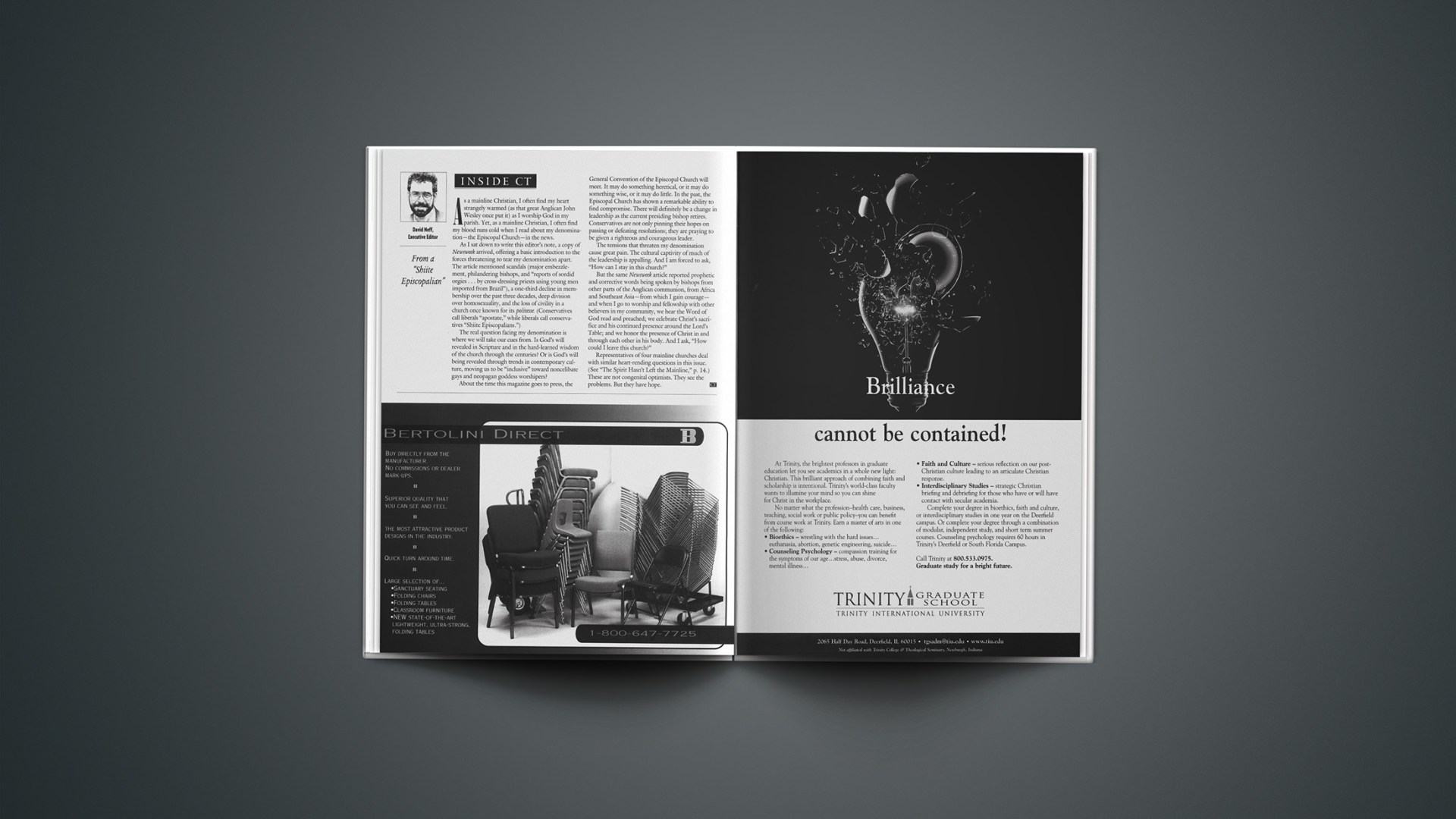

As a mainline Christian, I often find my heart strangely warmed (as thatgreat Anglican John Wesley once put it) as I worship God in my parish. Yet,as a mainline Christian, I often find my blood runs cold when I read aboutmy denomination—the Episcopal Church—in the news.
As I sat down to write this editor’s note, a copy of Newsweek arrived,offering a basic introduction to the forces threatening to tear my denominationapart. The article mentioned scandals (major embezzlement, philandering bishops,and “reports of sordid orgies … by cross-dressing priests using youngmen imported from Brazil”), a one-third decline in membership over the pastthree decades, deep division over homosexuality, and the loss of civilityin a church once known for its politesse. (Conservatives call liberals”apostate,” while liberals call conservatives “Shiite Episcopalians.”)
The real question facing my denomination is where we will take our cues from.Is God’s will revealed in Scripture and in the hard-learned wisdom of thechurch through the centuries? Or is God’s will being revealed through trendsin contemporary culture, moving us to be “inclusive” toward noncelibate gaysand neopagan goddess worshipers?
About the time this magazine goes to press, the General Convention of theEpiscopal Church will meet. It may do something heretical, or it may do somethingwise, or it may do little. In the past, the Episcopal Church has shown aremarkable ability to find compromise. There will definitely be a changein leadership as the current presiding bishop retires. Conservatives arenot only pinning their hopes on passing or defeating resolutions; they arepraying to be given a righteous and courageous leader.
The tensions that threaten my denomination cause great pain. The culturalcaptivity of much of the leadership is appalling. And I am forced to ask,”How can I stay in this church?”
But the same Newsweek article reported prophetic and corrective wordsbeing spoken by bishops from other parts of the Anglican communion, fromAfrica and Southeast Asia—from which I gain courage—and when I go to worshipand fellowship with other believers in my community, we hear the Word ofGod read and preached; we celebrate Christ’s sacrifice and his continuedpresence around the Lord’s Table; and we honor the presence of Christ inand through each other in his body. And I ask, “How could I leave this church?”
Representatives of four mainline churches deal with similar heart-rendingquestions in this issue. (See “The Spirit Hasn’tLeft the Mainline,” p. 14.) These are not congenital optimists. Theysee the problems. But they have hope.
Copyright © 1997 Christianity Today. Click for reprint information.