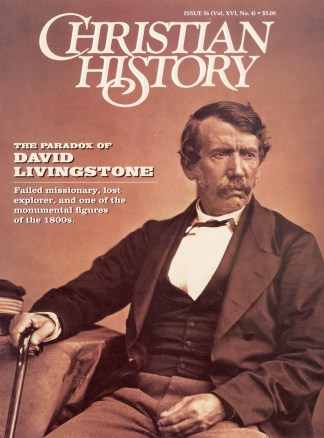
Although romance was far less a factor in marriage for nineteenth-century couples than it is today, the unmarried Livingstone seemed even less romantic than most.
Before he married, he prided himself on his celibacy and singleness. When his London Missionary Society (LMS) application asked simply for his marital status, for example, Livingstone wrote a mammoth reply: “Unmarried; under no engagement related to marriage, never made proposals of marriage, nor conducted myself so to any woman as to cause her to suspect that I intended anything related to marriage.”
Livingstone was not against marriage as an institution. He simply believed it was something best left to others. The only reason he would marry, he wrote a friend, would be to further his cause. “But whether my usefulness will be augmented by getting a wife,” he wrote, “I really don’t know.”
Pressed to marry
While he lived in a missionary community, however, the issue refused to be left alone. Letters from friends back home pressed him to marry and were often accompanied by baby clothes!
One missionary couple tried to get Livingstone interested in their daughter, but he showed no interest. Unsatisfied and incredulous, the couple zealously gathered information about his female correspondents, going so far as to open his mail. They were particularly concerned about a Mrs. Sewell, whom they suspected was a young widow hoarding Livingstone’s affections, and withheld his letters to her. In truth she was an elderly woman who ran the London boarding house Livingstone had stayed in.
Though single male missionaries were often suspected by married ones of “carrying on” with the natives, Livingstone persisted in singleness, even more so given what he felt were his options.
“Daughters of missionaries have miserably contracted minds,” he wrote, “colonial ladies worse and worse. There’s no outlet for me when I think of getting married but that of sending home an advertisement in the Evangelical Magazine.”
Doing his duty
Gradually Livingstone became convinced a wife would help him in his missionary work. Not only would she run a school but she would assuage (unfounded) suspicions some had about his relations with African women.
Of his potential brides, Mary Moffat offered Livingstone the best opportunity to pursue his missionary calling. She had lived 19 of her 23 years in Africa, and, unlike many other missionary daughters, did not see marriage as a ticket home to England. Beauty was certainly not an issue for him. To friends he once described Mary as “African in complexion, [with] a stout stumpy body.”
Things other than love or looks loomed larger in his mind. He wrote his mother, “My wife is amiable and good tempered, and my new connections pious, which you know to be the best certificate of character.”
And when it came to announcing his engagement to the LMS, his British reserve went out of control: “Various considerations connected with this new sphere of labor, and which to you need not be specified in detail, having led me to the conclusion that it was my duty to enter into the marriage relation, I have made the necessary arrangement for union with Mary, the eldest daughter of Mr. Moffat, in the beginning of January 1845.”
Copyright © 1997 by the author or Christianity Today/Christian History magazine. Click here for reprint information on Christian History.