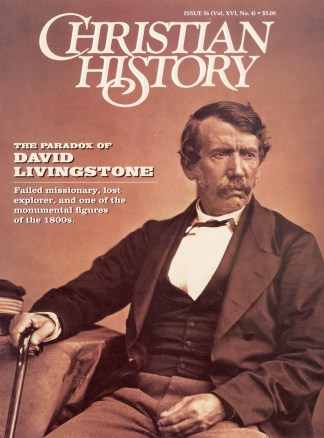
Though Livingstone is remembered as a missionary, only one-third of his 30 years in Africa were spent in the service of a mission board. Even during that time, he went his own way, often ignoring the advice and directives of colleagues and superiors.
Livingstone started life as did millions of other children in the industrial revolution: exploited by a society bereft of child labor laws. At age 10, he worked 14-hour days in a cotton factory, followed by two hours of night school. He grew up in a one-room tenement that overlooked the cotton mill where he worked.
With his first week’s wages, Livingstone purchased a copy of Ruddiman’s Rudiments of Latin. To break the tedium in the factory, he propped the book on the frame of his machine and studied while he worked.
Livingstone was determined to become a missionary to China but was prevented from doing so by the outbreak of the Opium War.
Livingstone closely connected mission work with social and economic progress. The only way to fight the slave trade in Africa, he said, was through “Christianity, Commerce, and Civilization.”
From his earliest years in Africa, Livingstone was often critical of fellow missionaries. Soon after he arrived in the Cape Colony, he wrote, “The missionaries in the interior are, I am grieved to say, a sorry set. … I shall be glad when I get away into the region beyond—away from their envy and backbiting.” He added that there was no more affection between them and himself than there was between his “riding ox and his grandmother.”
Livingstone’s penchant for exploring could not help but affect his family life. He and his wife, Mary, lived in the same house together only four of the seventeen years of their marriage.
When Mary Moffat, Livingstone’s mother-in-law, heard that he had taken her daughter and grandchildren on another dangerous exploring expedition, she wrote him a stinging letter, signed, “I remain yours in great perturbation. M. Moffat.”
Unlike his fellow explorers and traveling companions, Livingstone enjoyed relatively good health during his first years in Africa. He traversed the continent for a dozen years before he fell ill with “African fever.” At that time, he experimented with the local witch doctors to test their healing powers but concluded, after being “smoked like a red-herring over green twigs” and put under their charms, that European medical practices were superior.
Livingstone was the first European to feast his eyes on the great Victoria Falls: “Five columns of smoke [i.e., mist] arose. … The whole scene was extremely beautiful; the banks and islands dotted over the river are adorned with sylvan vegetation of great variety and form … scenes so lovely must have been gazed upon by angels in their flight.”
During his first visit back to the British Isles (1856-1858), Livingstone became a national hero. He was awarded a gold medal from the Royal Geographical Society, an honorary doctorate from Oxford University, and a private audience with Queen Victoria. He was mobbed in the streets; when he attended church, chaos ensued as people climbed over pews to shake his hand.
Livingstone is considered one of history’s greatest explorers, but his last two expeditions failed in their chief aims: The Zambezi Expedition sought to discover a navigable river that cut across southern Africa, and in his final adventure, Livingstone sought to find the source of the Nile.
Though Livingstone did little traditional missionary work while he was alive, after his death, he inspired hundreds of men and women to give their lives for African missions. Mary Slessor, for example, decided to follow in the footsteps of her hero and, in 1875, arrived in Calabar (in present-day Nigeria). She quickly became a living legend as an explorer and evangelist—and vice counsel for the British Empire. Peter Cameron Scott, founder of the Africa Inland Mission, was inspired to return to Africa after his first mission failed when he read the inscription on Livingstone’s tomb in Westminster Abbey: “Other sheep I have which are not of this fold; them also I must bring.”
Ruth Tucker is a member of the Christian History advisory board and the author of From Jerusalem to Irian Jaya: A Biographical History of Christian Missions (Zondervan, 1983) and Seasons of Motherhood (Victor, 1996).
Copyright © 1997 by the author or Christianity Today/Christian History magazine. Click here for reprint information on Christian History.