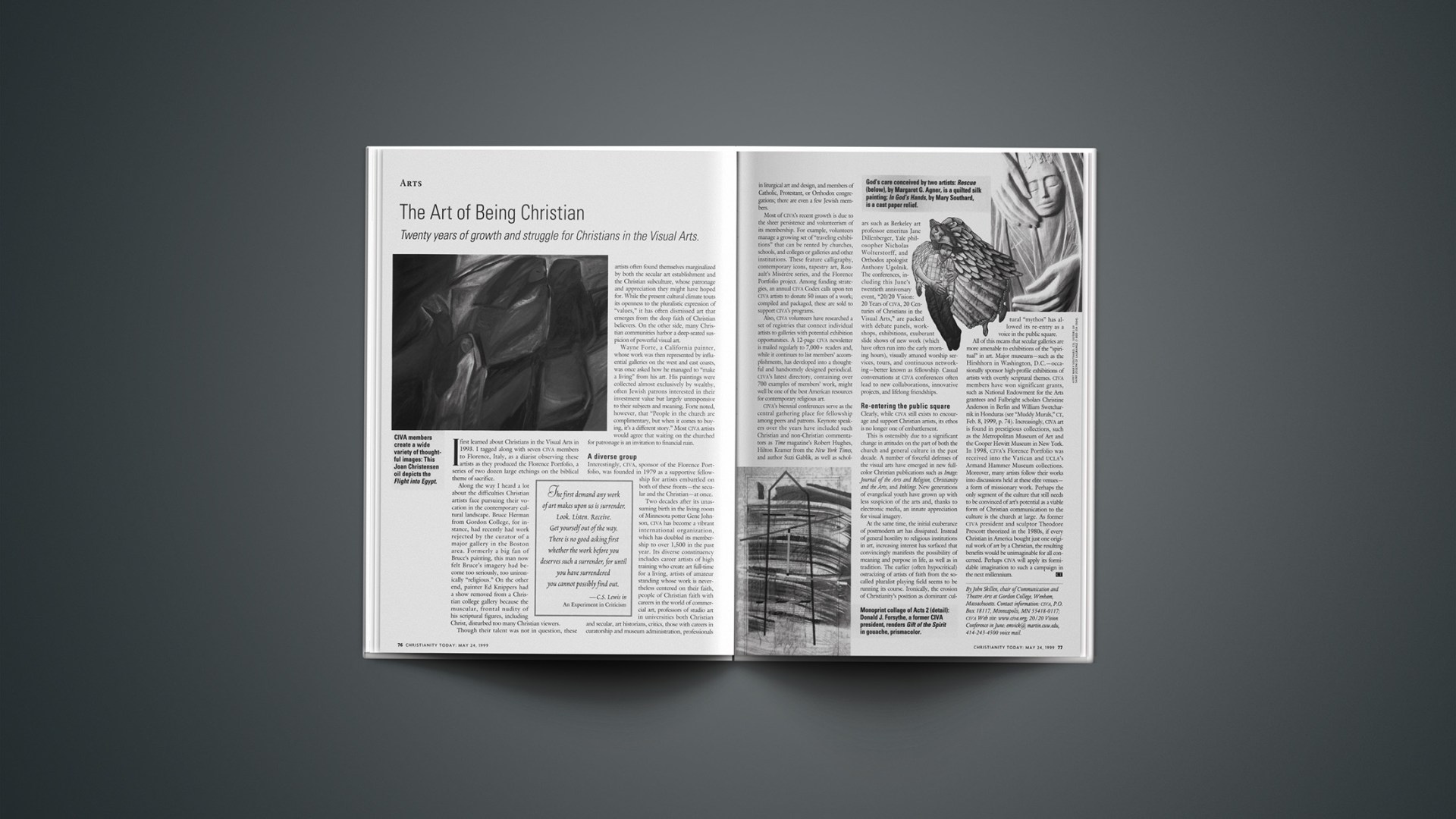

I first learned about Christians in the Visual Arts in 1993. I tagged along with seven CIVA members to Florence, Italy, as a diarist observing these artists as they produced the Florence Portfolio, a series of two dozen large etchings on the biblical theme of sacrifice.fdfsdfs
Along the way I heard a lot about the difficulties Christian artists face pursuing their vocation in the contemporary cultural landscape. Bruce Herman from Gordon College, for in stance, had recently had work rejected by the curator of a major gallery in the Boston area. Formerly a big fan of Bruce’s painting, this man now felt Bruce’s imagery had be come too seriously, too unironically “religious.” On the other end, painter Ed Knippers had a show removed from a Christian college gallery because the muscular, frontal nudity of his scriptural figures, including Christ, disturbed too many Christian viewers.
Though their talent was not in question, these artists often found themselves marginalized by both the secular art establishment and the Christian subculture, whose patronage and appreciation they might have hoped for. While the present cultural climate touts its openness to the pluralistic expression of “values,” it has often dismissed art that emerges from the deep faith of Christian believers. On the other side, many Christian communities harbor a deep-seated suspicion of powerful visual art.
Wayne Forte, a California painter, whose work was then represented by influential galleries on the west and east coasts, was once asked how he managed to “make a living” from his art. His paintings were collected almost exclusively by wealthy, often Jewish patrons interested in their investment value but largely unresponsive to their subjects and meaning. Forte noted, however, that “People in the church are complimentary, but when it comes to buying, it’s a different story.” Most CIVA artists would agree that waiting on the churched for patronage is an invitation to financial ruin.
A diverse groupInterestingly, CIVA, sponsor of the Florence Portfolio, was founded in 1979 as a supportive fellowship for artists embattled on both of these fronts-the secular and the Christian-at once.
Two decades after its unassuming birth in the living room of Minnesota potter Gene John son, CIVA has become a vibrant international organization, which has doubled its membership to over 1,500 in the past year. Its diverse constituency includes career artists of high training who create art full-time for a living, artists of amateur standing whose work is nevertheless centered on their faith, people of Christian faith with careers in the world of commercial art, professors of studio art in universities both Christian and secular, art historians, critics, those with careers in curatorship and museum administration, professionals in liturgical art and design, and members of Catholic, Protestant, or Orthodox congregations; there are even a few Jewish members.
The first demand any workof art makes upon us is surrender.Look. Listen. Receive.Get yourself out of the way.There is no good asking firstwhether the work before youdeserves such a surrender, for untilyou have surrenderedyou cannot possibly find out.
-C.S. Lewis inAn Experiment in Criticism
Most of CIVA’s recent growth is due to the sheer persistence and volunteerism of its membership. For example, volunteers manage a growing set of “traveling exhibitions” that can be rented by churches, schools, and colleges or galleries and other institutions. These feature calligraphy, contemporary icons, tapestry art, Rouault’s Miserere series, and the Florence Portfolio project. Among funding strategies, an annual CIVA Codex calls upon ten CIVA artists to donate 50 issues of a work; compiled and packaged, these are sold to support CIVA’s programs.
Also, CIVA volunteers have researched a set of registries that connect individual artists to galleries with potential exhibition opportunities. A 12-page CIVA news letter is mailed regularly to 7,000+ readers and, while it continues to list members’ accomplishments, has developed into a thoughtful and handsomely designed periodical. CIVA’s latest directory, containing over 700 examples of members’ work, might well be one of the best American resources for contemporary religious art.
CIVA’s biennial conferences serve as the central gathering place for fellowship among peers and patrons. Key note speakers over the years have included such Christian and non-Christian commentators as Time magazine’s Robert Hughes, Hilton Kramer from the New York Times, and author Suzi Gablik, as well as scholars such as Berkeley art professor emeritus Jane Dillenberger, Yale philosopher Nicholas Wolterstorff, and Orthodox apologist Anthony Ugolnik. The conferences, including this June’s twentieth anniversary event, “20/20 Vision: 20 Years of CIVA, 20 Centuries of Christians in the Visual Arts,” are packed with debate panels, workshops, exhibitions, exuberant slide shows of new work (which have often run into the early morning hours), visually attuned worship services, tours, and continuous networking-better known as fellowship. Casual conversations at CIVA conferences often lead to new collaborations, innovative projects, and lifelong friend ships.
Re-entering the public squareClearly, while CIVA still exists to encourage and support Christian artists, its ethos is no longer one of embattlement.
This is ostensibly due to a significant change in attitudes on the part of both the church and general culture in the past decade. A number of forceful defenses of the visual arts have emerged in new full-color Christian publications such as Image: Journal of the Arts and Religion, Christianity and the Arts, and Inklings. New generations of evangelical youth have grown up with less suspicion of the arts and, thanks to electronic media, an innate appreciation for visual imagery.
At the same time, the initial exuberance of postmodern art has dissipated. Instead of general hostility to religious institutions in art, increasing interest has surfaced that convincingly manifests the possibility of meaning and purpose in life, as well as in tradition. The earlier (often hypocritical) ostracizing of artists of faith from the so-called pluralist playing field seems to be running its course. Ironically, the erosion of Christianity’s position as dominant cultural “my thos” has allowed its re-entry as a voice in the public square.
All of this means that secular galleries are more amenable to exhibitions of the “spiritual” in art. Major museums-such as the Hirshhorn in Washing ton, D.C-occasionally sponsor high-profile exhibitions of artists with overtly scriptural themes. CIVA members have won significant grants, such as National Endowment for the Arts grantees and Fulbright scholars Chris tine Anderson in Berlin and William Swetcharnik in Honduras (see “Muddy Murals,” CT, Feb. 8, 1999, p. 74). Increasingly, CIVA art is found in prestigious collections, such as the Metropolitan Museum of Art and the Cooper Hewitt Museum in New York. In 1998, CIVA’s Florence Portfolio was received into the Vatican and UCLA’s Armand Hammer Museum collections. Moreover, many artists follow their works into discussions held at these elite venues-a form of missionary work. Perhaps the only segment of the culture that still needs to be convinced of art’s potential as a viable form of Christian communication to the culture is the church at large. As former CIVA president and sculptor Theodore Prescott theorized in the 1980s, if every Christian in America bought just one original work of art by a Christian, the resulting benefits would be unimaginable for all concerned. Perhaps CIVA will apply its formidable imagination to such a campaign in the next millennium.
By John Skillen, chair of Communication and Theatre Arts at Gordon College, Wenham, Massachusetts. Contact information: CIVA, P.O. Box 18117, Minneapolis, MN 55418-0117; CIVA Web site: www.civa.org; 20/20 Vision Conference in June: emvick@martin.cuw.edu, 414-243-4500 voice mail.
Copyright © 1999 Christianity Today. Click for reprint information.