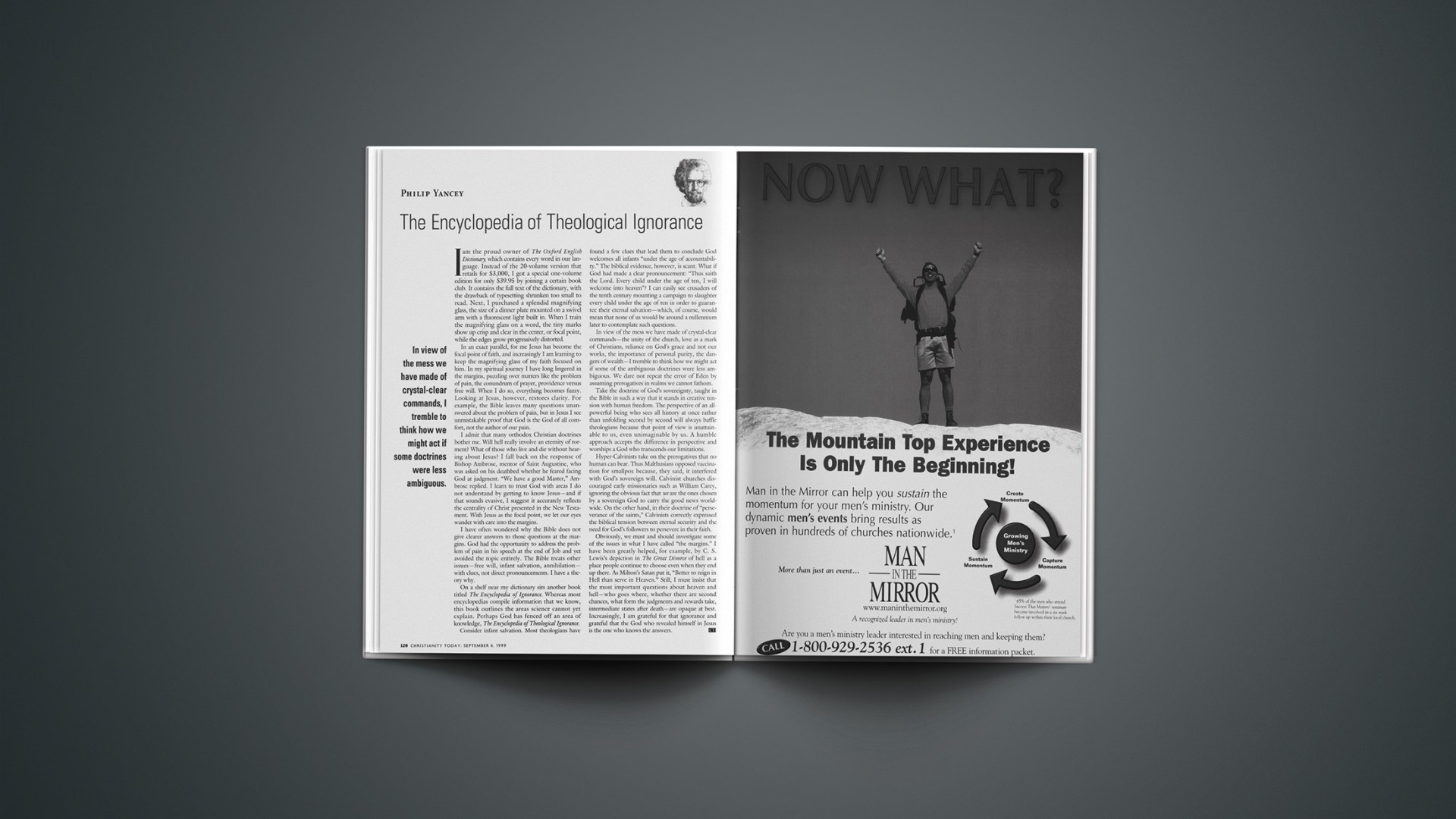

I am the proud owner of The Oxford English Dictionary, which contains every word in our language. Instead of the 20-volume version that retails for $3,000, I got a special one-volume edition for only $39.95 by joining a certain book club. It contains the full text of the dictionary, with the drawback of typesetting shrunken too small to read. Next, I purchased a splendid magnifying glass, the size of a dinner plate mounted on a swivel arm with a fluorescent light built in. When I train the magnifying glass on a word, the tiny marks show up crisp and clear in the center, or focal point, while the edges grow progressively distorted.
In an exact parallel, for me Jesus has become the focal point of faith, and increasingly I am learning to keep the magnifying glass of my faith focused on him. In my spiritual journey I have long lingered in the margins, puzzling over matters like the problem of pain, the conundrum of prayer, providence versus free will. When I do so, everything becomes fuzzy. Looking at Jesus, however, restores clarity. For example, the Bible leaves many questions unanswered about the problem of pain, but in Jesus I see unmistakable proof that God is the God of all comfort, not the author of our pain.
I admit that many orthodox Christian doctrines bother me. Will hell really involve an eternity of torment? What of those who live and die without hearing about Jesus? I fall back on the response of Bishop Ambrose, mentor of Saint Augustine, who was asked on his deathbed whether he feared facing God at judgment. “We have a good Master,” Ambrose replied. I learn to trust God with areas I do not understand by getting to know Jesus—and if that sounds evasive, I suggest it accurately reflects the centrality of Christ presented in the New Testament. With Jesus as the focal point, we let our eyes wander with care into the margins.
I have often wondered why the Bible does not give clearer answers to those questions at the margins. God had the opportunity to address the problem of pain in his speech at the end of Job and yet avoided the topic entirely. The Bible treats other issues—free will, infant salvation, annihilation—with clues, not direct pronouncements. I have a theory why.
On a shelf near my dictionary sits another book titled The Encyclopedia of Ignorance. Whereas most encyclopedias compile information that we know, this book outlines the areas science cannot yet explain. Perhaps God has fenced off an area of knowledge, The Encyclopedia of Theological Ignorance.
Consider infant salvation. Most theologians have found a few clues that lead them to conclude God welcomes all infants “under the age of accountability.” The biblical evidence, however, is scant. What if God had made a clear pronouncement: “Thus saith the Lord. Every child under the age of ten, I will welcome into heaven”? I can easily see crusaders of the tenth century mounting a campaign to slaughter every child under the age of ten in order to guarantee their eternal salvation—which, of course, would mean that none of us would be around a millennium later to contemplate such questions.
In view of the mess we have made of crystal-clear commands—the unity of the church, love as a mark of Christians, reliance on God’s grace and not our works, the importance of personal purity, the dangers of wealth—I tremble to think how we might act if some of the ambiguous doctrines were less ambiguous. We dare not repeat the error of Eden by assuming prerogatives in realms we cannot fathom.
Take the doctrine of God’s sovereignty, taught in the Bible in such a way that it stands in creative tension with human freedom. The perspective of an all-powerful being who sees all history at once rather than unfolding second by second will always baffle theologians because that point of view is unattainable to us, even unimaginable by us. A humble approach accepts the difference in perspective and worships a God who transcends our limitations.
Hyper-Calvinists take on the prerogatives that no human can bear. Thus Malthusians opposed vaccination for smallpox because, they said, it interfered with God’s sovereign will. Calvinist churches discouraged early missionaries such as William Carey, ignoring the obvious fact that we are the ones chosen by a sovereign God to carry the good news worldwide. On the other hand, in their doctrine of “perseverance of the saints,” Calvinists correctly expressed the biblical tension between eternal security and the need for God’s followers to persevere in their faith.
Obviously, we must and should investigate some of the issues in what I have called “the margins.” I have been greatly helped, for example, by C. S. Lewis’s depiction in The Great Divorce of hell as a place people continue to choose even when they end up there. As Milton’s Satan put it, “Better to reign in Hell than serve in Heaven.” Still, I must insist that the most important questions about heaven and hell—who goes where, whether there are second chances, what form the judgments and rewards take, intermediate states after death—are opaque at best. Increasingly, I am grateful for that ignorance and grateful that the God who revealed himself in Jesus is the one who knows the answers.
Copyright © 1999 Christianity Today. Click for reprint information.