A Nation That Sang Itself Free

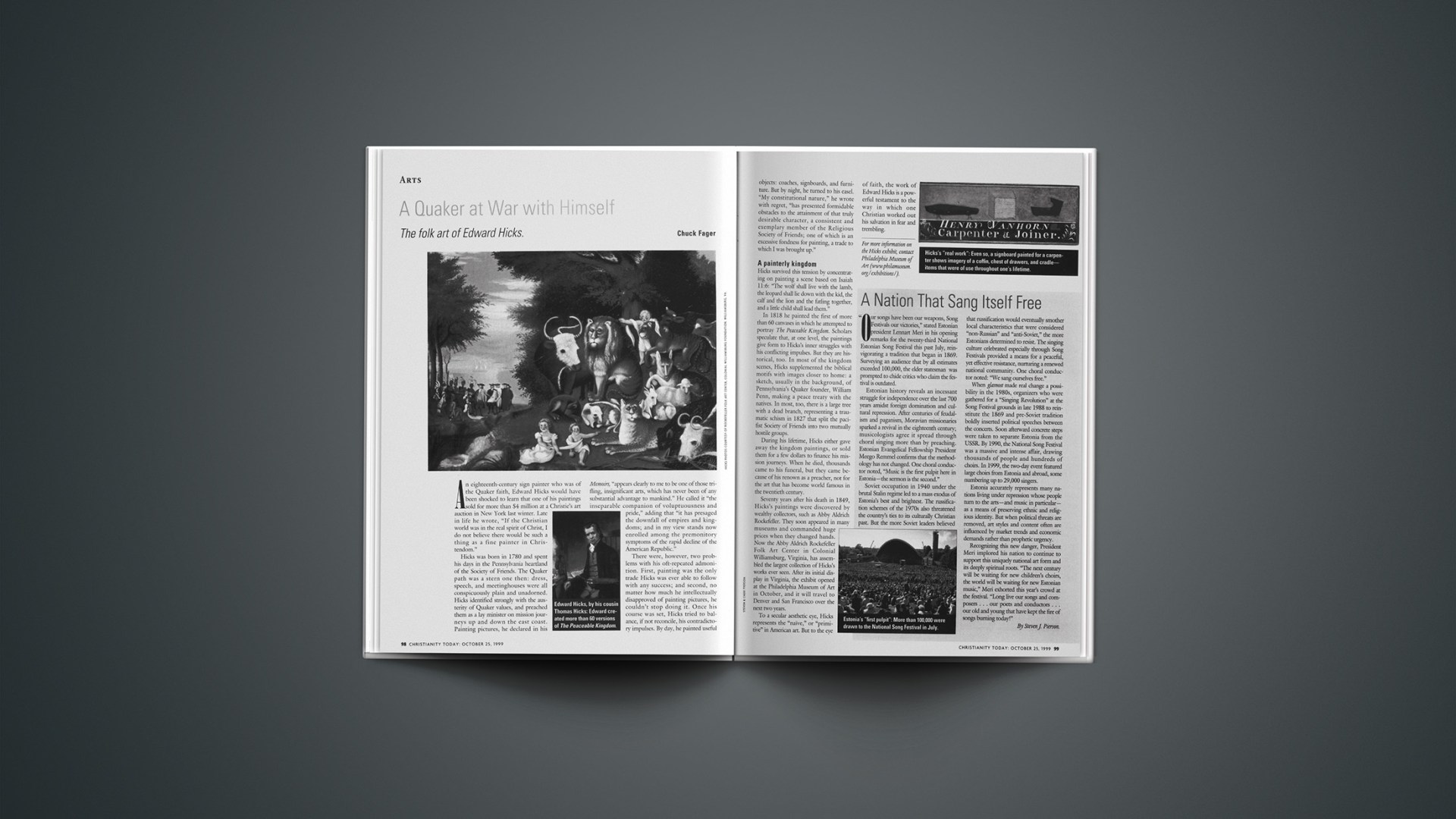
Our songs have been our weapons, Song Festivals our victories,” stated Estonian president Lennart Meri in his opening remarks for the twenty-third National Estonian Song Festival this past July, reinvigorating a tradition that began in 1869. Surveying an audience that by all estimates exceeded 100,000, the elder statesman was prompted to chide critics who claim the festival is outdated.

Estonian history reveals an incessant struggle for independence over the last 700 years amidst foreign domination and cultural repression. After centuries of feudalism and paganism, Moravian missionaries sparked a revival in the eighteenth century; musicologists agree it spread through choral singing more than by preaching. Estonian Evangelical Fellowship President Meego Remmel confirms that the methodology has not changed. One choral conductor noted, “Music is the first pulpit here in Estonia—the sermon is the second.”

Soviet occupation in 1940 under the brutal Stalin regime led to a mass exodus of Estonia’s best and brightest. The russification schemes of the 1970s also threatened the country’s ties to its culturally Christian past. But the more Soviet leaders believed that russification would eventually smother local characteristics that were considered “non-Russian” and “anti-Soviet,” the more Estonians determined to resist. The singing culture celebrated especially through Song Festivals provided a means for a peaceful, yet effective resistance, nurturing a renewed national community. One choral conductor noted: “We sang ourselves free.”

When glasnost made real change a possibility in the 1980s, organizers who were gathered for a “Singing Revolution” at the Song Festival grounds in late 1988 to reinstitute the 1869 and pre-Soviet tradition boldly inserted political speeches between the concerts. Soon afterward concrete steps were taken to separate Estonia from the USSR. By 1990, the National Song Festival was a massive and intense affair, drawing thousands of people and hundreds of choirs. In 1999, the two-day event featured large choirs from Estonia and abroad, some numbering up to 29,000 singers.

Estonia accurately represents many nations living under repression whose people turn to the arts—and music in particular—as a means of preserving ethnic and religious identity. But when political threats are removed, art styles and content often are influenced by market trends and economic demands rather than prophetic urgency.

Recognizing this new danger, President Meri implored his nation to continue to support this uniquely national art form and its deeply spiritual roots. “The next century will be waiting for new children’s choirs, the world will be waiting for new Estonian music,” Meri exhorted this year’s crowd at the festival. “Long live our songs and composers … our poets and conductors … our old and young that have kept the fire of songs burning today!”

Copyright © 1999 Christianity Today. Click for reprint information.

Also in this issue

Revelation NOW: What happens when you treat Revelation like other books of the Bible—looking at its historical context before applying its message to our day? Instead of an end-of-the-world preview, you'll find wisdom to help churches stay faithful in a hostile environment.

Cover Story

Apocalypse Now

J. NELSON KRAYBILL

New President Promises Reforms

Stop the Dating Game

What Hal Lindsey Taught Me About the Second Coming

Is Revelation Prophecy or History?

David S. Dockery

Called to Hate?

Jody Veenker

Church Leader Worships Whites

Jody Veenker.

Time Out

Classic & Contemporary Excerpts from October 25, 1999

A Quaker at War with Himself

Chuck Fager

Getting to Know Me

To the Church That Endures Persecution by Steve Haas

Business Funnels Profits to Churches

Jody Veenker.

Church Shooting Creates New Martyrs

Christine J. Gardner

In Brief: October 25, 1999

Porn Store Reborn As Church

Lis Trouten in Minneapolis.

Virtue Folds

Church Aids Refugees Despite Violence

Lutherans and Catholics Sign Declaration on Justification

Jody Veenker.

Christian Journalists Ponder Calling

Gordon Govier.

Religious Freedom Report Released

Editorial

Moms Without Marriage

Wire Story

Pro-Life Pharmacist Sues Kmart

Religion News Service.

Wire Story

Priest Killed for Illegal Conversions

Religion News Service.

The Millenial Book Awards

Extending the Dream

Michael G. Maudlin, Managing Editor

Letters

Baptist Foundation Faces Fraud Charges

Chuck Fager.

Interview: George W. Bush on Faith-Based Plans

Christian Filmmakers Flock to End-times Features

Peter T. Chattaway.

Editorial

Make Disciples, Not Just Converts

Wire Story

Africa: Can Christianity and Islam Coexist and Prosper?

Steve Chambers in Kano, Nigeria, Religion News Service.

Apocalyptic Palette

J. Nelson Kraybill.

You've Got Mail

To the Suburban Churches of North America

Eugene H. Peterson

To the Pentecostal & Charismatic Churches by Todd Hunter

Todd Hunter

To the Church Called Mainline by William H. Willimon

William H. Willimon

To the Inner-City Pastor & Church by Gardner Taylor

To the Rural Church by Susan Wise Bauer

Susan Wise Bauer

To the Church Which Seeks Seekers by John Ortberg

View issue

Our Latest

News

Died: John M. Perkins, Who Lived and Preached Racial Reconciliation

The civil rights leader believed in a gospel bigger than race or self-interest.

Review

Decoding the Supreme Court

Three books to read this month on politics and public life.

The Bulletin

Cost of Iran War, Quiet Southern Border, and Anglican Church Split

Mike Cosper, Clarissa Moll, Russell Moore

The financial and moral toll of war, immigration slows but ministry continues, and why denominations split.

The Year of the Evangelical

America prepared for a bicentennial, and religious identity dominated the presidential campaign.

Q&A: Eric Mason on Ministering to Men and Witnessing in Politics

Interview by Benjamin Watson

The Philadelphia-based pastor discusses how the church can engage Black men and have a biblical approach to government.

Review

‘The Secret Agent’ Explores Memory and Authoritarianism in Brazil

Mariana Albuquerque

The Oscar-nominated film reminds viewers to learn from the past—and to share our stories with the next generation.

The Just Life with Benjamin Watson

Michel Lusakueno: Why the World Can’t Ignore Congo

Exploring the sobering connection between modern convenience and human suffering.

Apple PodcastsDown ArrowDown ArrowDown Arrowarrow_left_altLeft ArrowLeft ArrowRight ArrowRight ArrowRight Arrowarrow_up_altUp ArrowUp ArrowAvailable at Amazoncaret-downCloseCloseEmailEmailExpandExpandExternalExternalFacebookfacebook-squareGiftGiftGooglegoogleGoogle KeephamburgerInstagraminstagram-squareLinkLinklinkedin-squareListenListenListenChristianity TodayCT Creative Studio Logologo_orgMegaphoneMenuMenupausePinterestPlayPlayPocketPodcastprintRSSRSSSaveSaveSaveSearchSearchsearchSpotifyStitcherTelegramTable of ContentsTable of Contentstwitter-squareWhatsAppXYouTubeYouTube