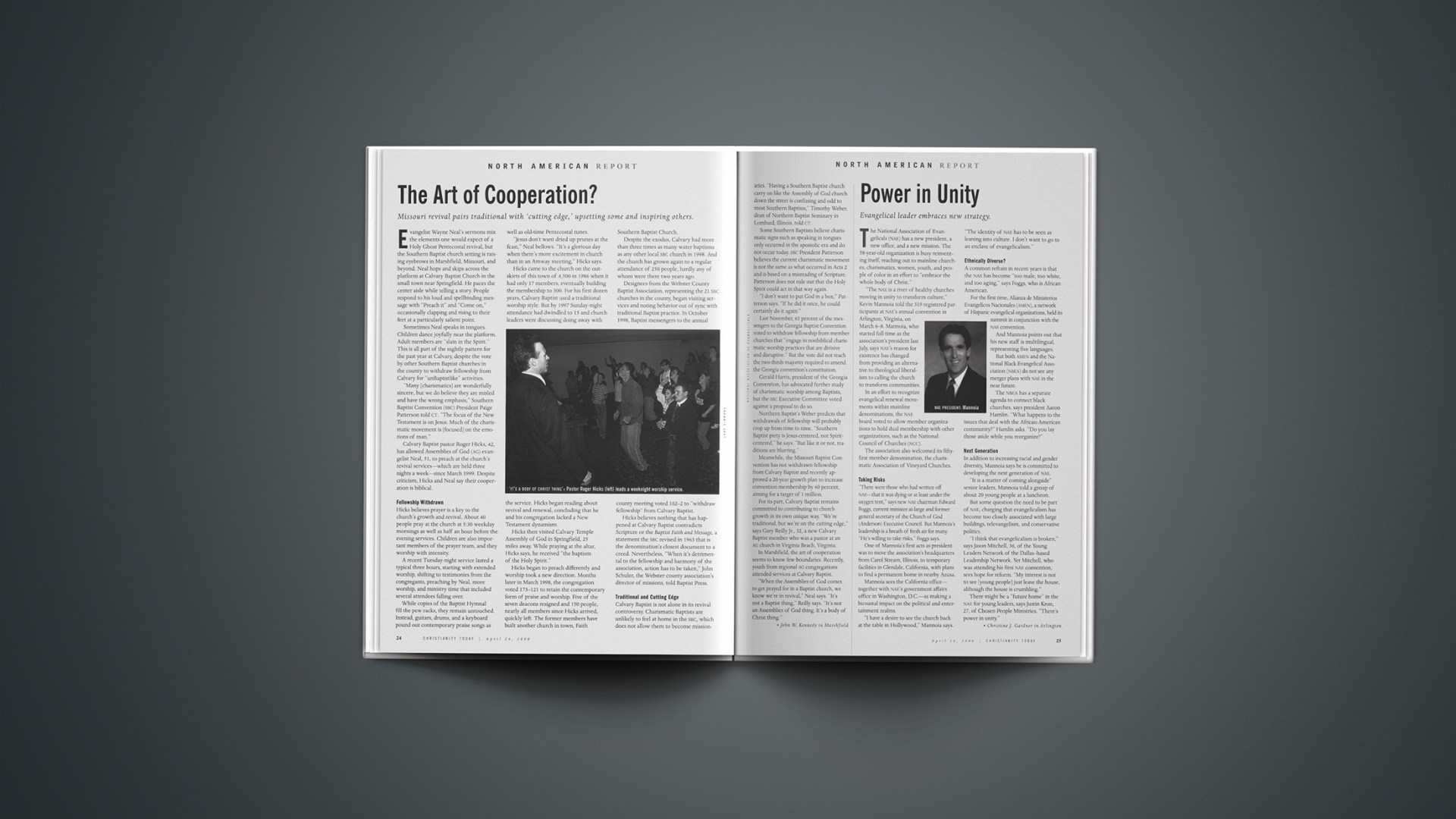

The National Association of Evangelicals (NAE) has a new president, a new office, and a new mission. The 58-year-old organization is busy reinventing itself, reaching out to mainline churches, charismatics, women, youth, and people of color in an effort to “embrace the whole body of Christ.””The NAE is a river of healthy churches moving in unity to transform culture,” Kevin Mannoia told the 319 registered participants at NAE’s annual convention in Arlington, Virginia, on March 6-8. Mannoia, who started full time as the association’s president last July, says NAE’s reason for existence has changed from providing an alternative to theological liberalism to calling the church to transform communities.In an effort to recognize evangelical renewal movements within mainline denominations, the NAE board voted to allow member organizations to hold dual membership with other organizations, such as the National Council of Churches (NCC).The association also welcomed its fifty-first member denomination, the charismatic Association of Vineyard Churches.
Taking Risks
“There were those who had written off NAE—that it was dying or at least under the oxygen tent,” says new NAE chairman Edward Foggs, current minister-at-large and former general secretary of the Church of God (Anderson) Executive Council. But Mannoia’s leadership is a breath of fresh air for many. “He’s willing to take risks,” Foggs says.One of Mannoia’s first acts as president was to move the association’s headquarters from Carol Stream, Illinois, to temporary facilities in Glendale, California, with plans to find a permanent home in nearby Azusa.Mannoia sees the California office—together with NAE’s government affairs office in Washington, D.C.–as making a bicoastal impact on the political and entertainment realms.”I have a desire to see the church back at the table in Hollywood,” Mannoia says. “The identity of NAE has to be seen as leaning into culture. I don’t want to go to an enclave of evangelicalism.”
Ethnically Diverse?
A common refrain in recent years is that the NAE has become “too male, too white, and too aging,” says Foggs, who is African-American.For the first time, Alianza de Ministerios Evangelicos Nacionales (AMEN), a network of Hispanic evangelical organizations, held its summit in conjunction with the NAE convention.And Mannoia points out that his new staff is multilingual, representing five languages.But both amen and the National Black Evangelical Association (NBEA) do not see any merger plans with NAE in the near future.The NBEA has a separate agenda to connect black churches, says president Aaron Hamlin. “What happens to the issues that deal with the African-American community?” Hamlin asks. “Do you lay those aside while you reorganize?”
Next Generation
In addition to increasing racial and gender diversity, Mannoia says he is committed to developing the next generation of NAE.”It is a matter of coming alongside” senior leaders, Mannoia told a group of about 20 young people at a luncheon.But some question the need to be part of NAE, charging that evangelicalism has become too closely associated with large buildings, televangelism, and conservative politics.”I think that evangelicalism is broken,” says Jason Mitchell, 36, of the Young Leaders Network of the Dallas-based Leadership Network. Yet Mitchell, who was attending his first NAE convention, sees hope for reform. “My interest is not to see [young people] just leave the house, although the house is crumbling.”There might be a “future home” in the NAE for young leaders, says Justin Kron, 27, of Chosen People Ministries. “There’s power in unity.”
Copyright © 2000 Christianity Today. Click for reprint information.