





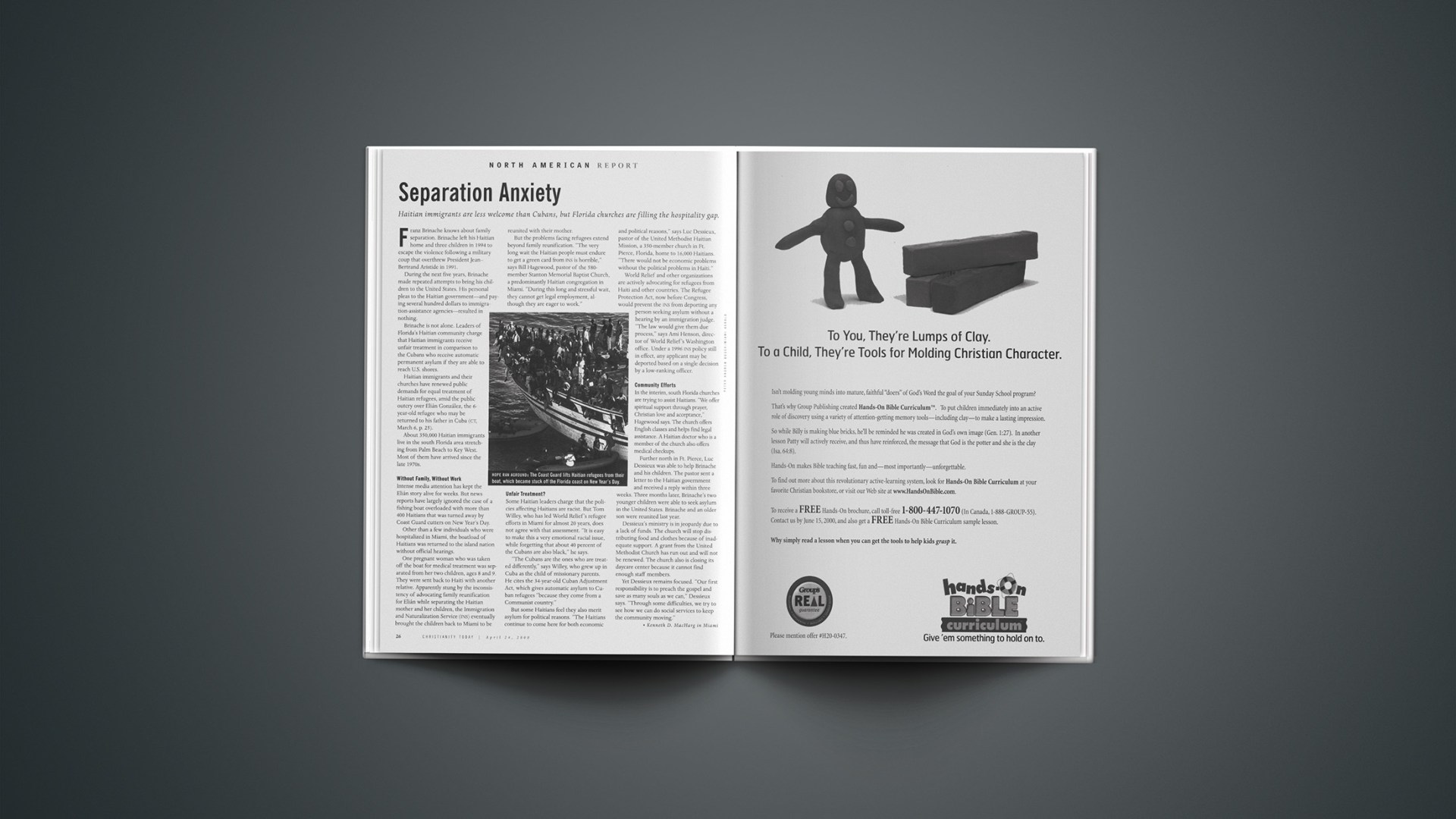

Franz Brinache knows about family separation. Brinache left his Haitian home and three children in 1994 to escape the violence following a military coup that overthrew President Jean-Bertrand Aristide in 1991. During the next five years, Brinache made repeated attempts to bring his children to the United States. His personal pleas to the Haitian government—and paying several hundred dollars to immigration-assistance agencies—resulted in nothing.Brinache is not alone. Leaders of Florida’s Haitian community charge that Haitian immigrants receive unfair treatment in comparison to the Cubans who receive automatic permanent asylum if they are able to reach U.S. shores.Haitian immigrants and their churches have renewed public demands for equal treatment of Haitian refugees, amid the public outcry over Elián González, the 6-year-old refugee who may be returned to his father in Cuba (CT, March 6, p. 25).About 350,000 Haitian immigrants live in the south Florida area stretching from Palm Beach to Key West. Most of them have arrived since the late 1970s.
Without Family, Without Work
Intense media attention has kept the Elián story alive for weeks. But news reports have largely ignored the case of a fishing boat overloaded with more than 400 Haitians that was turned away by Coast Guard cutters on New Year’s Day.Other than a few individuals who were hospitalized in Miami, the boatload of Haitians was returned to the island nation without official hearings.One pregnant woman who was taken off the boat for medical treatment was separated from her two children, ages 8 and 9. They were sent back to Haiti with another relative. Apparently stung by the inconsistency of advocating family reunification for Elián while separating the Haitian mother and her children, the Immigration and Naturalization Service (INS) eventually brought the children back to Miami to be reunited with their mother.But the problems facing refugees extend beyond family reunification. “The very long wait the Haitian people must endure to get a green card from INS is horrible,” says Bill Hagewood, pastor of the 580-member Stanton Memorial Baptist Church, a predominantly Haitian congregation in Miami. “During this long and stressful wait, they cannot get legal employment, although they are eager to work.”
Unfair Treatment?
Some Haitian leaders charge that the policies affecting Haitians are racist. But Tom Willey, who has led World Relief’s refugee efforts in Miami for almost 20 years, does not agree with that assessment. “It is easy to make this a very emotional racial issue, while forgetting that about 40 percent of the Cubans are also black,” he says.”The Cubans are the ones who are treated differently,” says Willey, who grew up in Cuba as the child of missionary parents. He cites the 34-year-old Cuban Adjustment Act, which gives automatic asylum to Cuban refugees “because they come from a Communist country.”But some Haitians feel they also merit asylum for political reasons. “The Haitians continue to come here for both economic and political reasons,” says Luc Dessieux, pastor of the United Methodist Haitian Mission, a 350-member church in Ft. Pierce, Florida, home to 16,000 Haitians. “There would not be economic problems without the political problems in Haiti.”World Relief and other organizations are actively advocating for refugees from Haiti and other countries. The Refugee Protection Act, now before Congress, would prevent the INS from deporting any person seeking asylum without a hearing by an immigration judge. “The law would give them due process,” says Ami Henson, director of World Relief’s Washington office. Under a 1996 INS policy still in effect, any applicant may be deported based on a single decision by a low-ranking officer.
Community Efforts
In the interim, south Florida churches are trying to assist Haitians. “We offer spiritual support through prayer, Christian love and acceptance,” Hagewood says. The church offers English classes and helps find legal assistance. A Haitian doctor who is a member of the church also offers medical checkups.Further north in Ft. Pierce, Luc Dessieux was able to help Brinache and his children. The pastor sent a letter to the Haitian government and received a reply within three weeks. Three months later, Brinache’s two younger children were able to seek asylum in the United States. Brinache and an older son were reunited last year.Dessieux’s ministry is in jeopardy due to a lack of funds. The church will stop distributing food and clothes because of inadequate support. A grant from the United Methodist Church has run out and will not be renewed. The church also is closing its daycare center because it cannot find enough staff members.Yet Dessieux remains focused. “Our first responsibility is to preach the gospel and save as many souls as we can,” Dessieux says. “Through some difficulties, we try to see how we can do social services to keep the community moving.”
Related Elsewhere
See yesterday’s ChristianityToday.com article on the most famous of Cuba’s refugees, Elián González: “Send Elián Home, Say Cuba’s Evangelicals | Church leaders who don’t usually agree with Castro or the Cuban Council of Churches say family comes first.”
Copyright © 2000 Christianity Today. Click for reprint information.







