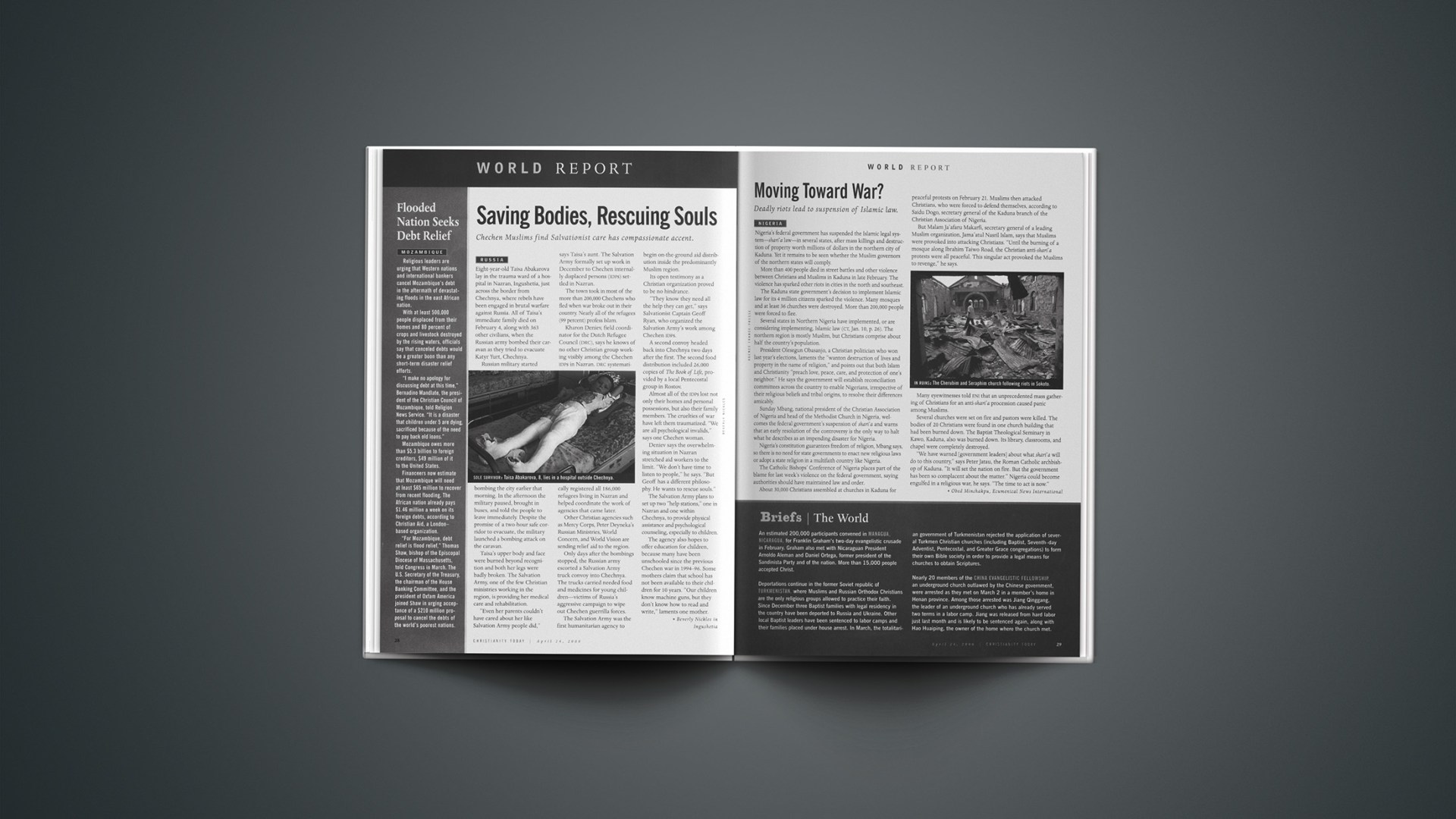

Nigeria’s federal government has suspended the Islamic legal system—shari’a law—in several states, after mass killings and destruction of property worth millions of dollars in the northern city of Kaduna. Yet it remains to be seen whether the Muslim governors of the northern states will comply.More than 400 people died in street battles and other violence between Christians and Muslims in Kaduna in late February. The violence has sparked other riots in cities in the north and southeast.The Kaduna state government’s decision to implement Islamic law for its 4 million citizens sparked the violence. Many mosques and at least 36 churches were destroyed. More than 200,000 people were forced to flee.Several states in Northern Nigeria have implemented, or are considering implementing, Islamic law (CT, Jan. 10, p. 26). The northern region is mostly Muslim, but Christians comprise about half the country’s population.President Olesegun Obasanjo, a Christian politician who won last year’s elections, laments the “wanton destruction of lives and property in the name of religion,” and points out that both Islam and Christianity “preach love, peace, care, and protection of one’s neighbor.” He says the government will establish reconciliation committees across the country to enable Nigerians, irrespective of their religious beliefs and tribal origins, to resolve their differences amicably.Sunday Mbang, national president of the Christian Association of Nigeria and head of the Methodist Church in Nigeria, welcomes the federal government’s suspension of shari’a and warns that an early resolution of the controversy is the only way to halt what he describes as an impending disaster for Nigeria.Nigeria’s constitution guarantees freedom of religion, Mbang says, so there is no need for state governments to enact new religious laws or adopt a state religion in a multifaith country like Nigeria.The Catholic Bishops’ Conference of Nigeria places part of the blame for last week’s violence on the federal government, saying authorities should have maintained law and order.About 30,000 Christians assembled at churches in Kaduna for peaceful protests on February 21. Muslims then attacked Christians, who were forced to defend themselves, according to Saidu Dogo, secretary general of the Kaduna branch of the Christian Association of Nigeria.But Malam Ja’afaru Makarfi, secretary general of a leading Muslim organization, Jama’atul Nasril Islam, says that Muslims were provoked into attacking Christians. “Until the burning of a mosque along Ibrahim Taiwo Road, the Christian anti-shari’a protests were all peaceful. This singular act provoked the Muslims to revenge,” he says.Many eyewitnesses told eni that an unprecedented mass gathering of Christians for an anti-shari’a procession caused panic among Muslims.Several churches were set on fire and pastors were killed. The bodies of 20 Christians were found in one church building that had been burned down. The Baptist Theological Seminary in Kawo, Kaduna, also was burned down. Its library, classrooms, and chapel were completely destroyed.”We have warned [government leaders] about what shari’a will do to this country,” says Peter Jatau, the Roman Catholic archbishop of Kaduna. “It will set the nation on fire. But the government has been so complacent about the matter.” Nigeria could become engulfed in a religious war, he says. “The time to act is now.”
Copyright © 2000 Christianity Today. Click for reprint information.