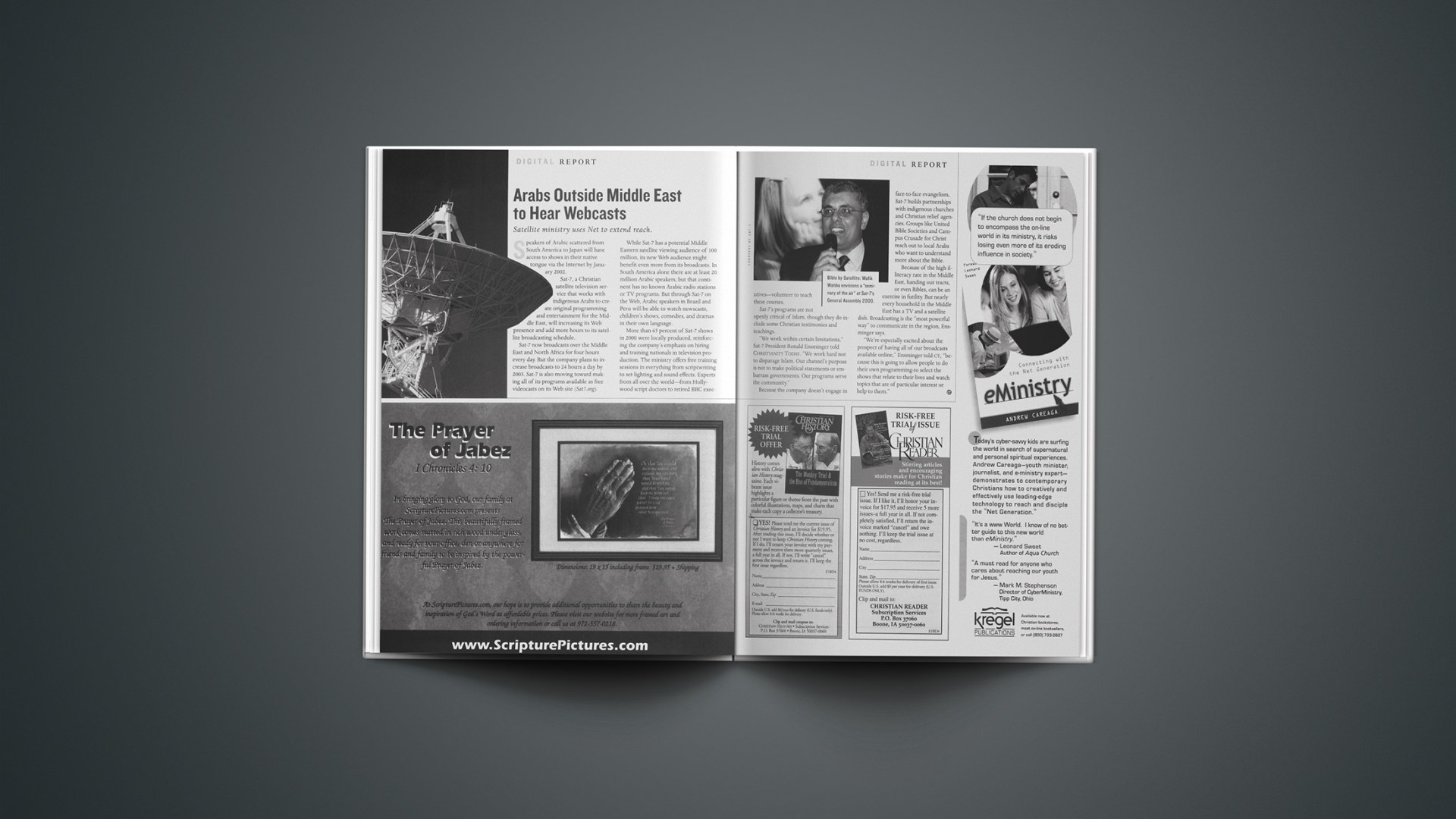

Sat-7, a Christian satellite television service that works with indigenous Arabs to create original programming and entertainment for the Middle East, will increasing its Web presence and add more hours to its satellite broadcasting schedule.
Sat-7 now broadcasts over the Middle East and North Africa for four hours every day. But the company plans to increase broadcasts to 24 hours a day by 2003. Sat-7 is also moving toward making all of its programs available as free videocasts on its Web site (Sat7.org).
While Sat-7 has a potential Middle Eastern satellite viewing audience of 100 million, its new Web audience might benefit even more from its broadcasts. In South America alone there are at least 20 million Arabic speakers, but that continent has no known Arabic radio stations or TV programs. But through Sat-7 on the Web, Arabic speakers in Brazil and Peru will be able to watch newscasts, children’s shows, comedies, and dramas in their own language.
More than 65 percent of Sat-7 shows in 2000 were locally produced, reinforcing the company’s emphasis on hiring and training nationals in television production. The ministry offers free training sessions in everything from scriptwriting to set-lighting and sound effects. Experts from all over the world—from Hollywood script doctors to retired BBC executives—volunteer to teach these courses.
Sat-7’s programs are not openly critical of Islam, though they do include some Christian testimonies and teachings.
“We work within certain limitations,” Sat-7 President Ronald Ensminger told Christianity Today. “We work hard not to disparage Islam. Our channel’s purpose is not to make political statements or embarrass governments. Our programs serve the community.”
Because the company doesn’t engage in face-to-face evangelism, Sat-7 builds partnerships with indigenous churches and Christian relief agencies. Groups like United Bible Societies and Campus Crusade for Christ reach out to local Arabs who want to understand more about the Bible.
Because of the high illiteracy rate in the Middle East, handing out tracts, or even Bibles, can be an exercise in futility. But nearly every household in the Middle East has a TV and a satellite dish. Broadcasting is the “most powerful way” to communicate in the region, Ensminger says.
“We’re especially excited about the prospect of having all of our broadcasts available online,” Ensminger told CT, “because this is going to allow people to do their own programming-to select the shows that relate to their lives and watch topics that are of particular interest or help to them.”
Copyright © 2001 Christianity Today. Click for reprint information.
Related Elsewhere
Visit Sat-7’s homepage, where you can read testimonies, find ways to get involved with the ministry, or see images of Sat-7 services and viewers.Variety ran an article about Sat-7 in 1997, “Sat takes to Sabbath.”