





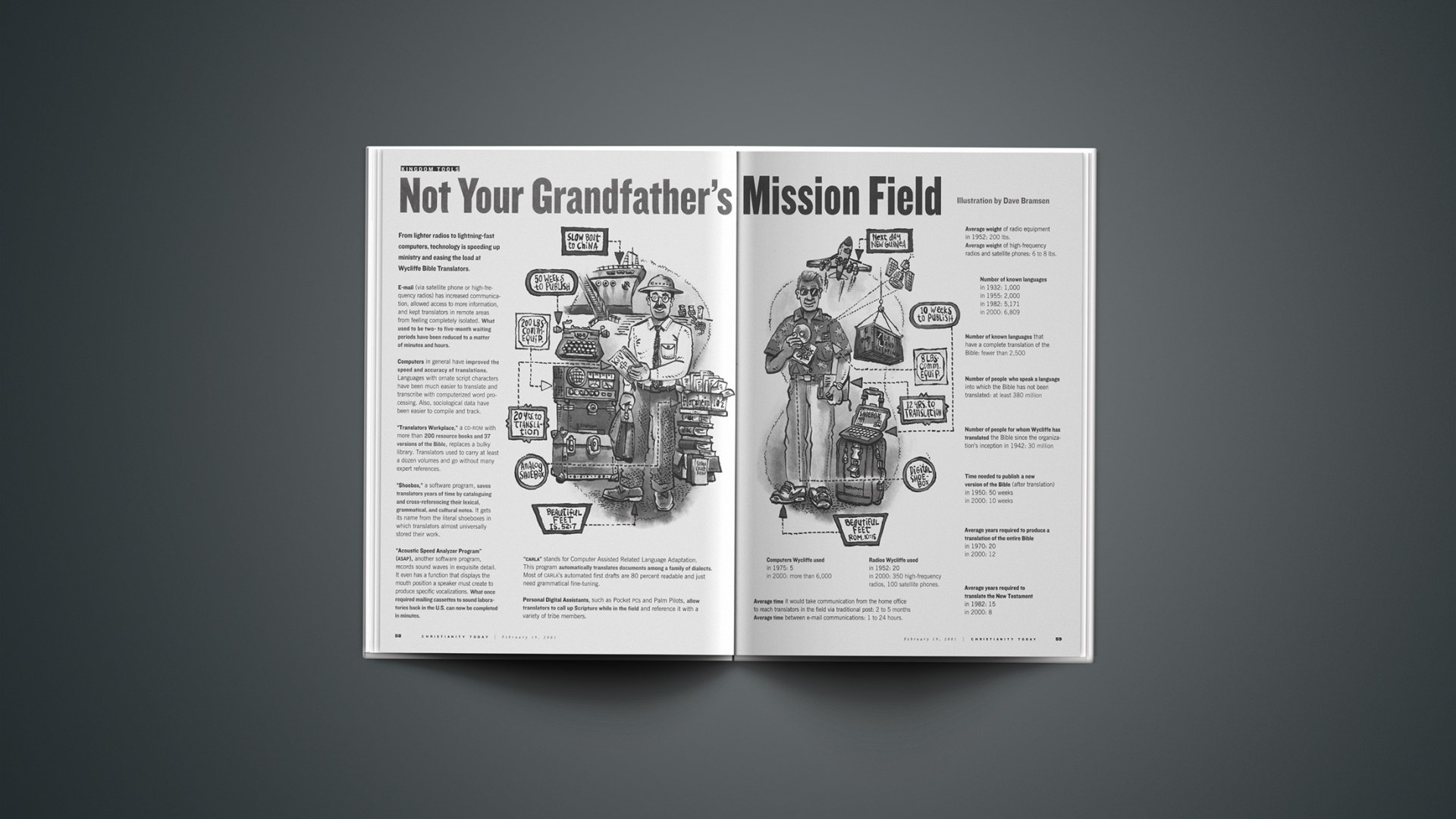

(via satellite phone or high-frequency radios) has increased communication, allowed access to more information, and kept translators in remote areas from feeling completely isolated. What used to be two- to five-month waiting periods have been reduced to a matter of minutes and hours.
Computers in general have improved the speed and accuracy of translations. Languages with ornate script characters have been much easier to translate and transcribe with computerized word processing. Also, sociological data have been easier to compile and track.
“Translators Workplace,” a CD-ROM with more than 200 resource books and 37 versions of the Bible, replaces a bulky library. Translators used to carry at least a dozen volumes and go without many expert references.
“Shoebox,” a software program, saves translators years of time by cataloguing and cross-referencing their lexical, grammatical, and cultural notes. It gets its name from the literal shoeboxes in which translators almost universally stored their work.
“Acoustic Speed Analyzer Program” (ASAP), another software program, records sound waves in exquisite detail. It even has a function that displays the mouth position a speaker must create to produce specific vocalizations. What once required mailing cassettes to sound laboratories back in the U.S. can now be completed in minutes.
“CARLA” stands for Computer Assisted Related Language Adaptation. This program automatically translates documents among a family of dialects. Most of CARLA’s automated first drafts are 80 percent readable and just need grammatical fine-tuning.
Personal Digital Assistants, such as Pocket PCs and Palm Pilots, allow translators to call up Scripture while in the field and reference it with a variety of tribe members.
Computers Wycliffe used in 1975: 5 in 2000: more than 6,000
Radios Wycliffe used in 1952: 20 in 2000: 350 high-frequency radios, 100 satellite phones.
Average time it would take communication from the home office to reach translators in the field via traditional post: 2 to 5 monthsAverage time between e-mail communications: 1 to 24 hours.
Average weight of radio equipment in 1952: 200 lbs.Average weight of high-frequency radios and satellite phones: 6 to 8 lbs.
Number of known languages in 1932: 1,000 in 1955: 2,000 in 1982: 5,171 in 2000: 6,809
Number of known languages that have a complete translation of the Bible: fewer than 2,500
Number of people who speak a language into which the Bible has not been translated: at least 380 million
Number of people for whom Wycliffe has translated the Bible since the organization’s inception in 1942: 30 million
Time needed to publish a new version of the Bible (after translation) in 1950: 50 weeks in 2000: 10 weeks
Average years required to produce a translation of the entire Bible in 1970: 20 in 2000: 12
Average years required to translate the New Testament in 1982: 15 in 2000: 8
Copyright © 2001 Christianity Today. Click for reprint information.
Related Elsewhere
Learn more about Wycliffe’s goal to begin translating the Bible in every known language by 2025. This site also allows you to read stories from the field, check out publications, or research the history of Bible translation.Link to Wycliffe’s Mission Partners, Missions Resources, Bibles on the Internet, Bible Study Software, and Language and Translation Resources.







