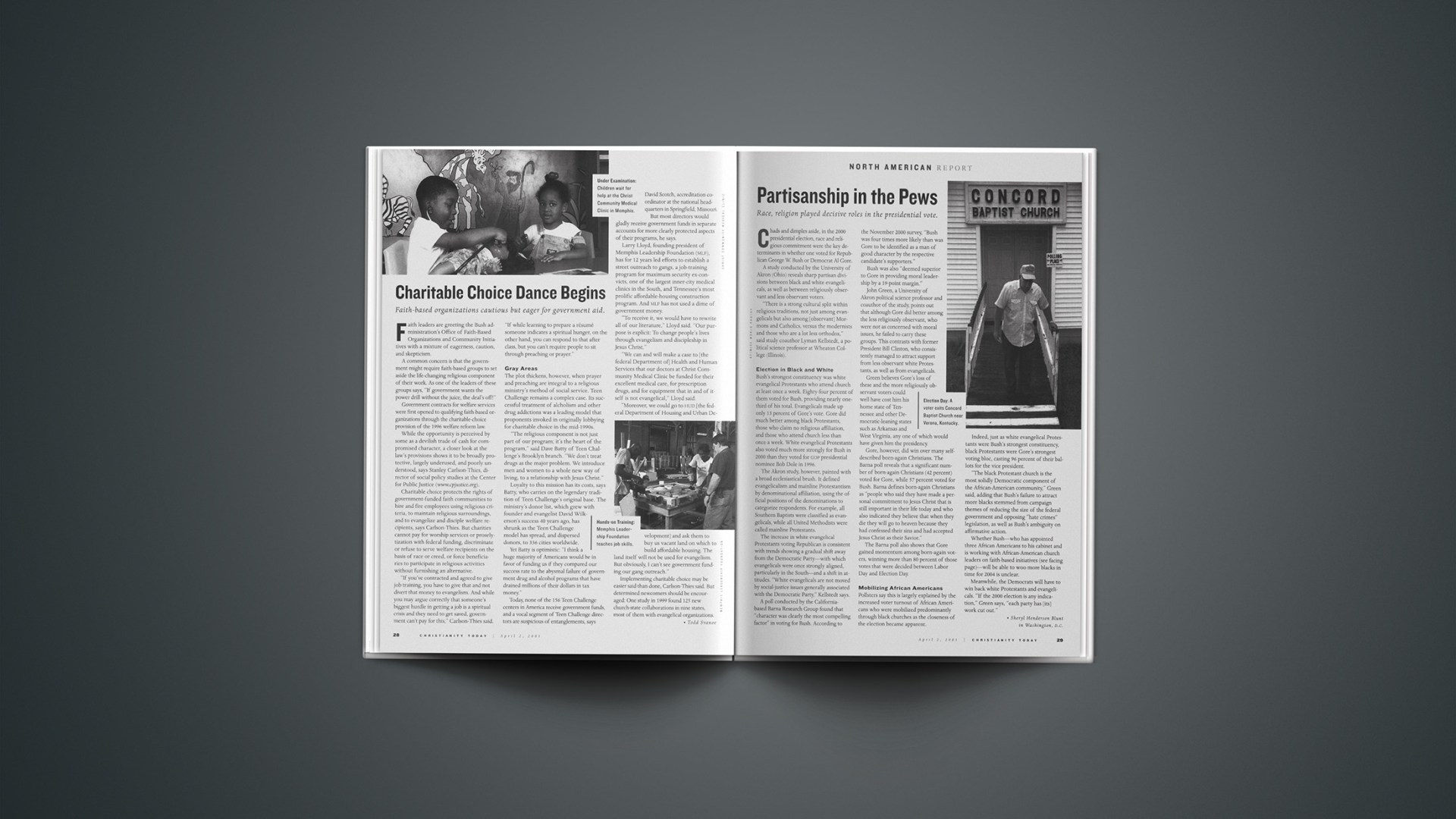

A common concern is that the government might require faith-based groups to set aside the life-changing religious component of their work. As one of the leaders of these groups says, “If government wants the power drill without the juice, the deal’s off!”
Government contracts for welfare services were first opened to qualifying faith-based organizations through the charitable-choice provision of the 1996 welfare reform law.
While the opportunity is perceived by some as a devilish trade of cash for compromised character, a closer look at the law’s provisions shows it to be broadly protective, largely underused, and poorly understood, says Stanley Carlson-Thies, director of social policy studies at the Center for Public Justice (www.cpjustice.org).
Charitable choice protects the rights of government-funded faith communities to hire and fire employees using religious criteria, to maintain religious surroundings, and to evangelize and disciple welfare recipients, says Carlson-Thies. But charities cannot pay for worship services or proselytization with federal funding, discriminate or refuse to serve welfare recipients on the basis of race or creed, or force beneficiaries to participate in religious activities without furnishing an alternative.
“If you’ve contracted and agreed to give job training, you have to give that and not divert that money to evangelism. And while you may argue correctly that someone’s biggest hurdle in getting a job is a spiritual crisis and they need to get saved, government can’t pay for this,” Carlson-Thies said. “If while learning to prepare a résumé someone indicates a spiritual hunger, on the other hand, you can respond to that after class, but you can’t require people to sit through preaching or prayer.”
Gray Areas
The plot thickens, however, when prayer and preaching are integral to a religious ministry’s method of social service. Teen Challenge remains a complex case. Its successful treatment of alcoholism and other drug addictions was a leading model that proponents invoked in originally lobbying for charitable choice in the mid-1990s.“The religious component is not just part of our program; it’s the heart of the program,” said Dave Batty of Teen Challenge’s Brooklyn branch. “We don’t treat drugs as the major problem. We introduce men and women to a whole new way of living, to a relationship with Jesus Christ.”
Loyalty to this mission has its costs, says Batty, who carries on the legendary tradition of Teen Challenge’s original base. The ministry’s donor list, which grew with founder and evangelist David Wilkerson’s success 40 years ago, has shrunk as the Teen Challenge model has spread, and dispersed donors, to 336 cities worldwide.
Yet Batty is optimistic: “I think a huge majority of Americans would be in favor of funding us if they compared our success rate to the abysmal failure of government drug and alcohol programs that have drained millions of their dollars in tax money.”
Today, none of the 156 Teen Challenge centers in America receive government funds, and a vocal segment of Teen Challenge directors are suspicious of entanglements, says David Scotch, accreditation coordinator at the national headquarters in Springfield, Missouri.
But most directors would gladly receive government funds in separate accounts for more clearly protected aspects of their programs, he says.
Larry Lloyd, founding president of Memphis Leadership Foundation (MLF), has for 12 years led efforts to establish a street outreach to gangs, a job-training program for maximum security ex-convicts, one of the largest inner-city medical clinics in the South, and Tennessee’s most prolific affordable-housing construction program. And MLF has not used a dime of government money.
“To receive it, we would have to rewrite all of our literature,” Lloyd said. “Our purpose is explicit: To change people’s lives through evangelism and discipleship in Jesus Christ.”
“We can and will make a case to [the federal Department of] Health and Human Services that our doctors at Christ Community Medical Clinic be funded for their excellent medical care, for prescription drugs, and for equipment that in and of itself is not evangelical,” Lloyd said.
“Moreover, we could go to HUD [the federal Department of Housing and Urban Development] and ask them to buy us vacant land on which to build affordable housing. The land itself will not be used for evangelism. But obviously, I can’t see government funding our gang outreach.”
Implementing charitable choice may be easier said than done, Carlson-Thies said. But determined newcomers should be encouraged: One study in 1999 found 125 new church-state collaborations in nine states, most of them with evangelical organizations.
Copyright © 2001 Christianity Today. Click for reprint information.
Related Elsewhere
See today’s related editorial, “No More Excuses | Bush’s faith-based initiative should reinvigorate our mission of service.”The Christianity TodayWeblog regularly covers the charitable choice debate. In the last few days, for example, it took note of the comment by Don Eberly, deputy director of the White House Office of Faith-Based and Community Initiatives, that office was postponing its plans—and Bush’s subsequent denial of the delay.
The Center for Public Justice Web site offers reams of information about “charitable choice” plans past and present