In this series

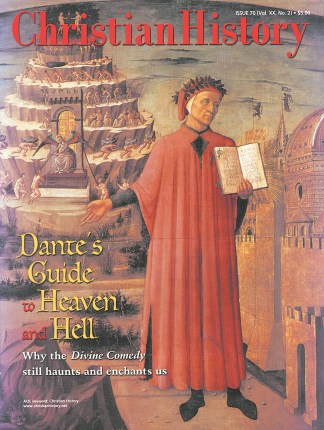
Dante Alighieri1265 Dante born, possibly May 29 1274 First meets and falls in love with Beatrice Portinari 1283 Soon after his father’s death, Dante marries Gemma Donati, with whom he has three or four children 1289 Fights on the side of the victorious Guelf League (Florence and Lucca) against the Ghibellines of Arezzo at the Battle of Campaldino 1290 Beatrice dies 1292 Writes the Vita Nuova 1295 Joins the guild of physicians and apothecaries for the purpose of entering public life 1297 Borrows more than 750 florins from various lenders—probably a sign of economic hardship 1300 Serves on Florence’s priorate for two months (June 15-August 15); fictional date for Divine Comedy (Eastertime) 1301 Travels to Rome as an envoy to Pope Boniface VIII 1302 Banished from Florence after Black Guelfs seize power 1303 Separates from a group of exiles who were plotting a return to Florence c. 1304 Writes De Vulgari Eloquentia (“On Common Speech”), a history and rhetoric of vernacular literature, and begins Il Convivio (“The Banquet”), an encyclopedia of knowledge 1306 Probably the year in which Dante interrupts the Convivio and begins the Comedy 1310 Possible date of De Monarchia (“On Universal Monarchy”) 1311 Writes an epistle to Emperor Henry VII, whose coronation at Milan he likely attended 1312 Declines amnesty offered in Florence 1314 In a letter, rebukes Italian cardinals and urges return of the papacy to Rome; Inferno published 1315 Works on Purgatorio and Paradiso while lodging with Can Grande della Scala in Verona 1319 Moves to Ravenna, where he is the guest of Guido Novello da Polenta; Latin correspondence with humanist Giovanni del Virgilio 1320 Writes De Aqua et Terra, a treatise on the relative proportions of land and sea on the earth 1321 Finishes Comedy; falls ill on return from Venice, where he had been sent as ambassador by Guido Da Polenta, and dies September 13 or 14 |
Politics, Art, and Religion1265 Pope Urban IV enlists Charles of Anjou to expel Ghibelline party from Florence; philosopher Duns Scotus born 1266 Giotto di Bondone, Dante’s friend and the “father of modern painting,” born 1267 Eighth and final Holy Land crusade launched by leaders of France and England 1271 Kublai Khan becomes emperor of China 1273 Thomas Aquinas abruptly ceases work on Summa Theologica 1274 Aquinas, Bonaventure die; Guido Guinicelli, the most illustrious poet in Italy before Dante, expelled from Bologna; Latin and Greek theologians meet at the Council of Lyons 1285 Philip the Fair (Philip IV) becomes king of France 1290 Jews expelled from England; Osman I founds Ottoman dynasty 1291 Christian military presence in Holy Land ends as Muslims take Acre 1294 Hermit Peter Morone elected Pope Celestine V, resigns after five months; Benedict Gaetani becomes Pope Boniface VIII 1295 Marco Polo returns to Venice with fantastic tales of the Far East 1300 Black and White Guelfs begin street warfare in Florence; Boniface VIII proclaims Jubilee; poet Guido Cavalcanti, Dante’s friend whom he had reluctantly banished from Florence, dies of illness contracted during exile 1301 Charles of Valois called to pacify Florence but takes Black Guelf side instead 1302 In the bull Unam Sanctam, Boniface VIII makes sweeping claims of papal supremacy 1303 Boniface VIII founds University of Rome, then dies after confrontation with King Philip’s men 1304 Petrarch, celebrated humanist poet, born 1305 Papacy begins “Babylonian Captivity” at Avignon, France 1307 To seize their wealth, King Philip begins slandering and torturing the Knights Templar, a military order founded to protect Holy Land pilgrims 1308 Giotto’s teacher, artist Giovanni Cimabue, dies 1311 Henry of Luxembourg crowned Holy Roman Emperor Henry VII 1312 Henry lays siege to Florence, then abandons campaign to unify Italy 1313 Giovanni Boccaccio, author of the Decameron, born in Paris c. 1320 Aztecs found their capital at Tenochtitlán (modern Mexico City) 1321 William Bélibaste, the last Albigensian perfect in Languedoc (southern France), is burned at the stake |
Copyright © 2001 by the author or Christianity Today, Inc./Christian History magazine. Click here for reprint information on Christian History.