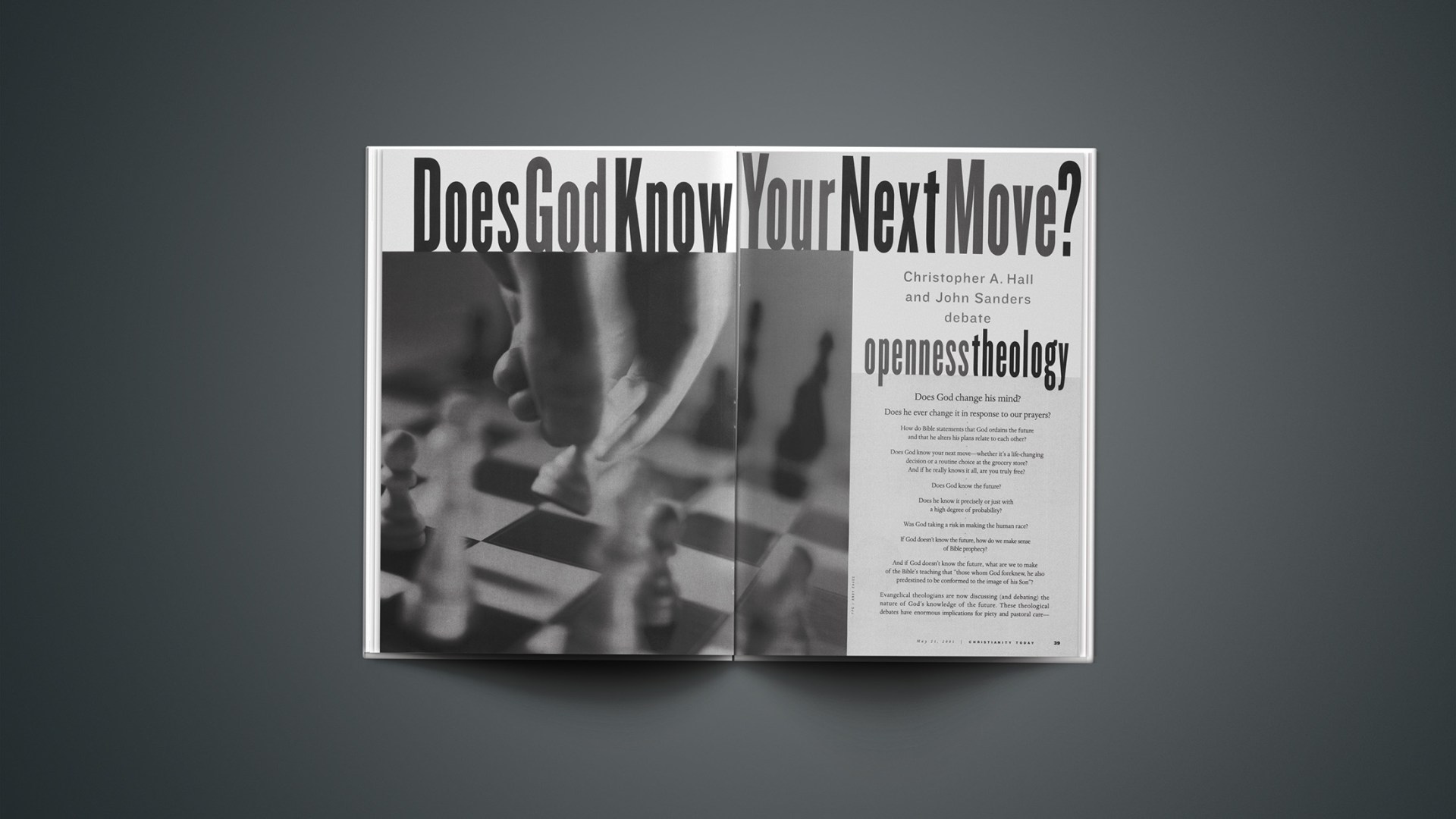

Introduction | John Sanders 1 | Chris Hall 1 | Sanders 2 | Hall 2
Part 2:
John Sanders 3 | Chris Hall 3 | Sanders 4 | Hall 4 | Sanders 5 | PostscriptDear Chris,
When I was in high school one of my brothers was killed in a motorcycle accident. For the first time, I began to think about God’s role in human affairs—was God responsible for my brother’s death?A few years later, while in Bible college, I read what my theology textbooks said about the nature of God. According to these books, God could not change in any way, could not be affected by us in any respect, and never responded to us. I was shocked! The piety that I had learned from other evangelical Christians was directly opposed to such beliefs. For instance, I was taught that our prayers of petition could influence what God decided to do. Not that God has to do what we ask, but God has decided that some of his decisions will be in response to what we ask or don’t ask.
Such problems put me into a state of questioning—either the piety I had been taught was wrong, or the theology I was reading was wrong, or both my piety and the theology had to be modified in some way. I continued to wrestle with these issues while in seminary and it took me over 20 years to formulate the views I now have. My conclusion is that the evangelical piety I was taught as a young Christian was biblically correct and so we need to modify our theology at certain points (not every point) so that our theology corresponds, rather than conflicts, with our biblically grounded piety.
Let me summarize the perspective I now hold—the so-called openness of God theology.
First, according to openness theology, the triune God of love has, in almighty power, created all that is and is sovereign over all. In freedom God decided to create beings capable of experiencing his love. God loves us and desires for us to enter into reciprocal relations of love with God as well as our fellow creatures. In creating us, the divine intention was that we would come to experience the triune love and respond to it with love of our own, and freely come to collaborate with God toward the achievement of his goals. God has granted us the freedom necessary for a truly personal relationship of love to develop. Despite the fact that we have abused our freedom by turning away from the divine love, God remains faithful to his intentions for creation.
Second, God has, in sovereign freedom, decided to make some of his actions contingent upon our requests and actions. God elicits our free collaboration in his plans. Hence, God can be influenced by what we do and pray for, and God truly responds to what we do. God genuinely interacts and enters into dynamic give-and-take relationships with us.
Third, the only wise God has chosen to exercise general rather than meticulous providence, allowing space for us to operate and for God to be creative and resourceful in working with us. God has chosen not to control every detail that happens in our lives. Moreover, God has flexible strategies. Though the divine nature does not change, God reacts to contingencies, even adjusting his plans, if necessary, to take into account the decisions of his free creatures. God is endlessly resourceful and wise in working toward the fulfillment of his ultimate goals. Sometimes God alone decides how to accomplish these goals. Usually, however, God elicits human cooperation such that it is both God and humanity who decide what the future shall be. God’s plan is not a detailed script or blueprint, but a broad intention that allows for a variety of options regarding precisely how his goals may be reached.
What God and people do in history matters. If the Hebrew midwives had feared Pharaoh rather than God and killed the baby boys, then God would have responded accordingly and a different story wouldhave emerged. Moses’ refusal to return to Egypt prompted God to resort to plan B, allowing Aaron to do the public speaking instead of Moses. What people do and whether they come to trust God makes a difference concerning what God does—God does not fake the story of human history.
Finally, the omniscient God knows all that is logically possible to know. God knows the past and present with exhaustive definite knowledge and knows the future as partly definite (closed) and partly indefinite (open). God’s knowledge of the future contains knowledge of what God has decided to bring about unilaterally (that which is definite), knowledge of possibilities (that which is indefinite), and those events that are determined to occur (e.g., an asteroid hitting a planet). Hence, the future is partly open, or indefinite, and partly closed, or definite. It is not the case that just anything may happen, for God has acted in history to bring about events in order to achieve his unchanging purpose. Graciously, however, God invites us to collaborate with him to bring the open part of the future into being.
Your fellow servant in Jesus,John
Chris Hall replies, next page.
Copyright © 2001 Christianity Today. Click for reprint information.