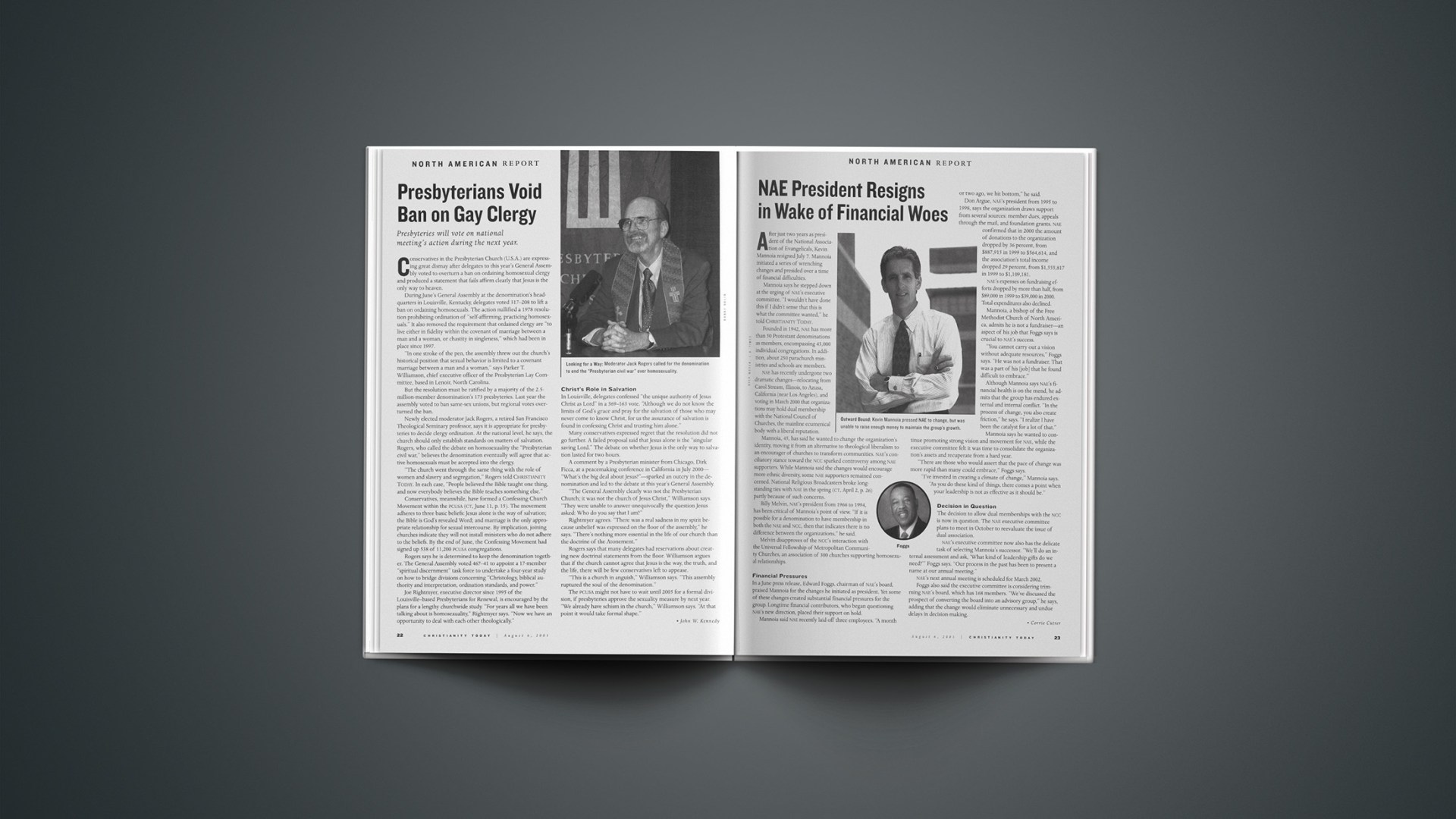

Mannoia says he stepped down at the urging of NAE’s executive committee. “I wouldn’t have done this if I didn’t sense that this is what the committee wanted,” he told Christianity Today.
Founded in 1942, NAE has more than 50 Protestant denominations as members, encompassing 43,000 individual congregations. In addition, about 250 parachurch ministries and schools are members.
NAE has recently undergone two dramatic changes—relocating from Carol Stream, Illinois, to Azusa, California (near Los Angeles), and voting in March 2000 that organizations may hold dual membership with the National Council of Churches, the mainline ecumenical body with a liberal reputation.
Mannoia, 45, has said he wanted to change the organization’s identity, moving it from an alternative to theological liberalism to an encourager of churches to transform communities. NAE’s conciliatory stance toward the NCC sparked controversy among NAE supporters. While Mannoia said the changes would encourage more ethnic diversity, some NAE supporters remained concerned. National Religious Broadcasters broke long-standing ties with NAE in the spring partly because of such concerns.
Billy Melvin, NAE’s president from 1966 to 1994, has been critical of Mannoia’s point of view. “If it is possible for a denomination to have membership in both the NAE and NCC, then that indicates there is no difference between the organizations,” he said.
Melvin disapproves of the NCC’s interaction with the Universal Fellowship of Metropolitan Community Churches, an association of 300 churches supporting homosexual relationships.
Financial Pressures
In a June press release, Edward Foggs, chairman of NAE’s board, praised Mannoia for the changes he initiated as president. Yet some of these changes created substantial financial pressures for the group. Longtime financial contributors, who began questioning NAE’s new direction, placed their support on hold.Mannoia said NAE recently laid off three employees. “A month or two ago, we hit bottom,” he said.
Don Argue, NAE’s president from 1995 to 1998, says the organization draws support from several sources: member dues, appeals through the mail, and foundation grants. NAE confirmed that in 2000 the amount of donations to the organization dropped by 36 percent, from $887,915 in 1999 to $564,614, and the association’s total income dropped 29 percent, from $1,555,817 in 1999 to $1,109,181.
NAE’s expenses on fundraising efforts dropped by more than half, from $89,000 in 1999 to $39,000 in 2000. Total expenditures also declined.
Mannoia, a bishop of the Free Methodist Church of North America, admits he is not a fundraiser—an aspect of his job that Foggs says is crucial to NAE’s success.
“You cannot carry out a vision without adequate resources,” Foggs says. “He was not a fundraiser. That was a part of his [job] that he found difficult to embrace.”
Although Mannoia says NAE’s financial health is on the mend, he admits that the group has endured external and internal conflict. “In the process of change, you also create friction,” he says. “I realize I have been the catalyst for a lot of that.”
Mannoia says he wanted to continue promoting strong vision and movement for NAE, while the executive committee felt it was time to consolidate the organization’s assets and recuperate from a hard year.
“There are those who would assert that the pace of change was more rapid than many could embrace,” Foggs says.
“I’ve invested in creating a climate of change,” Mannoia says. “As you do these kind of things, there comes a point when your leadership is not as effective as it should be.”
Decision in Question
The decision to allow dual memberships with the NCC is now in question. The NAE executive committee plans to meet in October to reevaluate the issue of dual association.NAE’s executive committee now also has the delicate task of selecting Mannoia’s successor. “We’ll do an internal assessment and ask, ‘What kind of leadership gifts do we need?'” Foggs says. “Our process in the past has been to present a name at our annual meeting.”
NAE’s next annual meeting is scheduled for March 2002.
Foggs also said the executive committee is considering trimming NAE’s board, which has 168 members. “We’ve discussed the prospect of converting the board into an advisory group,” he says, adding that the change would eliminate unnecessary and undue delays in decision-making.
Copyright © 2001 Christianity Today. Click for reprint information.