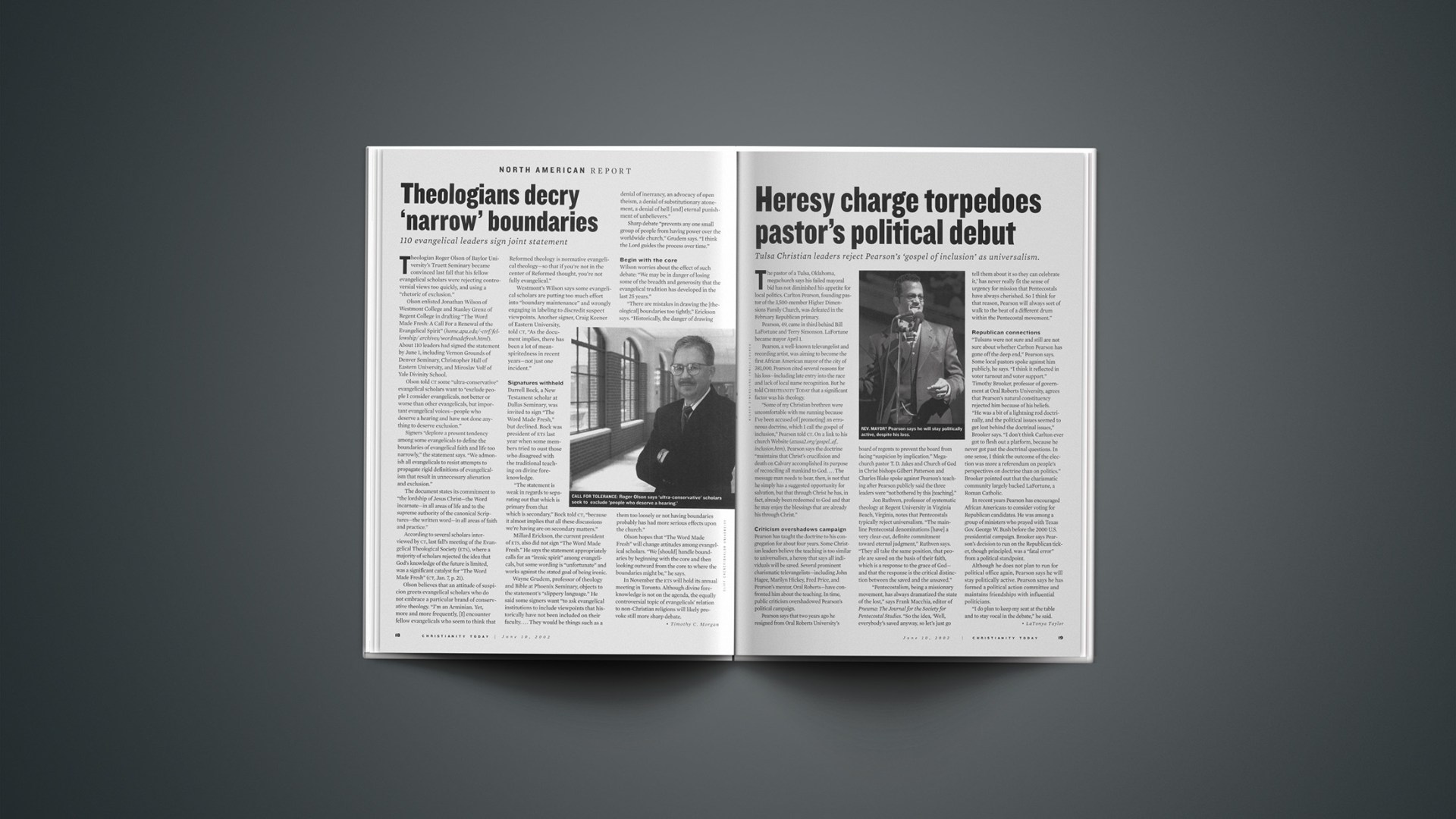

Theologian Roger Olson of Baylor University’s Truett Seminary became convinced last fall that his fellow evangelical scholars were rejecting controversial views too quickly, and using a “rhetoric of exclusion.”
Olson enlisted Jonathan Wilson of Westmont College and Stanley Grenz of Regent College in drafting “The Word Made Fresh: A Call For a Renewal of the Evangelical Spirit” (www.thewordmadefresh.com). About 110 leaders had signed the statement by June 1, including Vernon Grounds of Denver Seminary, Christopher Hall of Eastern University, and Miroslav Volf of Yale Divinity School.
Olson told CT some “ultra-conservative” evangelical scholars want to “exclude people I consider evangelicals, not better or worse than other evangelicals, but important evangelical voices—people who deserve a hearing and have not done anything to deserve exclusion.”
Signers “deplore a present tendency among some evangelicals to define the boundaries of evangelical faith and life too narrowly,” the statement says. “We admonish all evangelicals to resist attempts to propagate rigid definitions of evangelicalism that result in unnecessary alienation and exclusion.”
The document states its commitment to “the lordship of Jesus Christ—the Word incarnate—in all areas of life and to the supreme authority of the canonical Scriptures—the written word—in all areas of faith and practice.”
According to several scholars interviewed by CT, last fall’s meeting of the Evangelical Theological Society (ETS), where a majority of scholars rejected the idea that God’s knowledge of the future is limited, was a significant catalyst for “The Word Made Fresh” (CT, Jan. 7, p. 21).
Olson believes that an attitude of suspicion greets evangelical scholars who do not embrace a particular brand of conservative theology. “I’m an Arminian. Yet, more and more frequently, [I] encounter fellow evangelicals who seem to think that Reformed theology is normative evangelical theology—so that if you’re not in the center of Reformed thought, you’re not fully evangelical.”
Westmont’s Wilson says some evangelical scholars are putting too much effort into “boundary maintenance” and wrongly engaging in labeling to discredit suspect viewpoints. Another signer, Craig Keener of Eastern University, told CT, “As the document implies, there has been a lot of mean-spiritedness in recent years—not just one incident.”
Signatures withheld
Darrell Bock, a New Testament scholar at Dallas Seminary, was invited to sign “The Word Made Fresh,” but declined. Bock was president of ETS last year when some members tried to oust those who disagreed with the traditional teaching on divine foreknowledge.
“The statement is weak in regards to separating out that which is primary from that which is secondary,” Bock told CT, “because it almost implies that all these discussions we’re having are on secondary matters.”
Millard Erickson, the current president of ETS, also did not sign “The Word Made Fresh.” He says the statement appropriately calls for an “irenic spirit” among evangelicals, but some wording is “unfortunate” and works against the stated goal of being irenic.
Wayne Grudem, professor of theology and Bible at Phoenix Seminary, objects to the statement’s “slippery language.” He said some signers want “to ask evangelical institutions to include viewpoints that historically have not been included on their faculty . …They would be things such as a denial of inerrancy, an advocacy of open theism, a denial of substitutionary atonement, a denial of hell [and] eternal punishment of unbelievers.”
Sharp debate “prevents any one small group of people from having power over the worldwide church,” Grudem says. “I think the Lord guides the process over time.”
Begin with the core
Wilson worries about the effect of such debate: “We may be in danger of losing some of the breadth and generosity that the evangelical tradition has developed in the last 25 years.”
“There are mistakes in drawing the [theological] boundaries too tightly,” Erickson says. “Historically, the danger of drawing them too loosely or not having boundaries probably has had more serious effects upon the church.”
Olson hopes that “The Word Made Fresh” will change attitudes among evangelical scholars. “We [should] handle boundaries by beginning with the core and then looking outward from the core to where the boundaries might be,” he says.
In November the ETS will hold its annual meeting in Toronto. Although divine foreknowledge is not on the agenda, the equally controversial topic of evangelicals’ relation to non-Christian religions will likely provoke still more sharp debate.
Copyright © 2002 Christianity Today. Click for reprint information.
Related Elsewhere
The Word Made Fresh: A Call for a Renewal of the Evangelical Spirit is posted online.
Christianity Today coverage of last fall’s meeting of the Evangelical Theological Society includes:
Scholars Vote: God Knows FutureBut supporters of open theism say they’ll stay in the Evangelical Theological Society despite resolution. (Jan. 7, 2002)
Foreknowledge Debate Clouded by “Political Agenda”Evangelical Theologians differ over excluding Open Theists. (Nov. 19, 2001)
See the Evangelical Theological Society Web site.