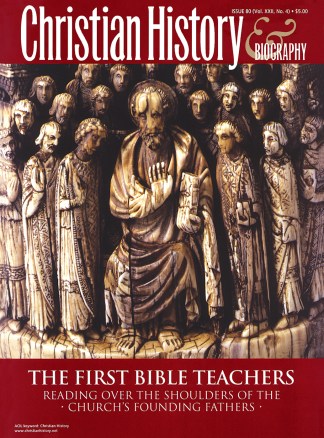
There are passages in the Bible—obvious figures of speech, metaphors—that modern readers would not even think to take literally. But during the period of the early church, some of these passages still caused confusion among the uninitiated, giving enemies of Christianity fodder for their attacks. Among the confused ones was, at one point in his life, Augustine himself.
In the last months before his conversion, the brilliant young orator had become disenchanted with the Manichaean philosophy to which he had adhered. He was finding himself increasingly attracted to Christianity. Yet, he still stumbled over one particular Manichaean objection to Christianity—based on a too-literal reading of the Hebrew Scriptures.
In his Two Books on Genesis Against the Manichees, Augustine later reconstructed the Manichees’ argument. They taunt the Christians, he wrote, “for believing that man was made to the image and likeness of God. They look at the shape of our body and ask so infelicitously whether God has a nose and teeth and a beard and also inner organs and the other things we need.”
Not until he heard the great preacher Ambrose, bishop of Milan, exposit texts from Genesis figuratively did Augustine find this difficulty solved:
“It struck me that it was, after all, possible to vindicate his [Ambrose’s] arguments. I began to believe that the Catholic faith, which I had thought impossible to defend against the objections of the Manichees, might fairly be maintained, especially since I had heard one passage after another in the Old Testament figuratively explained. These passages had been death to me when I took them literally, but once I had heard them explained in their spiritual meaning I began to blame myself for my despair. … “
It was soon after this objection was cleared away that Augustine heard that voice in the garden, “Take, read!” and yielded to Christ. Significantly, he later chalked up his youthful skepticism not to mere over-literalism, but to something deeper and more universally human:
“I was deluded in the past when … I tried to start by applying to the divine Scriptures critical discussion rather than pious research. Through my lax morals, I closed off my own access to the Lord. … In my pride, I dared to seek that which no man can find unless he practices humility.”
—Adapted from Reading Scripture with the Church Fathers by Christopher A. Hall. (c)1998 by Christopher A. Hall. Used by permission of InterVarsity Press, P.O. Box 1400, Downers Grove, IL 60515. www.ivpress.com.
Copyright © 2003 by the author or Christianity Today/Christian History magazine. Click here for reprint information on Christian History.