
 |
There’s a paradox to the spiritual disciplines—they aren’t so much about doing as becoming. Yet, if we are going to be transformed into the likeness of Christ, we seem to have a lot of work to do.
Soon after William Watkins’s conversion, he got caught up in the same conundrum. He understood there were things one did to better live the Christian life: evangelism, daily devotions, prayer, Bible study, regular church attendance, and tithing. But when Watkins found he couldn’t do these core activities to his satisfaction, he felt overwhelming guilt.
Watkins, author of The New Absolutes (Bethany, 1997) and an instructor of history and logic, describes that which transformed his life: the discovery that love was the ultimate expression of faith. Once Watkins centered on love, the subsequent outflow brought him freedom and spiritual reward. He was still doing, but for the right reason: the joy of becoming a better lover of God and neighbor. In this practical book, Watkins confidently offers detailed ideas about how this filter of love can transform the spiritual disciplines, or what he calls “love habits.”
Like Richard J. Foster in his classic Celebration of Discipline: The Path to Spiritual Growth (Harper, 1988), Watkins unpacks the disciplines of meditation, prayer, study, simplicity, solitude, submission, service, confession, and guidance. He purposely leaves out Foster’s fasting, worship, and celebration “in the interest of space.” He also leaves out fellowship, which makes it onto other writers’ lists.
Instead, he adds journaling (combined with meditation), sacrifice (combined with service), evangelism, and apologetics. Anticipating readers’ surprise about the inclusion of the last two disciplines, he insists that evangelism and apologetics are not optional. Rather, he writes, they are necessary for deepening our love for God and others. Journaling may dovetail nicely with meditation, but perhaps I am too attached to tradition—it’s hard to avoid the suspicion that fasting, worship, and celebration would have been better choices than sacrifice, evangelism, and apologetics. Worship and celebration in particular are foundational building blocks of the Christian life; their inclusion would have rounded out Watkins’s thoughts on prayer more fully.
What Prayer Is and Isn’t
Watkins begins with simplicity, which he says is about focus rather than balance. (Foster wrote that “simplicity brings … balance.”) There is one God we give our supreme devotion to, Watkins says, and because of our new “centered living,” our days revolve around him, simplifying our priorities.
Turning to prayer, he describes what it is not: having “right” prayer formulas, positions, words, places, times, feelings, or thoughts. He also offers a helpful reference list of recorded prayers drawn from different church traditions, including two traditional favorites, The Book of Common Prayer (Oxford University Press), and Disciplines for the Inner Life (Nelson).
While he emphasizes that communion with God is what all of prayer’s facets have in common, he writes that prayer is largely petitionary. Watkins partially supports this idea by describing the petitionary nature of the Lord’s Prayer. The discourse on “Hallowed be your name,” however, includes a disturbing anecdote. Watkins told an unbelieving coworker that he would pray that God would cause his associate to be unable to sleep until he confessed Christ. The frightened workmate spent several nights wide awake, until he was sick with exhaustion and unable to work. He finally told Watkins, “I was so tired I couldn’t stand it any longer” and confessed Christ.
“God had revealed his presence and vindicated his name,” Watkins writes.
A few pages later, Watkins explains “Give us today our daily bread” with a story about giving a $25 pledge to his church when he, his wife, and two children were down to their last can of beans and in danger of eviction. Providentially, as soon as he gave the $25, another church member stepped in, covering their rent and giving them groceries.
“By the following Sunday … we were flush with money and food,” he writes. “God had met our needs. He had kept his promise, and we continued keeping our promise to him.”
Contrast this with Lorraine Kisly’s interpretation of the Lord’s Prayer in The Prayer of Fire (Paraclete): “While each phrase is indeed a petition, it is not a petition in the sense of a request to be granted in the future.” When we pray, “Give us this day our daily bread,” Kisly sees it as asking for the bread of life: “Do we think we can get by with earthly bread alone?”
Some of Watkins’s best insights on prayer come in three chapters on other subjects. In a section on guidance, or listening to God, he examines specifically how God speaks: through answered prayer, thoughts and feelings, the Bible, creation, and other methods.
In his thoughtful discourse on meditation, Watkins explores how Christian meditation “leads us to fill our minds, and therefore ourselves, with God.” He then connects this to journaling, and while some of his advice may seem over-instructive (“I start by writing down the day and date”), his eventual return to the goal of focus is helpful: “Journaling can also be wonderful for prayer; there is perhaps no better cure for a wandering mind than the act of writing.”
In an insightful section on confession and forgiveness, Watkins tackles the disturbing question, “Is it ever appropriate to forgive God?” (He says no.) In his thorough exploration, he notes that forgiveness is not the same as forgetting; that reconciliation is not always achievable or expected; and that forgiving ourselves is crucial. In the following chapter on service and sacrifice, he offers many concrete suggestions. They come with a welcome admonition to compulsive do-ers to “consider saying no more often.”
Watkins writes with the unwavering certainty of one who has found an interpretation of the disciplines that has changed his life. Readers should find that his discussable book opens up conversations about what it means to be transformed by the spiritual disciplines.
Cindy Crosby is the author of By Willoway Brook: Exploring the Landscape of Prayer (Paraclete, 2003).
Copyright © 2004 Christianity Today. Click for reprint information.
Related Elsewhere:
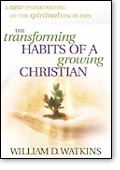
The Transforming Habits of a Growing Christian is available from Christianbook.com and other book retailers.
More information is available from the publisher.
Other reviews or book news are available on our 2004 book awards and books pages.