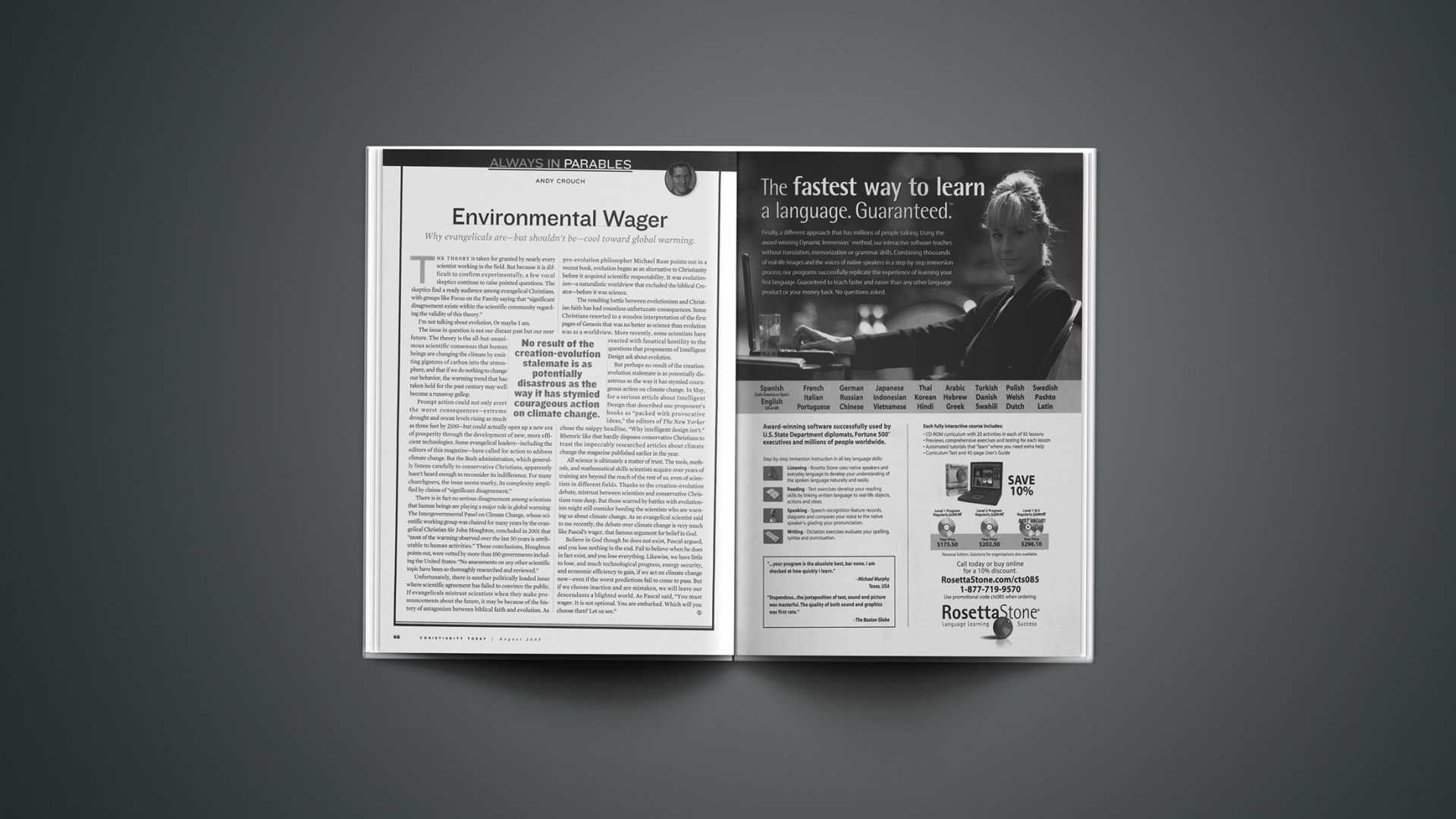

The theory is taken for granted by nearly every scientist working in the field. But because it is difficult to confirm experimentally, a few vocal skeptics continue to raise pointed questions. The skeptics find a ready audience among evangelical Christians, with groups like Focus on the Family saying that “significant disagreement exists within the scientific community regarding the validity of this theory.”
I’m not talking about evolution. Or maybe I am.
The issue in question is not our distant past but our near future. The theory is the all-but-unanimous scientific consensus that human beings are changing the climate by emitting gigatons of carbon into the atmosphere, and that if we do nothing to change our behavior, the warming trend that has taken hold for the past century may well become a runaway gallop.
Prompt action could not only avert the worst consequences—extreme drought and ocean levels rising as much as three feet by 2100—but could actually open up a new era of prosperity through the development of new, more efficient technologies. Some evangelical leaders—including the editors of this magazine—have called for action to address climate change. But the Bush administration, which generally listens carefully to conservative Christians, apparently hasn’t heard enough to reconsider its indifference. For many churchgoers, the issue seems murky, its complexity amplified by claims of “significant disagreement.”
There is in fact no serious disagreement among scientists that human beings are playing a major role in global warming. The Intergovernmental Panel on Climate Change, whose scientific working group was chaired for many years by the evangelical Christian Sir John Houghton, concluded in 2001 that “most of the warming observed over the last 50 years is attributable to human activities.” These conclusions, Houghton points out, were vetted by more than 100 governments including the United States: “No assessments on any other scientific topic have been so thoroughly researched and reviewed.”
Unfortunately, there is another politically loaded issue where scientific agreement has failed to convince the public. If evangelicals mistrust scientists when they make pronouncements about the future, it may be because of the history of antagonism between biblical faith and evolution. As pro-evolution philosopher Michael Ruse points out in a recent book, evolution began as an alternative to Christianity before it acquired scientific respectability. It was evolutionism—a naturalistic worldview that excluded the biblical Creator—before it was science.
The resulting battle between evolutionism and Christian faith has had countless unfortunate consequences. Some Christians resorted to a wooden interpretation of the first pages of Genesis that was no better as science than evolution was as a worldview. More recently, some scientists have reacted with fanatical hostility to the questions that proponents of Intelligent Design ask about evolution.
But perhaps no result of the creation-evolution stalemate is as potentially disastrous as the way it has stymied courageous action on climate change. In May, for a serious article about Intelligent Design that described one proponent’s books as “packed with provocative ideas,” the editors of The New Yorker chose the snippy headline, “Why intelligent design isn’t.” Rhetoric like that hardly disposes conservative Christians to trust the impeccably researched articles about climate change the magazine published earlier in the year.
All science is ultimately a matter of trust. The tools, methods, and mathematical skills scientists acquire over years of training are beyond the reach of the rest of us, even of scientists in different fields. Thanks to the creation-evolution debate, mistrust between scientists and conservative Christians runs deep. But those scarred by battles with evolutionists might still consider heeding the scientists who are warning us about climate change. As an evangelical scientist said to me recently, the debate over climate change is very much like Pascal’s wager, that famous argument for belief in God.
Believe in God though he does not exist, Pascal argued, and you lose nothing in the end. Fail to believe when he does in fact exist, and you lose everything. Likewise, we have little to lose, and much technological progress, energy security, and economic efficiency to gain, if we act on climate change now—even if the worst predictions fail to come to pass. But if we choose inaction and are mistaken, we will leave our descendants a blighted world. As Pascal said, “You must wager. It is not optional. You are embarked. Which will you choose then? Let us see.”
Copyright © 2005 Christianity Today. Click for reprint information.