| • |
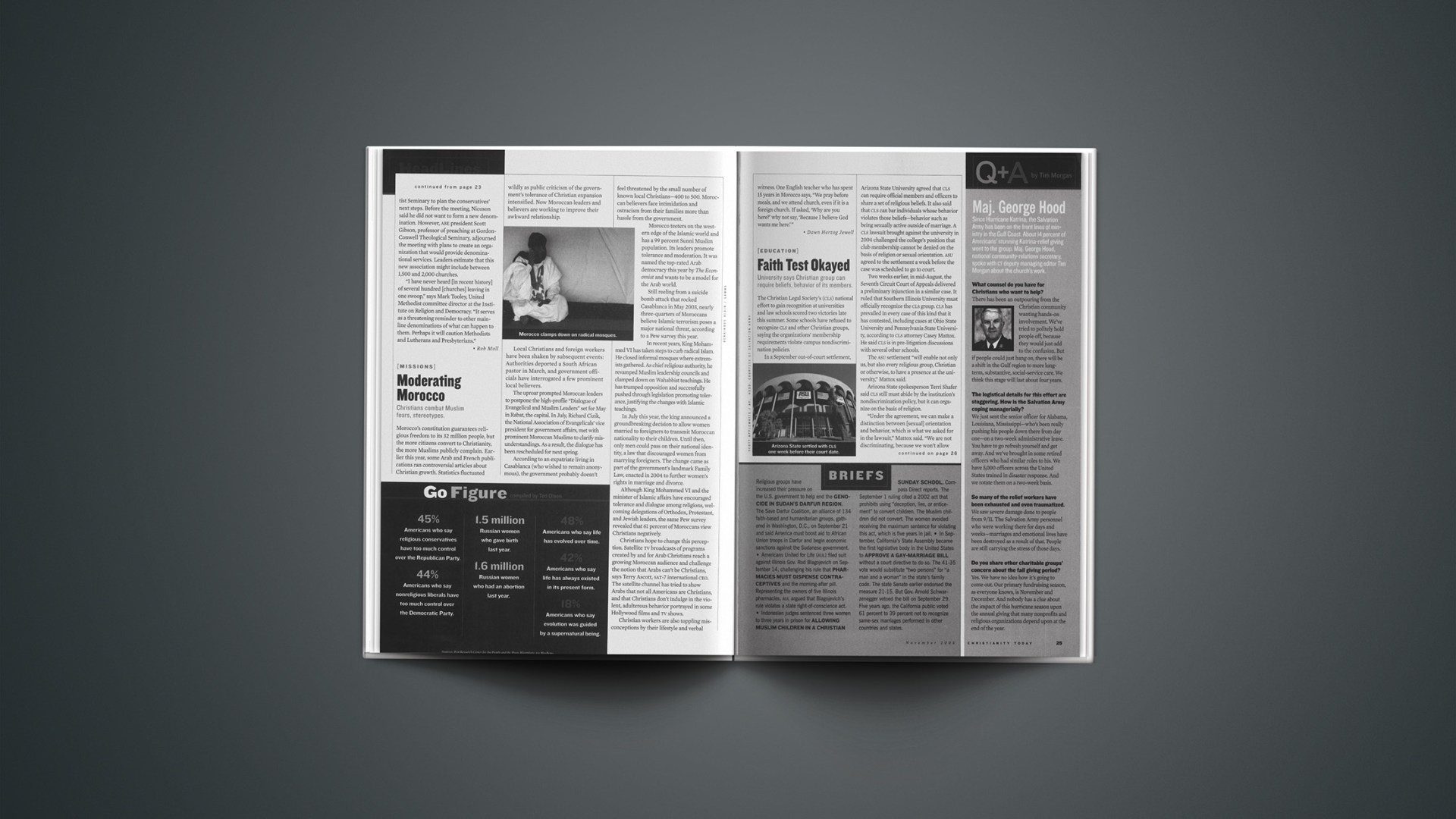
Morocco’s constitution guarantees religious freedom to its 32 million people, but the more citizens convert to Christianity, the more Muslims publicly complain. Earlier this year, some Arab and French publications ran controversial articles about Christian growth. Statistics fluctuated wildly as public criticism of the government’s tolerance of Christian expansion intensified. Now Moroccan leaders and believers are working to improve their awkward relationship.
Local Christians and foreign workers have been shaken by subsequent events: Authorities deported a South African pastor in March, and government officials have interrogated a few prominent local believers.
The uproar prompted Moroccan leaders to postpone the high-profile “Dialogue of Evangelical and Muslim Leaders” set for May in Rabat, the capital. In July, Richard Cizik, the National Association of Evangelicals’ vice president for government affairs, met with prominent Moroccan Muslims to clarify misunderstandings. As a result, the dialogue has been rescheduled for next spring.
According to an expatriate living in Casablanca (who wished to remain anonymous), the government probably doesn’t feel threatened by the small number of known local Christians—400 to 500. Moroccan believers face intimidation and ostracism from their families more than hassle from the government.
Morocco teeters on the western edge of the Islamic world and has a 99 percent Sunni Muslim population. Its leaders promote tolerance and moderation. It was named the top-rated Arab democracy this year by The Economist and wants to be a model for the Arab world.
Still reeling from a suicide bomb attack that rocked Casablanca in May 2003, nearly three-quarters of Moroccans believe Islamic terrorism poses a major national threat, according to a Pew survey this year.
In recent years, King Mohammed VI has taken steps to curb radical Islam. He closed informal mosques where extremists gathered. As chief religious authority, he revamped Muslim leadership councils and clamped down on Wahabbist teachings. He has trumped opposition and successfully pushed through legislation promoting tolerance, justifying the changes with Islamic teachings.
In July this year, the king announced a groundbreaking decision to allow women married to foreigners to transmit Moroccan nationality to their children. Until then, only men could pass on their national identity, a law that discouraged women from marrying foreigners. The change came as part of the government’s landmark Family Law, enacted in 2004 to further women’s rights in marriage and divorce.
Although King Mohammed VI and the minister of Islamic affairs have encouraged tolerance and dialogue among religions, welcoming delegations of Orthodox, Protestant, and Jewish leaders, the same Pew survey revealed that 61 percent of Moroccans view Christians negatively.
Christians hope to change this perception. Satellite TV broadcasts of programs created by and for Arab Christians reach a growing Moroccan audience and challenge the notion that Arabs can’t be Christians, says Terry Ascott, SAT-7 international CEO. The satellite channel has tried to show Arabs that not all Americans are Christians, and that Christians don’t indulge in the violent, adulterous behavior portrayed in some Hollywood films and TV shows.
Christian workers are also toppling misconceptions by their lifestyle and verbal witness. One English teacher who has spent 15 years in Morocco says, “We pray before meals, and we attend church, even if it is a foreign church. If asked, ‘Why are you here?’ why not say, ‘Because I believe God wants me here.'”
Copyright © 2005 Christianity Today. Click for reprint information.
Related Elsewhere:
Christianity Todayinterviewed Cizik on evangelical actions in Morocco in May 2004.
Christianity Today sister publication Christian Music Today covered Friendship Fest, a Morocco concert that included Christian music artists, as did The Washington Times, The New York Times, The Telegraph, CBN, and other publications.
The National Association of Evangelicals has a press release describing its “breakthrough accord with the Moroccan government.”