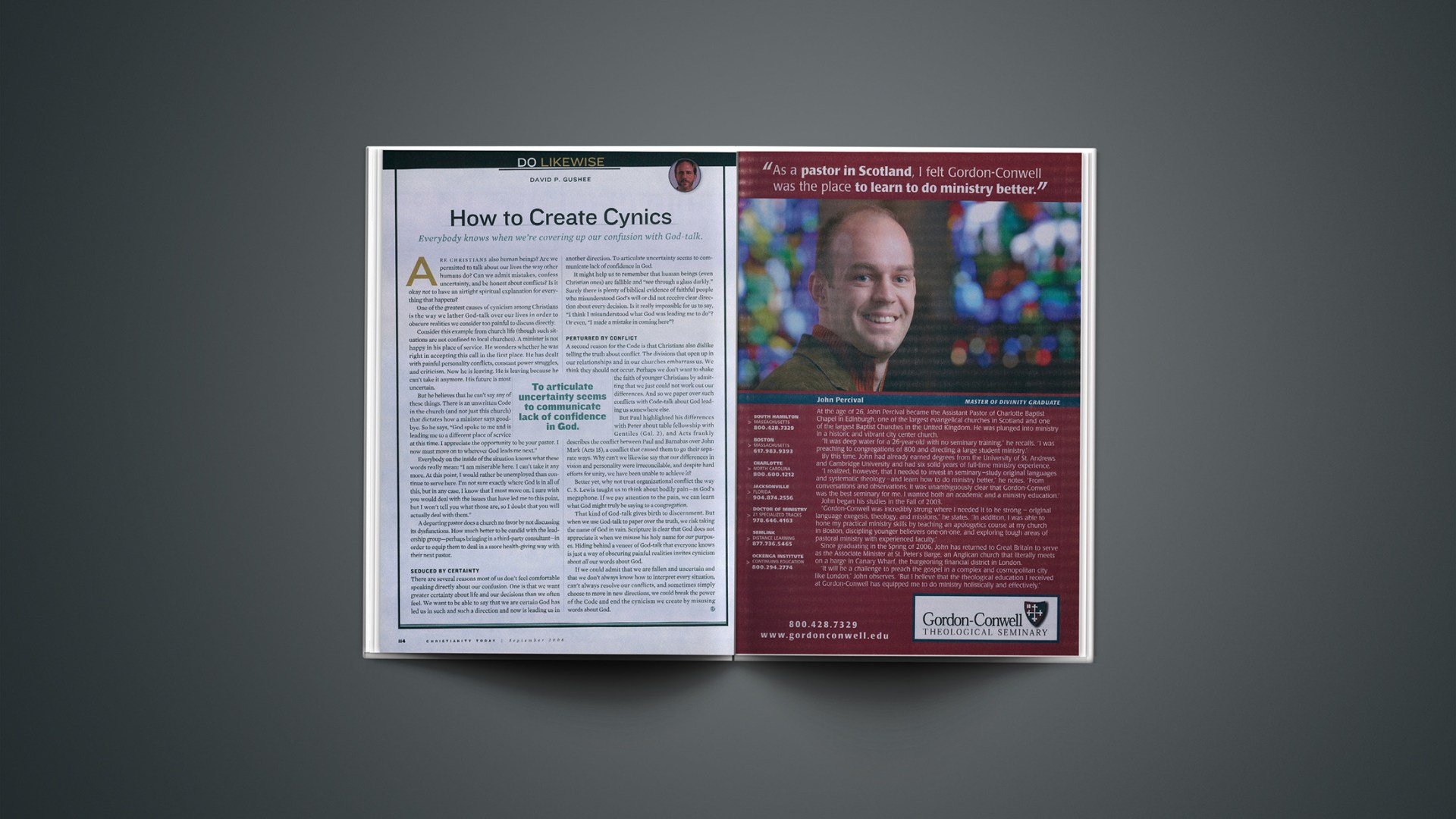

Are Christians also human beings? Are we permitted to talk about our lives the way other humans do? Can we admit mistakes, confess uncertainty, and be honest about conflicts? Is it okay not to have an airtight spiritual explanation for everything that happens?
One of the greatest causes of cynicism among Christians is the way we lather God-talk over our lives in order to obscure realities we consider too painful to discuss directly.
Consider this example from church life (though such situations are not confined to local churches). A minister is not happy in his place of service. He wonders whether he was right in accepting this call in the first place. He has dealt with painful personality conflicts, constant power struggles, and criticism. Now he is leaving. He is leaving because he can’t take it anymore. His future is most uncertain.
But he believes that he can’t say any of these things. There is an unwritten Code in the church (and not just this church) that dictates how a minister says goodbye. So he says, “God spoke to me and is leading me to a different place of service at this time. I appreciate the opportunity to be your pastor. I now must move on to wherever God leads me next.”
Everybody on the inside of the situation knows what these words really mean: “I am miserable here. I can’t take it any more. At this point, I would rather be unemployed than continue to serve here. I’m not sure exactly where God is in all of this, but in any case, I know that I must move on. I sure wish you would deal with the issues that have led me to this point, but I won’t tell you what those are, so I doubt that you will actually deal with them.”
A departing pastor does a church no favor by not discussing its dysfunctions. How much better to be candid with the leadership group—perhaps bringing in a third-party consultant—in order to equip them to deal in a more health-giving way with their next pastor.
Seduced by Certainty
There are several reasons most of us don’t feel comfortable speaking directly about our confusion. One is that we want greater certainty about life and our decisions than we often feel. We want to be able to say that we are certain God has led us in such and such a direction and now is leading us in another direction. To articulate uncertainty seems to communicate lack of confidence in God.
It might help us to remember that human beings (even Christian ones) are fallible and “see through a glass darkly.” Surely there is plenty of biblical evidence of faithful people who misunderstood God’s will or did not receive clear direction about every decision. Is it really impossible for us to say, “I think I misunderstood what God was leading me to do”? Or even, “I made a mistake in coming here”?
Perturbed by Conflict
A second reason for the Code is that Christians also dislike telling the truth about conflict. The divisions that open up in our relationships and in our churches embarrass us. We think they should not occur. Perhaps we don’t want to shake the faith of younger Christians by admitting that we just could not work out our differences. And so we paper over such conflicts with Code-talk about God leading us somewhere else.
But Paul highlighted his differences with Peter about table fellowship with Gentiles (Gal. 2), and Acts frankly describes the conflict between Paul and Barnabas over John Mark (Acts 15), a conflict that caused them to go their separate ways. Why can’t we likewise say that our differences in vision and personality were irreconcilable, and despite hard efforts for unity, we have been unable to achieve it?
Better yet, why not treat organizational conflict the way C. S. Lewis taught us to think about bodily pain—as God’s megaphone. If we pay attention to the pain, we can learn what God might truly be saying to a congregation.
That kind of God-talk gives birth to discernment. But when we use God-talk to paper over the truth, we risk taking the name of God in vain. Scripture is clear that God does not appreciate it when we misuse his holy name for our purposes. Hiding behind a veneer of God-talk that everyone knows is just a way of obscuring painful realities invites cynicism about all our words about God.
If we could admit that we are fallen and uncertain and that we don’t always know how to interpret every situation, can’t always resolve our conflicts, and sometimes simply choose to move in new directions, we could break the power of the Code and end the cynicism we create by misusing words about God.
Copyright © 2006 Christianity Today. Click for reprint information.
Related Elsewhere:
David P. Gushee is Graves Professor of Moral Philosophy at Union University. His books include Only Human: Christian Reflections on the Journey Toward Wholeness, Getting Marriage Right, and he is coauthor of Kingdom Ethics Following Jesus in a Contemporary Context. His columns for Christianity Today include:
What’s Right About Patriotism | The nation is not our highest love, but it still deserves our affection. (July 18, 2006)
Crash | What our harrowing experience taught me about human nature. (May 1, 2006)
The Truth About Deceit | Most lies are pitiful attempts to protect our pride. (March 20, 2006)
Our Missing Moral Compass | Christianity is more than an event, an experience, or a set of beliefs. (Nov. 14, 2005)
Bill’s Big Career Move | How do we make important family decisions? (Jan. 10, 2006)