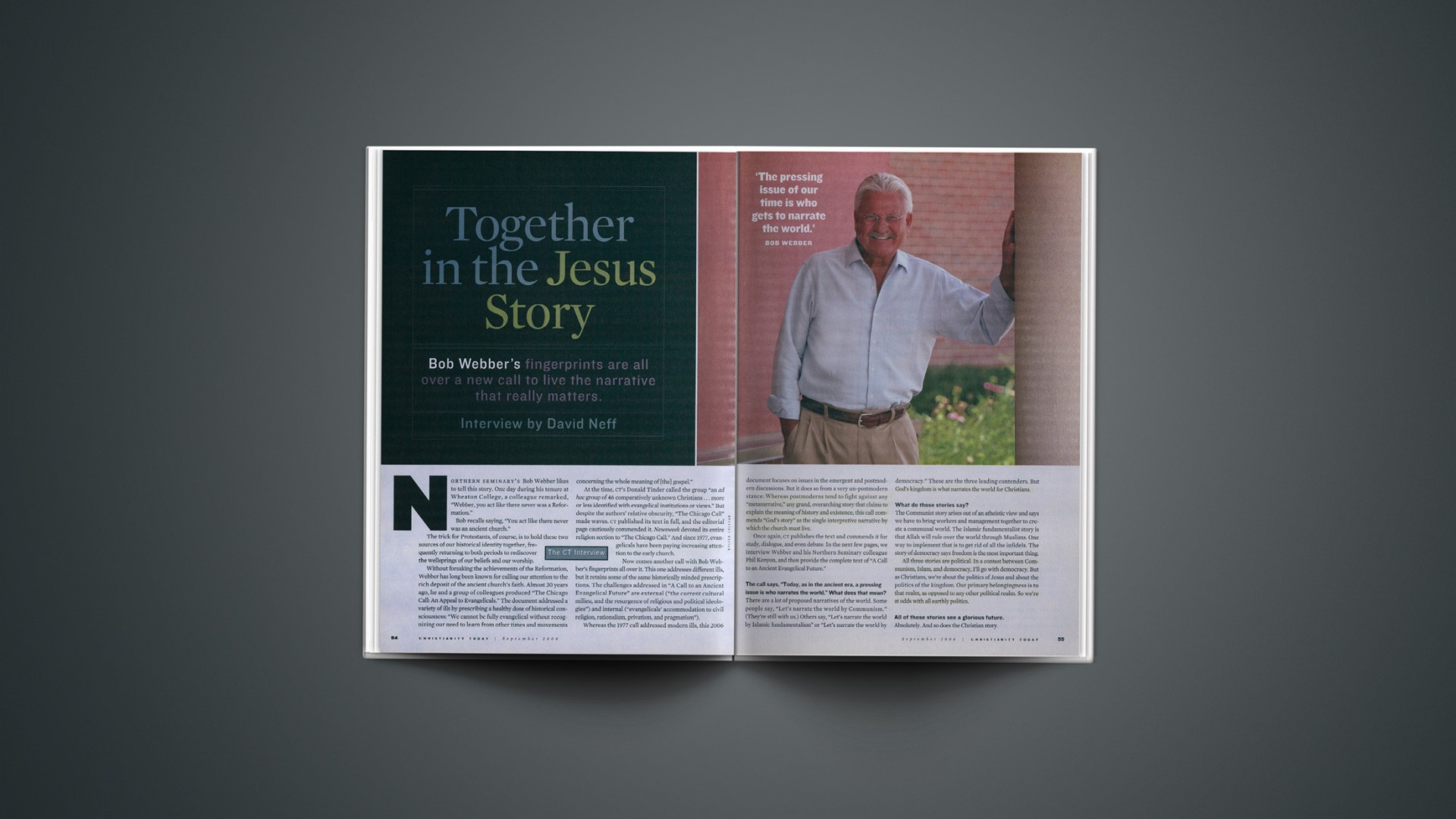

Northern seminary’s Bob Webber likes to tell this story. One day during his tenure at Wheaton College, a colleague remarked, “Webber, you act like there never was a Reformation.”
Bob recalls saying, “You act like there never was an ancient church.”
The trick for Protestants, of course, is to hold these two sources of our historical identity together, frequently returning to both periods to rediscover the wellsprings of our beliefs and our worship.
Without forsaking the achievements of the Reformation, Webber has long been known for calling our attention to the rich deposit of the ancient church’s faith. Almost 30 years ago, he and a group of colleagues produced “The Chicago Call: An Appeal to Evangelicals.” The document addressed a variety of ills by prescribing a healthy dose of historical consciousness: “We cannot be fully evangelical without recognizing our need to learn from other times and movements concerning the whole meaning of [the] gospel.”
At the time, CT’s Donald Tinder called the group “an ad hoc group of 46 comparatively unknown Christians … more or less identified with evangelical institutions or views.” But despite the authors’ relative obscurity, “The Chicago Call” made waves. CT published its text in full, and the editorial page cautiously commended it. Newsweek devoted its entire religion section to “The Chicago Call.” And since 1977, evangelicals have been paying increasing attention to the early church.
Now comes another call with Bob Webber’s fingerprints all over it. This one addresses different ills, but it retains some of the same historically minded prescriptions. The challenges addressed in “A Call to an Ancient Evangelical Future” are external (“the current cultural milieu, and the resurgence of religious and political ideologies”) and internal (“evangelicals’ accommodation to civil religion, rationalism, privatism, and pragmatism”).
Whereas the 1977 call addressed modern ills, this 2006 document focuses on issues in the emergent and postmodern discussions. But it does so from a very un-postmodern stance: Whereas postmoderns tend to fight against any “metanarrative,” any grand, overarching story that claims to explain the meaning of history and existence, this call commends “God’s story” as the single interpretive narrative by which the church must live.
Once again, CT publishes the text and commends it for study, dialogue, and even debate. In the next few pages, we interview Webber and his Northern Seminary colleague Phil Kenyon, and then provide the complete text of “A Call to an Ancient Evangelical Future.”
The call says, “Today, as in the ancient era, a pressing issue is who narrates the world.” What does that mean? There are a lot of proposed narratives of the world. Some people say, “Let’s narrate the world by Communism.” (They’re still with us.) Others say, “Let’s narrate the world by Islamic fundamentalism” or “Let’s narrate the world by democracy.” These are the three leading contenders. But God’s kingdom is what narrates the world for Christians.
What do those stories say? The Communist story arises out of an atheistic view and says we have to bring workers and management together to create a communal world. The Islamic fundamentalist story is that Allah will rule over the world through Muslims. One way to implement that is to get rid of all the infidels. The story of democracy says freedom is the most important thing.
All three stories are political. In a contest between Communism, Islam, and democracy, I’ll go with democracy. But as Christians, we’re about the politics of Jesus and about the politics of the kingdom. Our primary belongingness is to that realm, as opposed to any other political realm. So we’re at odds with all earthly politics.
All of those stories see a glorious future. Absolutely. And so does the Christian story.
Most of the “calls” and “covenants” issued by evangelical groups are created in some face-to-face meeting. But this call was crafted by e-mail and on the Web. How did that work? It worked rather well, but it was very difficult, very time-consuming. I started off by just making a list of concerns. At various times, there were 36, 39, even up to 41 different items. We e-mailed them out broadly and said respond to this, and about 300 people responded. We read everything that came through. There wasn’t a single response that wasn’t seriously considered.
The way the call was developed dovetailed nicely with how the Web works. Once you put something out there, you really don’t have control. We had people recommend the working document to other people, so then we would send them a copy of it.
And then one day, the current scheme just fell into place. Bang, it was there. In the end, there were four people who were e-mailing back and forth two or three times a week. And those are the four people who are called the theological editors.
So you and Phil Kenyon were conveners, and there were four theological editors, a 25-person board of reference, and a long list of participants. And now we’re sending it out for signatures. Soon we’ll probably have 500 or 600 people.
Why did you take on this arduous process? One of the things that drove me to put this together is the enormous diversity among evangelicals. There is no longer a common set of convictions around which evangelicalism evolves. One of the things I wanted to accomplish was to say that the items in this call are the fundamentals.
You sound like a fundamentalist. God’s story is no myth. It constitutes the fundamentals of the faith that are applicable to the life of the church in a postmodern world. I do not think that it’s any different from any historic document that attempts to unite people, but it is articulated differently. The story-formed consciousness of the document is a new kind of hermeneutic; we’re calling people into a united grasp of the Christian faith that restores the biblical narrative as the primary one from which all ministry derives.
The big problem is that we have compartmentalized the story, and we have tried to analyze each piece of the story and even prove it. In doing that, we’ve lost the story. We need to regain the fullness of the story and resituate all ministry within the story’s fullness; modern evangelicals, by creating a faith of propositions, have divorced theological reflection from ministry. I hope to see that corrected.
Another key element in this document is a consciousness of the church. Why is it important always to think about the gospel in the context of the church? God has always been about the business of creating a people to witness to himself. God calls a family into being with Abraham, calls a nation into being with Moses. And now God has called a universal body of people, the church, to be a continuation of the presence of Jesus in the world and thus a witness to the reality of God and to God’s story.
I’m asking people to see all of history through the story of God. God’s story is the substance of the church, its worship, its spirituality, and its life in the world.
What difference would this make in pastoral ministry? We would get away from a lot of our counseling techniques and go back to confession. A lot of what we do is sin, and we need forgiveness for that sin. And confession will help us to deal with that, rather than trying to analyze ourselves into some way of feeling better about ourselves.
How else would it affect ministry? Primarily in worship. Currently, worship seems to be divorced from the story. It is programmatic and narcissistic. If we resituate worship in the story, then worship tells and enacts the story of God. And God is the subject of that worship rather than the object that we worship. The subject acts on us in worship and forms us into Christ’s likeness and thus affects our spirituality.
And today, spirituality, like worship, is divorced from the story. Spirituality is shaped by psychology, shaped by focusing on the self. It’s very narcissistic instead of being our continual embodiment of the story. Spirituality is ultimately not having some sort of esoteric experience, but becoming what God created us to be and making the world what God created it to be, a place of his glory.
Hans Urs Von Balthazar said that we need to take a passage of Scripture and so internalize it that we become it. If somebody asks where’s Matthew 25, we should be able to say, “Oh, it’s walking over there.”
The call says some harsh things about “separatist ecclesiologies.” But can a separatist ecclesiology be a temporary expedient? Just today I picked up one of my favorite books—The Principle of Protestantism by Philip Schaff. Schaff does say that there is a principle of separation to bring about a correction. When that correction has been achieved, we ought quickly to unite again with the group from which we separated. He was using that with regard to the whole Protestant world and saying the Protestant world left the Catholic church for a correction. Once that correction has been made, he said, we should reunite again with the Catholic church.
We’ll have a hard time agreeing with each other on when that should happen. Right.
Copyright © 2006 Christianity Today. Click for reprint information.
Related Elsewhere:
Find electronic copies of “A Call to an Ancient Evangelical Future”:
Read the Call (html).
Download the call (Microsoft Word format).
Download the Call (.PDF).
Read and Sign the Call.
Find information about an Ancient Evangelical Future Conference (December 7-9, 2006).
More information on “A Call to an Ancient Evangelical Future” will soon be available at Ancient Future Worship.
Read the related 1977 document “The Chicago Call: An Appeal to Evangelicals“.
An excerpt from Webber’s Ancient-Future Time: Forming Spirituality Through the Christian Year is available on our site.