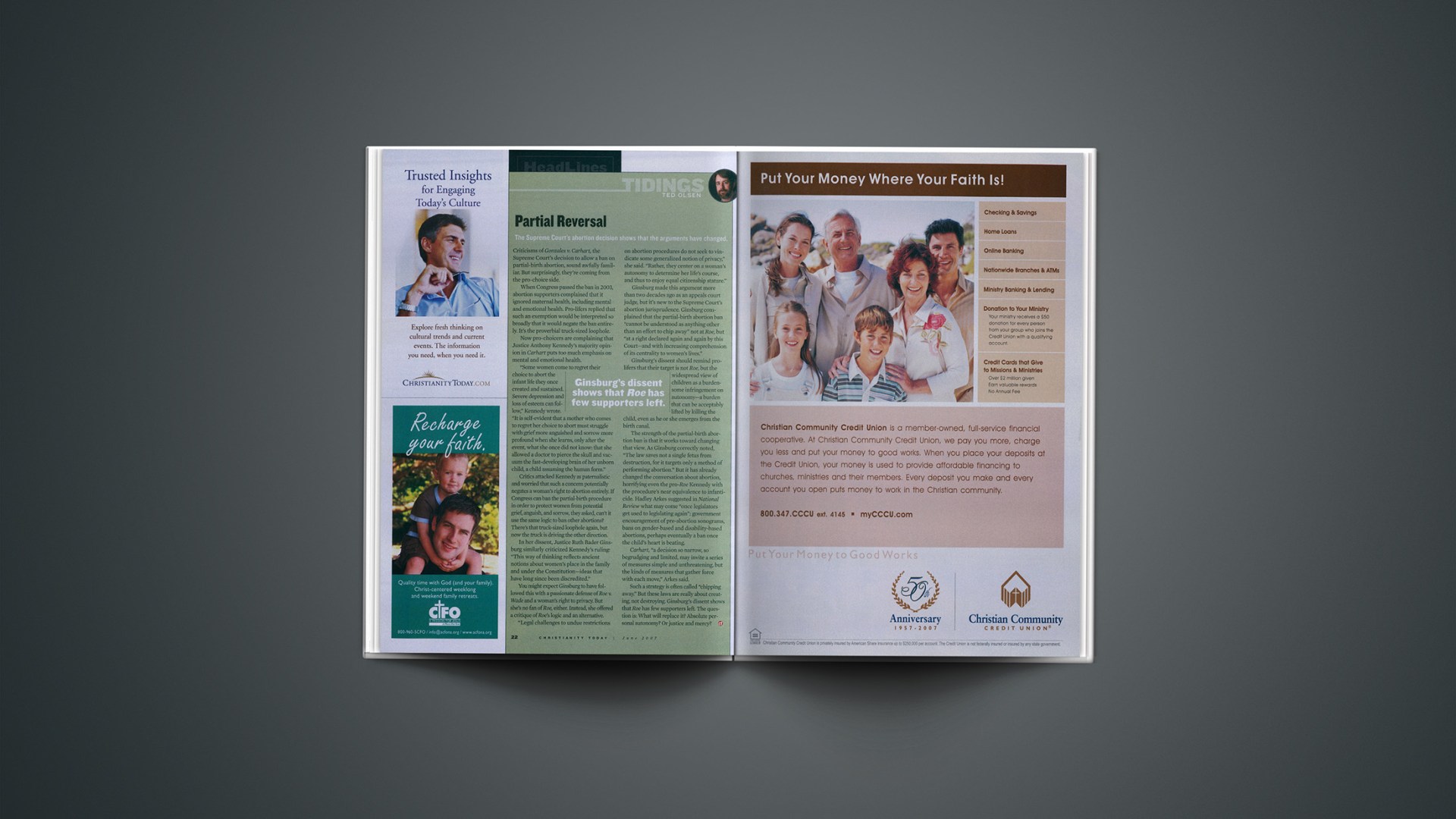

Criticisms of Gonzales v. Carhart, the Supreme Court’s decision to allow a ban on partial-birth abortion, sound awfully familiar. But surprisingly, they’re coming from the pro-choice side.
When Congress passed the ban in 2003, abortion supporters complained that it ignored maternal health, including mental and emotional health. Pro-lifers replied that such an exemption would be interpreted so broadly that it would negate the ban entirely. It’s the proverbial truck-sized loophole.
Now pro-choicers are complaining that Justice Anthony Kennedy’s majority opinion in Carhart puts too much emphasis on mental and emotional health.
“Some women come to regret their choice to abort the infant life they once created and sustained. Severe depression and loss of esteem can follow,” Kennedy wrote. “It is self-evident that a mother who comes to regret her choice to abort must struggle with grief more anguished and sorrow more profound when she learns, only after the event, what she once did not know: that she allowed a doctor to pierce the skull and vacuum the fast-developing brain of her unborn child, a child assuming the human form.”
Critics attacked Kennedy as paternalistic and worried that such a concern potentially negates a woman’s right to abortion entirely. If Congress can ban the partial-birth procedure in order to protect women from potential grief, anguish, and sorrow, they asked, can’t it use the same logic to ban other abortions? There’s that truck-sized loophole again, but now the truck is driving the other direction.
In her dissent, Justice Ruth Bader Ginsburg similarly criticized Kennedy’s ruling: “This way of thinking reflects ancient notions about women’s place in the family and under the Constitution—ideas that have long since been discredited.”
You might expect Ginsburg to have followed this with a passionate defense of Roe v. Wade and a woman’s right to privacy. But she’s no fan of Roe, either. Instead, she offered a critique of Roe‘s logic and an alternative.
“Legal challenges to undue restrictions on abortion procedures do not seek to vindicate some generalized notion of privacy,” she said. “Rather, they center on a woman’s autonomy to determine her life’s course, and thus to enjoy equal citizenship stature.”
Ginsburg made this argument more than two decades ago as an appeals court judge, but it’s new to the Supreme Court’s abortion jurisprudence. Ginsburg complained that the partial-birth abortion ban “cannot be understood as anything other than an effort to chip away” not at Roe, but “at a right declared again and again by this Court—and with increasing comprehension of its centrality to women’s lives.”
Ginsburg’s dissent should remind pro-lifers that their target is not Roe, but the widespread view of children as a burdensome infringement on autonomy—a burden that can be acceptably lifted by killing the child, even as he or she emerges from the birth canal.
The strength of the partial-birth abortion ban is that it works toward changing that view. As Ginsburg correctly noted, “The law saves not a single fetus from destruction, for it targets only a method of performing abortion.” But it has already changed the conversation about abortion, horrifying even the pro-Roe Kennedy with the procedure’s near equivalence to infanticide. Hadley Arkes suggested in National Review what may come “once legislators get used to legislating again”: government encouragement of pre-abortion sonograms, bans on gender-based and disability-based abortions, perhaps eventually a ban once the child’s heart is beating.
Carhart, “a decision so narrow, so begrudging and limited, may invite a series of measures simple and unthreatening, but the kinds of measures that gather force with each move,” Arkes said.
Such a strategy is often called “chipping away.” But these laws are really about creating, not destroying. Ginsburg’s dissent shows that Roe has few supporters left. The question is: What will replace it? Absolute personal autonomy? Or justice and mercy?
Copyright © 2007 Christianity Today. Click for reprint information.
Related Elsewhere:
The decision is available at the Supreme Court website.
Christianity Today editorialized on the Supreme Court’s ruling. CT’s Weblog also commented.
SCOTUSBlog has severalanalysispieces on the Supreme Court’s decision, which reporter Lyle Denniston calls “on a par, historically, with Roe v. Wade.” The How Appealing blog has manylinks to news stories and opinion pieces in the mainstream media.
More on the partial-birth abortion ban, including “Total Victory on Partial-Birth Abortion” is available in our full coverage area. Our Life Ethics area has articles on the South Dakota ban and related topics.
Recent Tidings columns include:
Jingo Jangle | Christian tribalism is a renunciation of God’s kingdom. (April 18, 2007)
Church Divorce Done Right | Denominational splits just aren’t what they used to be. (Mar. 7, 2007)
Why Isn’t ‘Yes’ Enough? | The fuss over swearing-in ceremonies reveals a deeper problem. (Feb. 23, 2007)
Bottom-Up Discipline | What do you do when your pastor–or your entire denomination–strays? (January 16, 2007)