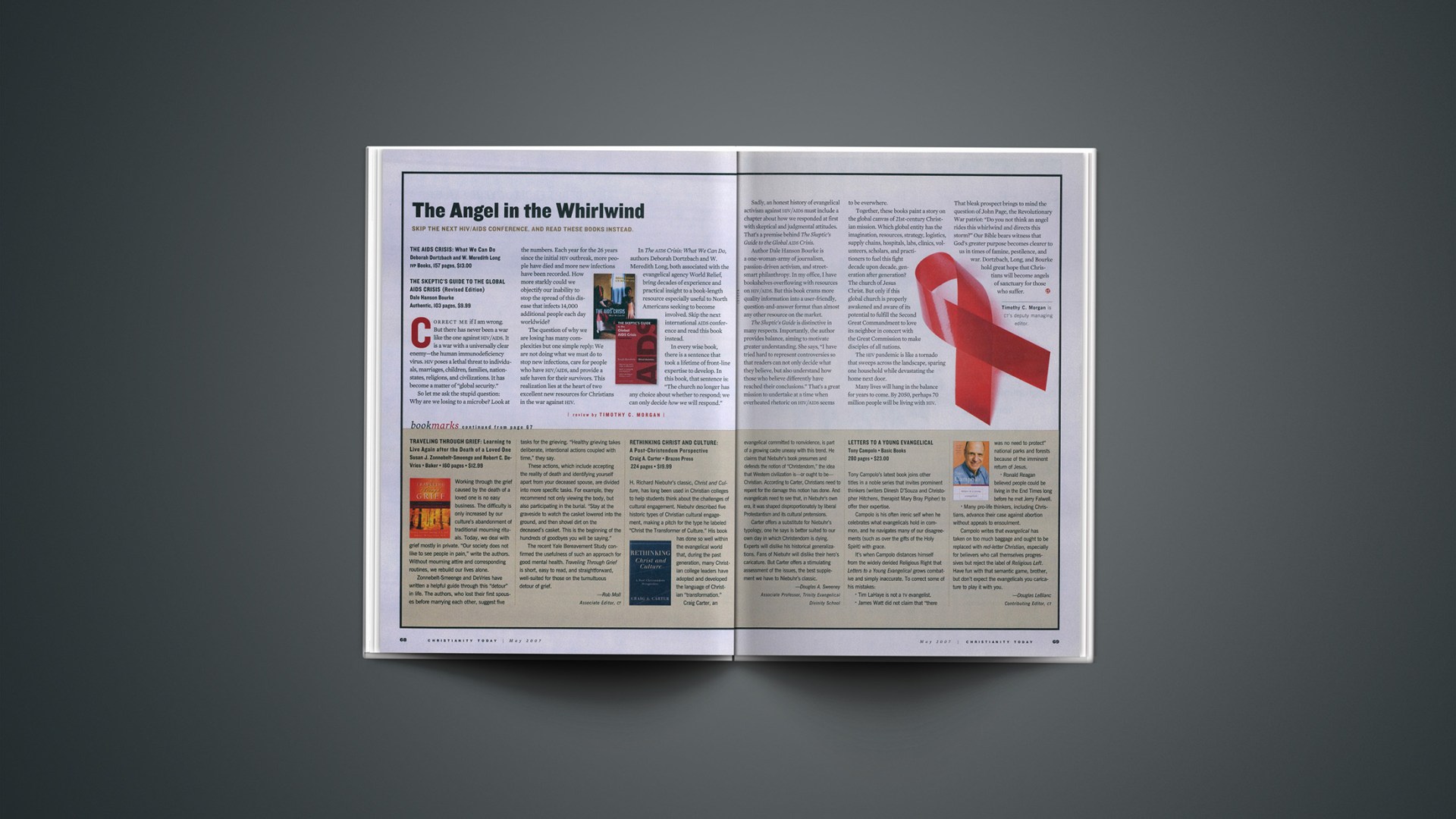

Rethinking Christ and Culture: A Post-Christendom Perspective Craig A. Carter • Brazos Press • 224 pages • $19.99
H. Richard Niebuhr’s classic, Christ and Culture, has long been used in Christian colleges to help students think about the challenges of cultural engagement. Niebuhr described five historic types of Christian cultural engagement, making a pitch for the type he labeled “Christ the Transformer of Culture.” His book has done so well within the evangelical world that, during the past generation, many Christian college leaders have adopted and developed the language of Christian “transformation.”
Craig Carter, an evangelical committed to nonviolence, is part of a growing cadre uneasy with this trend. He claims that Niebuhr’s book presumes and defends the notion of “Christendom,” the idea that Western civilization is—or ought to be—Christian. According to Carter, Christians need to repent for the damage this notion has done. And evangelicals need to see that, in Niebuhr’s own era, it was shaped disproportionately by liberal Protestantism and its cultural pretensions.
Carter offers a substitute for Niebuhr’s typology, one he says is better suited to our own day in which Christendom is dying. Experts will dislike his historical generalizations. Fans of Niebuhr will dislike their hero’s caricature. But Carter offers a stimulating assessment of the issues, the best supplement we have to Niebuhr’s classic.
Copyright © 2007 Christianity Today. Click for reprint information.
Related Elsewhere:
Rethinking Christ and Culture and Christ and Culture are available from ChristianBook.com and other retailers.
Craig Carterblogs about theology, politics, ethics, postmodernism, and culture.
Other Christianity Today articles about Christ and Culture include:
“In the World, but … “ | Richard Niebuhr’s Christ and Culture is 50 years old—and still has something wise to say to evangelicals. (John G. Stackhouse Jr., April 22, 2002)
Stopping Cultural Drift | An Asian Pentecostal argues that we need to know what the church is before we figure out what the church does. (November 16, 2006)
With or Against Culture? | I take the possibilities enumerated by H. Richard Niebuhr in his classic work to be strong tendencies rather than airtight laws of Christian engagement, often with considerable overlap between categories. (Books & Culture, October 2006)
Christ, Culture, and History | Is the “main character” in the church’s story God, transforming faith, or an inspired yet wayward community? (Christian History & Biography, April 2002)