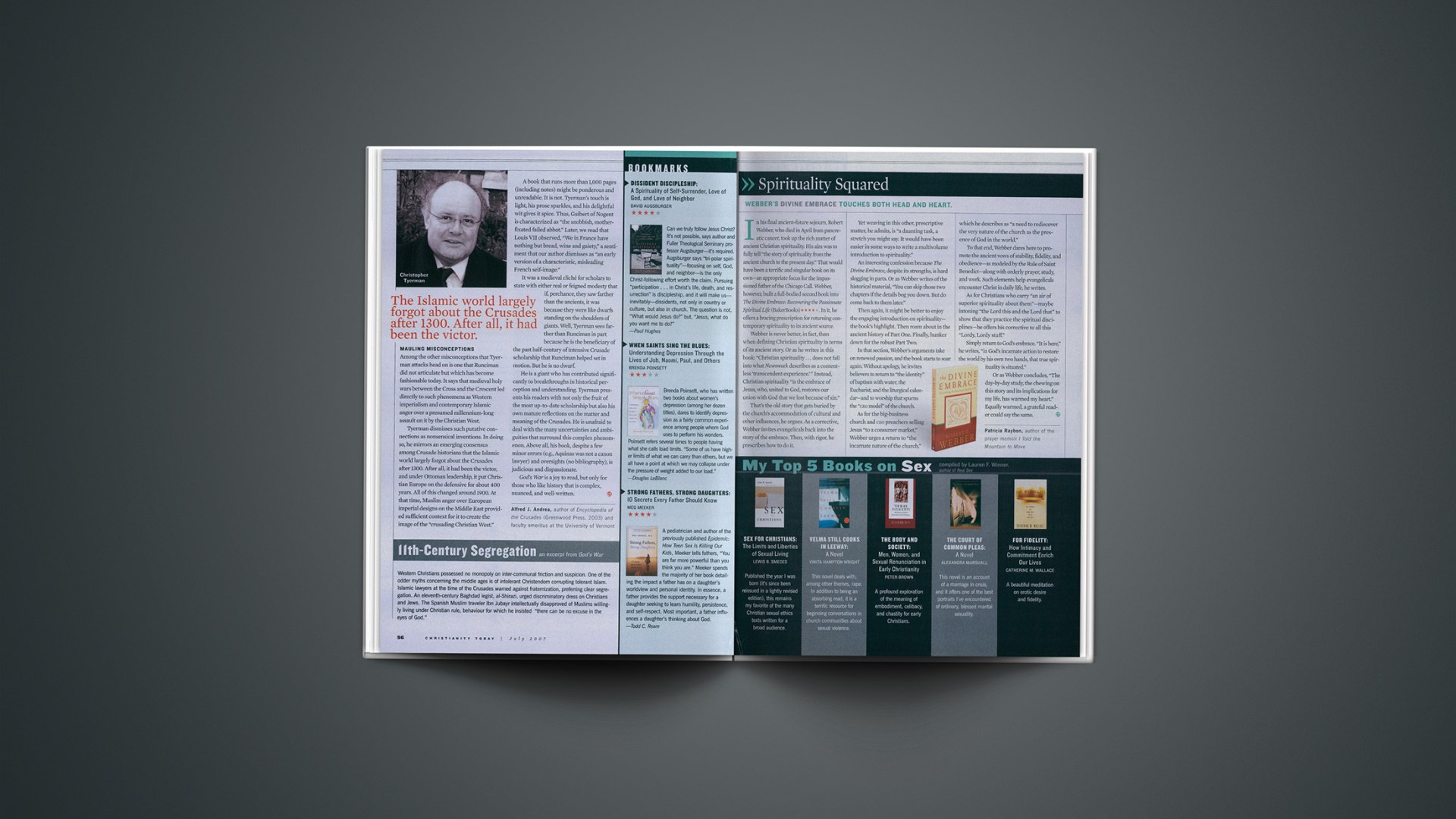

In his final ancient-future sojourn, Robert Webber, who died in April from pancreatic cancer, took up the rich matter of ancient Christian spirituality. His aim was to fully tell “the story of spirituality from the ancient church to the present day.” That would have been a terrific and singular book on its own—an appropriate focus for the impassioned father of the Chicago Call. Webber, however, built a full-bodied second book into The Divine Embrace: Recovering the Passionate Spiritual Life (BakerBooks). In it, he offers a bracing prescription for returning contemporary spirituality to its ancient source.
Webber is never better, in fact, than when defining Christian spirituality in terms of its ancient story. Or as he writes in this book: “Christian spirituality … does not fall into what Newsweek describes as a contentless ‘transcendent experience.'” Instead, Christian spirituality “is the embrace of Jesus, who, united to God, restores our union with God that we lost because of sin.”
That’s the old story that gets buried by the church’s accommodation of cultural and other influences, he argues. As a corrective, Webber invites evangelicals back into the story of the embrace. Then, with rigor, he prescribes how to do it.
Yet weaving in this other, prescriptive matter, he admits, is “a daunting task, a stretch you might say. It would have been easier in some ways to write a multivolume introduction to spirituality.”
An interesting confession because The Divine Embrace, despite its strengths, is hard slogging in parts. Or as Webber writes of the historical material, “You can skip those two chapters if the details bog you down. But do come back to them later.”
Then again, it might be better to enjoy the engaging introduction on spirituality—the book’s highlight. Then roam about in the ancient history of Part One. Finally, hunker down for the robust Part Two.
In that section, Webber’s arguments take on renewed passion, and the book starts to soar again. Without apology, he invites believers to return to “the identity” of baptism with water, the Eucharist, and the liturgical calendar—and to worship that spurns the “CEO model” of the church.
As for the big-business church and CEO preachers selling Jesus “to a consumer market,” Webber urges a return to “the incarnate nature of the church,” which he describes as “a need to rediscover the very nature of the church as the presence of God in the world.”
To that end, Webber dares here to promote the ancient vows of stability, fidelity, and obedience—as modeled by the Rule of Saint Benedict—along with orderly prayer, study, and work. Such elements help evangelicals encounter Christ in daily life, he writes.
As for Christians who carry “an air of superior spirituality about them”—maybe intoning “the Lord this and the Lord that” to show that they practice the spiritual disciplines—he offers his corrective to all this “Lordy, Lordy stuff.”
Simply return to God’s embrace. “It is here,” he writes, “in God’s incarnate action to restore the world by his own two hands, that true spirituality is situated.”
Or as Webber concludes, “The day-by-day study, the chewing on this story and its implications for my life, has warmed my heart.” Equally warmed, a grateful reader could say the same.
Patricia Raybon, author of the prayer memoir I Told the Mountain to Move
Copyright © 2007 Christianity Today. Click for reprint information.
Related Elsewhere:
The Divine Embrace is available from ChristianBook.com and other retailers.
The book won Christianity Today‘s 2007 book award in the spirituality category. Previous coverage of the book includes “Together in the Jesus Story” and an excerpt, “God Is Not the Object of Our Worship.”
Christianity Today published Webber’s obituary on April 30, 2007.
The Robert E. Webber Institute for Worship Studies, Northern Seminary, and AncientFutureWorship.com have more on Webber. Northern also hosts Webber’s “Call to an Ancient Evangelical Future.”
Editor David Neff interviewed Webber in 2006 about the AEF Call.
Christianity Today briefly reviewed Ancient-Future Evangelism in 2004, briefly excerpted Ancient-Future Faith in 2000, and briefly profiled Webber’s work on “blended worship” in 1997.