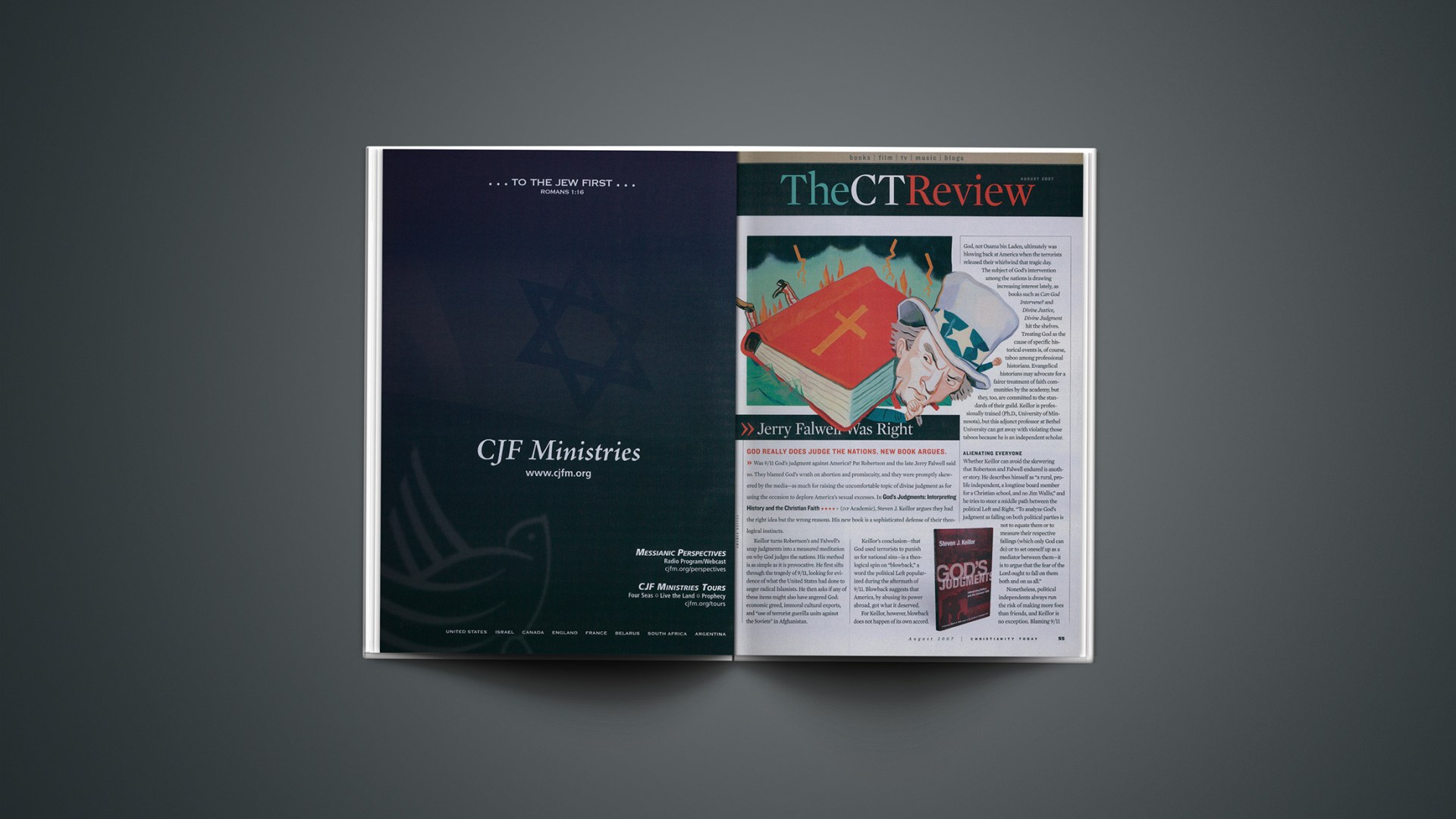

Was 9/11 God’s judgment against America? Pat Robertson and the late Jerry Falwell said so. They blamed God’s wrath on abortion and promiscuity, and they were promptly skewered by the media—as much for raising the uncomfortable topic of divine judgment as for using the occasion to deplore America’s sexual excesses. In God’s Judgments: Interpreting History and the Christian Faith (IVP Academic), Steven J. Keillor argues they had the right idea but the wrong reasons. His new book is a sophisticated defense of their theological instincts.
Keillor turns Robertson’s and Falwell’s snap judgments into a measured meditation on why God judges the nations. His method is as simple as it is provocative. He first sifts through the tragedy of 9/11, looking for evidence of what the United States had done to anger radical Islamists. He then asks if any of these items might also have angered God: economic greed, immoral cultural exports, and “use of terrorist guerilla units against the Soviets” in Afghanistan.
Keillor’s conclusion—that God used terrorists to punish us for national sins—is a theological spin on “blowback,” a word the political Left popularized during the aftermath of 9/11. Blowback suggests that America, by abusing its power abroad, got what it deserved.
For Keillor, however, blowback does not happen of its own accord. God, not Osama bin Laden, ultimately was blowing back at America when the terrorists released their whirlwind that tragic day.
The subject of God’s intervention among the nations is drawing increasing interest lately, as books such as Can God Intervene? and Divine Justice, Divine Judgment hit the shelves. Treating God as the cause of specific historical events is, of course, taboo among professional historians. Evangelical historians may advocate for a fairer treatment of faith communities by the academy, but they, too, are committed to the standards of their guild. Keillor is professionally trained (Ph.D., University of Minnesota), but this adjunct professor at Bethel University can get away with violating those taboos because he is an independent scholar.
Alienating Everyone
Whether Keillor can avoid the skewering that Robertson and Falwell endured is another story. He describes himself as “a rural, pro-life independent, a longtime board member for a Christian school, and no Jim Wallis,” and he tries to steer a middle path between the political Left and Right. “To analyze God’s judgment as falling on both political parties is not to equate them or to measure their respective failings (which only God can do) or to set oneself up as a mediator between them—it is to argue that the fear of the Lord ought to fall on them both and on us all.”
Nonetheless, political independents always run the risk of making more foes than friends, and Keillor is no exception. Blaming 9/11 on CIA involvement in Afghanistan will annoy anyone who does not like Noam Chomsky. Blaming it on our refusal “to exempt from judgment all our acts in the market, as if the market scrubbed them clean” will anger the political Right. And blaming it on Hollywood will alienate the political Left.
Holding God responsible for 9/11, however, risks infuriating everyone. Keillor recognizes that 9/11 might be too recent for such analysis, which is why he devotes several chapters to making similar claims about more distant events, such as the burning of Washington in 1814 and the Civil War.
He also deepens his case by retrieving judgments of the Old Testament prophets that scholars call “oracles against the nations.” The words of Amos 3:6 are especially poignant: “When disaster comes to a city, has not the Lord caused it?” These oracles, however, generally target nations that have mistreated Israel, something that can hardly be said of America.
Even more problematic, Keillor’s single-minded focus on judgment obscures the broader topic of providence. God can use, guide, and bless nations as well as judge them, but Keillor has no patience for any talk about America as a special nation.
America’s founders were certain that their new country was chosen by God to play a providential role in the world, but even Christians who would agree with that proposition have largely lost the skill of analyzing contemporary events as signs of God’s will. The Vietnam War taught many Christians that God’s plan does not always coincide with our good intentions.
After Vietnam, theologians on the political Left stood providence on its head. They became convinced that God had singled out America for special judgment, not special blessing, because American influence abroad was so evil. Anti-Americanism thus became a perverse kind of providentialism among the cultural elite.
What anti-Americanists do not understand is that God allows nations to obtain enormous power for good as well as evil. This is true especially with regard to the treatment of Israel. God said of Cyrus, the founder of the Persian Empire, “He is my shepherd and will accomplish all that I please” (Isa. 44:28). God used Cyrus to subdue the nations, including Babylon, and to free the Jews from their captivity.
If God could use Cyrus, surely he can use America not only to defend Israel but also to advance the cause of freedom around the world. America exports Christianity as well as raunchy movies. Democracy and capitalism are the new Roman roads on which Christianity is spreading to the corners of the globe. America is not Israel, but it is not Babylon, either. 9/11 could be interpreted as judgment against those who want to impede the great Christian theme of freedom. If so, then God is not done with America yet.
Stephen H. Webb, professor of religion and philosophy at Wabash College and author of American Providence and Dylan Redeemed.
Copyright © 2007 Christianity Today. Click for reprint information.
Related Elsewhere:
God’s Judgments is available from ChristianBook.com and other retailers.
Excerpts of the introduction and first chapter are available from IVP.
Books & Culture also reviewed the book.
“Weblog: As the World Prays, Falwell and Robertson Blame ACLU, Gays, and Others for ‘Deserved’ Attack” comments on the initial reactions to Robertson’s statements on God’s judgment.