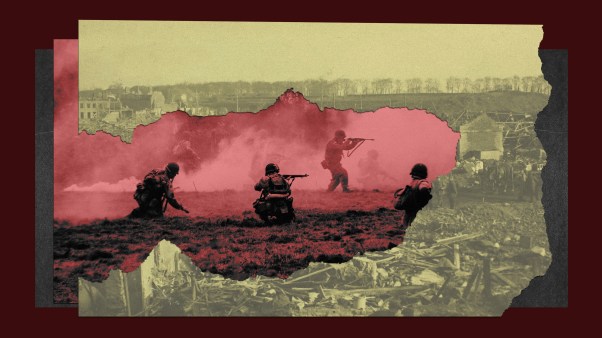
"Wars are stupid and can therefore only be caused by people who are more stupid than those who recognize the stupidity of war."
As my professor read those words during a recent religion and political order class at the University of Chicago, a wistfulness came over me. I wished wars were merely nonsensical. Then they would be easy to stop: All we'd have to do is educate warmongers out of their ignorance.
The theologian who penned the statement, Reinhold Niebuhr, didn't believe it either. He meant it as a characterization of the Christian pacifism he had espoused before he saw what the fascists were up to in the 1930s. Eventually, he articulated a view of world politics called Christian realism, which influenced his student Dietrich Bonhoeffer, contributed to the development of just-war theory, and today shows up in Barack Obama's public statements.
As I thought about Niebuhr, my mind went to a recent book by William Langewiesche, whose pithy, world-enlarging reporting made The Atlantic Monthly a must-subscribe in my home. In The Atomic Bazaar: The Rise of the Nuclear Poor, Langewiesche attempts to disarm fears of nuclear doom. He does it by pointing out that international hostilities—especially ones that involve the development of nuclear weapons—are far from stupid.
A nuclear-free world is not realistic, Langewiesche argues; poorer countries will inevitably join the group of countries we like to think are more responsible in stockpiling nukes. North Korea and Iran are just the beginning.
Politicians may paint some developing nations as evil, but their production of nuclear weapons signals to Langewiesche that they're making rational choices. Nuclear weapons are the wisest investment cash-strapped countries can make. The biggest bang for their buck. And, oddly, there's hope in that.
Langewiesche writes that even regimes with the kookiest leaders are "subject to conventional logic of deterrence and will hesitate to use their weapons because of the certainty of a crushing response—since they, too, have cities and infrastructures that they will lose." Thus, any nuclear attack by nation-states is highly unlikely, and their arsenals are well-secured.
It gets trickier, of course, with transnational terrorists who act independently of any state, because they don't have territory that could be hit in retaliation. But very few people in the world have the money, know-how, and connections needed to make nuclear weapons. Langewiesche explains that their success would depend on a series of highly risky operations, including: infiltrating a well-protected site with at least 100 pounds of weapons-grade uranium, stealing the uranium, transporting the fuel across borders to an assembly point, and producing the weapon. All improbable in a world far removed from the one Jack Bauer takes on in the TV series 24.
Langewiesche believes that precluding such a scenario could be fairly easy, but the means would most likely have to be "non-governmental," requiring flexibility, curiosity, and imag-ination. We'd need people who could hitchhike—not attract attention by driving government-provided SUVS—and become acquainted with the people who cross borders regularly. The solution to nuclear theft is informal relationships. The rub, of course, is that sources who know the most are often shady types, narcotics traders and such. Government officials told Langewiesche off the record that this kind of approach gets tripped up on the formal chain of command—and by senators who'd want to grab headlines by exclaiming that "we cannot work with criminals!"
Hmm … a non-governmental, transnational group of people who want to build relationships and can get by in no man's lands sans government-provided comforts? Who care about the peace of this planet but also have an air of otherworldliness about them? Who wouldn't mind getting to know a drug trafficker just to get to know him? And who, in the unlikely scenario that some big transport was coming down, would be willing to tip someone off, just because they care about human life?
Even Niebuhr the realist wrote, "It would be ridiculous to assert that there can be no moral and spiritual disinterestedness in international affairs, simply because there is no political vantage point for its expression."
A number of people in the U.S. are caught up in a vision greater than any political vantage point, which infuses them with concern that each human life be lived to the fullest. They pop up as volunteer aid workers in ravaged regions, as English teachers to the poor, as micro-loan educators in Africa, as friends to all kinds of people, filling in the gaps where governments are powerless.
Who knows, maybe someday their work will prove useful in another area of world need.
Copyright © 2007 Christianity Today. Click for reprint information.
Related Elsewhere:
The Atomic Bazaar: The Rise of the Nuclear Poor is available from Amazon.com and other retailers.
NPR interviewed Langewiesche (Slate explained the pronunciation) and had him read an excerpt from the book, which was reviewed by the New York Times, The Boston Globe, The Christian Science Monitor, and others.
The Niebuhr Society links to Niebuhr's writings and speeches.
The Dallas Morning News published an interview on Niebuhr's philosophy of Christian Realism, which presents "the compelling idea that there's serious evil in the world. … But we shouldn't use that as an excuse for cynicism and inaction," according to Barack Obama.
Previous Taste and See columns include:
Brave New Salvation | A vision of a sinless future. (June 20, 2007)
Desire Happens | You see, you want. Then what? (March 29, 2007)
'Ordinary' Delights | Let us praise the consoling banality of good. (March 13, 2007)
Dating Jesus | When 'lover of my soul' language goes too far. (December 6, 2006)
To Russia with Fury | Sometimes charity means anger. (October 9, 2006)
What (Not All) Women Want | The finicky femininity of 'Captivating' by John and Stasi Eldredge. (August 1, 2006)
A Velveteen Apologetic | How two creatures dig a rabbit hole in my disbelief. (April 1, 2006)
What Would Jesus Buy? | Saving the world one cashmere sweater at a time. (February 1, 2006)