In this series




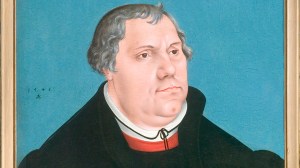
Luther's diseases were caused by the way he lived rather than by genetic disposition. Years of malnutrition in the monastery, long days and nights of hard mental labor, as well as his later thorough enjoyment of food, drink, and sex had their effect on Luther's health.
During his exile at the Wartburg, Luther was plagued by stomach disorders and constipation. "The Lord has afflicted me with painful constipation," he told Melanchthon in May 1521. "I did not sleep all night and still have no peace. Please pray for me."
From 1526 on, Luther endured sporadic gall and kidney-stone attacks, which reminded him of death because of the excruciating pain. He frequently talked about these attacks, complaining about pain. He distrusted physicians and linked the experience to the kind of Anfechtungen [combination physical illness and depression] sent by God to remind Christians that life is indeed a struggle with sin, death, and the Devil.
"I was dead"
One of his worst kidney-stone attacks occurred when Luther attended the convention of the Schmalkald League in 1537. He told his wife, Katie, "I had not been healthy there for more than three days, and from the first Sunday to this night, not one little drop of water passed from me; I had no rest nor did I sleep, and I was unable to retain any drink or food. In summary, I was dead; I commended you, together with the little ones, to God and to my gracious Lord, since I thought that I would never again see you in this mortal life.… But many people prayed to God so hard on my behalf that their tears moved God to open my bladder this night … and I feel as if I were born again."
Those who were with Luther during this attack heard him grumbling about his wretched body, which had become the target of the Devil. "The Devil hates me, and so he increases my pain," he said while sipping some almond broth.
After 1530, Luther suffered from severe headaches that often included a ringing or "buzzing" in the ears. After 1541, these headaches often forced Luther to interrupt his routine and even to avoid the bright light of a sunny day. He was sometimes able to joke about them, describing them as the Devil's ride through his brain; or, when they had ceased, as the Devil's way of getting a vacation by traveling to a spa.
After 1530, Luther also suffered from an open sore on his leg, and doctors finally provided some relief in 1543 by keeping the sore open for drainage.
The Devil and doctors
Luther viewed all these physical ailment—as well as the epidemic diseases, like the bubonic plague that struck Wittenberg in 1527—as ways the Devil used to persuade Christians to leave Christ and join his realm. "To be sure, Satan would gladly kill me if he could," Luther commented in January 1532. Luther considered physicians and medical expertise an integral part of this struggle, even if many physicians failed to recognize that the Devil was the cause of disease.
According to Luther, medicine and faith belong together in the struggle for health. To be sure, Luther did not always obey the doctors' orders. In 1526, during his first attack of kidney stones, he defied his physician's order to avoid solid food and persuaded Katie to cook one of his favorite meals of fried herring with mustard and cold peas. Shortly after the meal, he passed a sizable kidney stone, and he delighted in the surprise of his physicians. This combination of faith, humor, and commitment to ministry enabled Luther to endure what Paul called "the thorn in the flesh" (2 Cor. 12:7).
Amazing accomplishments
Despite all these ailments, as well as the normal hazards of sixteenth-century living, Luther managed to do an extraordinary amount of work. [See A Sick Man's Healthy Accomplishments].
Luther did not allow himself to be severely impeded by physical and mental illness! On the contrary, he seemed to thrive under the impact of the various Anfechtungen.He could say that Christians must view their sufferings as part of Christ'sown sufferings and that Christ will also provide the strength to endure. He wrote to Elector Frederick in 1519, when the elector had become gravely ill: "Such evils as sickness and the like are borne not by us Christians but by Christ himself, our Lord and Savior, in whom we live and who plainly testifies in the gospel, "Whatever you have done unto the least of mine, you have done unto me" (Matt. 25:40)."
Dr. Eric W. Gritsch is Maryland Synod Professor of Church History at Lutheran Theological Seminary in Gettysburg, Pennsylvania, and director of the Institute for Luther Studies.
Copyright © by the author or Christianity Today/Christian History magazine.Click here for reprint information on Christian History.