In this series

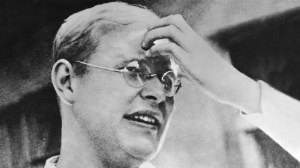
In June 1939, Dietrich Bonhoeffer traveled to the United States and received a warm welcome. By July he'd decided that, despite the danger, he had to go back to his Nazi-dominated homeland: "I have made a mistake in coming to America," he wrote to his former teacher, Reinhold Niebuhr. "I must live through this difficult period of our national history with the Christian people of Germany." But he didn't live through it. He was hanged for "political high treason" on April 9, 1945, just a month before Germany surrendered.
This span of years is the subject for a fine new film, "Bonhoeffer: Agent of Grace," which will debut on PBS next Wednesday, June 14, at 9:30 p.m. ET (or check your local listings). The PR promises "a vital portrait of the man, the teacher, the resistance fighter, the moralist, the prisoner and, eventually, the martyr"—but the film delivers even more. It shows us a theologian in action, rethinking what it means to serve God, love others, and, especially, to tell the truth.
Early in the film, Bonhoeffer is convinced by his friend Hans (who was also his brother-in-law, though the film doesn't make this clear) to join military intelligence, the Abwehr, as a double agent. He was to use the international contacts forged in his ministry career ostensibly to gather information, but really to act as a courier for the resistance and attempt to seek terms of surrender from the Allies, should the Abwehr's plot to assassinate Hitler succeed. He was also involved in Operation 7, which snuck Jews out of the country by giving them sham posts in the Abwehr. The film shows a pastor reluctant to participate in this duplicity but quickly persuaded that "it is worse to be evil than to do evil."
Between spying, ministering, working on his never-finished Ethics, and being watched by the Gestapo (which had strong suspicions about the Abwehr), Bonhoeffer also managed to fall in love and get engaged. His fiancee, Maria, was 18; he was 36. The film really plays up the age difference, and it also portrays Maria as a slightly ditzy blond, which makes their romance seem not only highly unusual—which it was—but also kind of creepy. Incidentally, the real Maria was a brunette and hardly ditzy; after the war, she went on to be a successful engineer at Honeywell. (We'll know even more about their romance in 2002, when Maria's collection of 38 love letters from Dietrich, currently housed at Harvard, will be opened to the public.)
This brings up the standard question: How many artistic liberties does the film take? It is a film, not a documentary, so dramatic narrative does edge out historical reporting. That said, the script sticks close to actual events and personalities, though many of these flit by so fast that a viewer unfamiliar with the story will likely be lost—for example, the early scene where Bonhoeffer meets someone important outside Germany (I think it's Bishop Bell, whom Bonhoeffer met in Sweden in 1942 to discuss a potential German surrender, but I'm really not sure).
The settings are less accurate, as director/co-writer Eric Till shifted several venues for dramatic effect (eg. Bonhoeffer's musings on the future of Christianity were set in a bombed-out church, though he really spent his last day outside Flossenburg concentration camp at a school). "You can get bogged down by the truth of it all," Till says. "At the same time, one is most anxious not to in any way distort the essence of the real story itself."
I'm pretty confident that Bonhoeffer was more inspiring in person than his character is on film. In a split scene, as Bonhoeffer awaits execution and Maria gets caught in an air raid, his words echoing in her head are, "Maria, believe in the future, no matter what." Surely the man who wrote Life Together and the amazing Letters and Papers from Prison, who conducted a worship service the day before his execution, gave Maria something more significant than that to hold onto. Still, there's more than enough of Bonhoeffer's courage and depth to make "Agent of Grace" a film with real force.
* For Christian History's coverage of Dietrich Bonhoeffer, see issue 32.
* A review of two other fairly recent Bonhoeffer films, "Hanged on a Twisted Cross" (1996) and "A View from the Underside" (1992) can be found at www.sojourners.com/soj9705/970532d.html
* You can browse the official PBS site at pbs.org/opb/bonhoeffer/
Copyright © by the author or Christianity Today/Christian History magazine. Click here for reprint information on Christian History.