News

After George Tiller’s Death

Pro-life advocates wonder whether doctor’s murder will reshape debate.

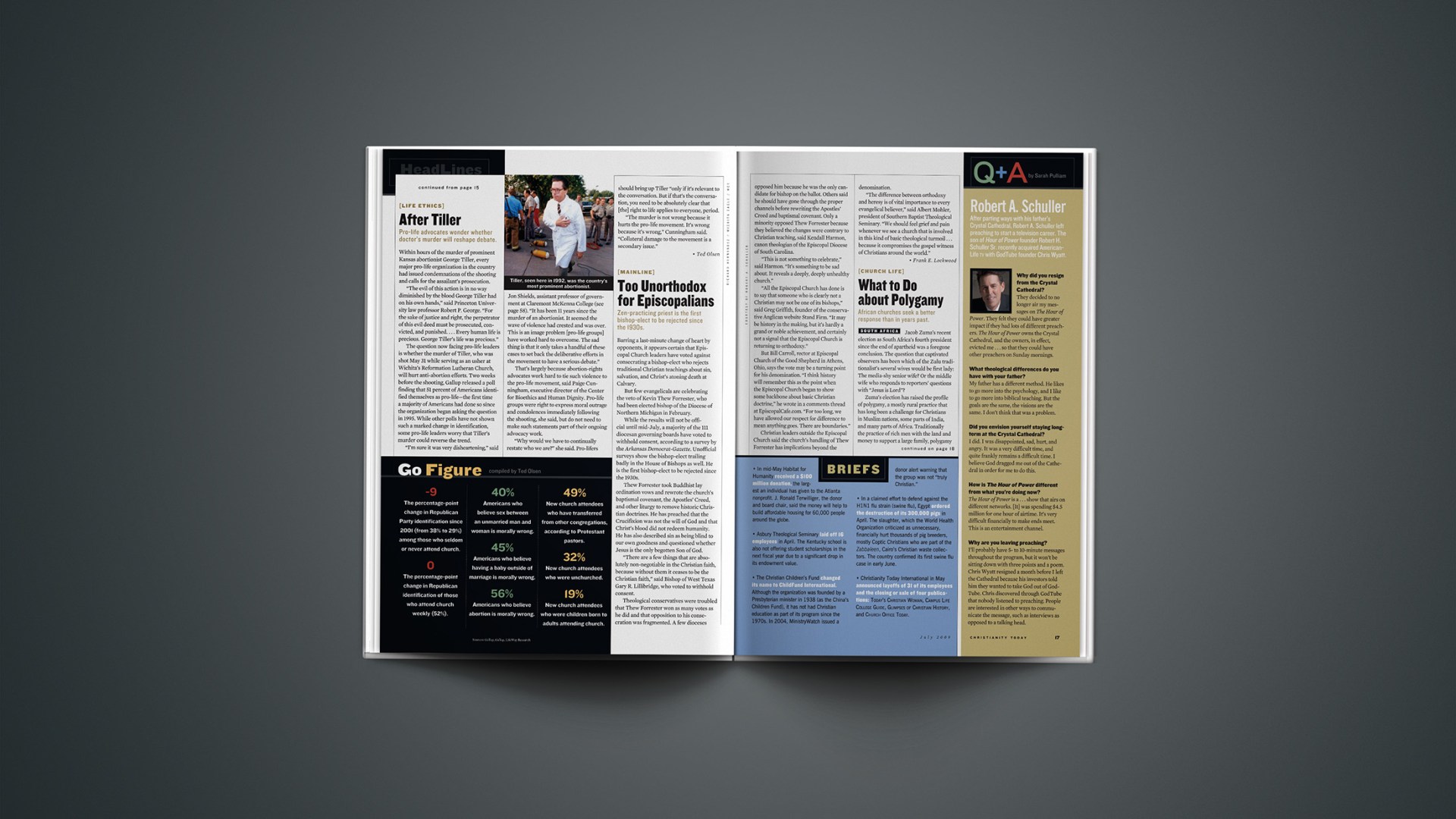
Within hours of the murder of prominent Kansas abortionist George Tiller, every major pro-life organization in the country had issued condemnations of the shooting and calls for the assailant’s prosecution.

“The evil of this action is in no way diminished by the blood George Tiller had on his own hands,” said Princeton University law professor Robert P. George. “For the sake of justice and right, the perpetrator of this evil deed must be prosecuted, convicted, and punished. … Every human life is precious. George Tiller’s life was precious.”

The question now facing pro-life leaders is whether the murder of Tiller, who was shot May 31 while serving as an usher at Wichita’s Reformation Lutheran Church, will hurt anti-abortion efforts. Two weeks before the shooting, Gallup released a poll finding that 51 percent of Americans identified themselves as pro-life—the first time a majority of Americans had done so since the organization began asking the question in 1995. While other polls have not shown such a marked change in identification, some pro-life leaders worry that Tiller’s murder could reverse the trend.

“I’m sure it was very disheartening,” said Jon Shields, assistant professor of government at Claremont McKenna College. “It has been 11 years since the murder of an abortionist. It seemed the wave of violence had crested and was over. This is an image problem [pro-life groups] have worked hard to overcome. The sad thing is that it only takes a handful of these cases to set back the deliberative efforts in the movement to have a serious debate.”

That’s largely because abortion-rights advocates work hard to tie such violence to the pro-life movement, said Paige Cunningham, executive director of the Center for Bioethics and Human Dignity. Pro-life groups were right to express moral outrage and condolences immediately following the shooting, she said, but do not need to make such statements part of their ongoing advocacy work.

“Why would we have to continually restate who we are?” she said. Pro-lifers should bring up Tiller “only if it’s relevant to the conversation. But if that’s the conversation, you need to be absolutely clear that [the] right to life applies to everyone, period.

“The murder is not wrong because it hurts the pro-life movement. It’s wrong because it’s wrong,” Cunningham said. “Collateral damage to the movement is a secondary issue.”

Copyright © 2009 Christianity Today. Click for reprint information.

Related Elsewhere:

Christianity Today has more stories on abortion and life ethics, including:

Abortion Violence and American Democracy | The ironic relationship between the pro-life movement and its radical fringe. (June 3, 2009)

Reversing Roe v. Wade | It may take more than a single court decision to counter abortion on demand. (January 1, 2003)

The Abortion Wars | What most Christians don’t know about the history of prolife struggles. (January 1, 2003)

You Say Choice, I Say Murder | Before prolife arguments can reach the undecided American, we have got to look at the language we use. (June 24, 1991)

Also in this issue

The CT archives are a rich treasure of biblical wisdom and insight from our past. Some things we would say differently today, and some stances we've changed. But overall, we're amazed at how relevant so much of this content is. We trust that you'll find it a helpful resource.

Cover Story

Cuba for Christ—Ahora!

Review

Wings for the Single Person

Marcy Hintz

A More Civilized Christian Right

Interview by Sarah Pulliam

Books Uncommon and Offbeat

John Wilson

Is The Gay Marriage Debate Over?

Evangelicals on the Newburyport Trail

G. Jeffrey MacDonald

Hard Times

Compiled by Richard A. Kauffman

The Clash of Stereotypes

To Kill or to Love—That Was the Question

Brandon O'Brien

News

Where Jerusalem and Mecca Meet

Gregg Chenoweth and Caleb Benoit

Editorial

Not One Sparrow

A Christianity Today Editorial

My Top 5 Books on Calvin

Michael Horton, editor in chief of 'Modern Reformation'

Back to Cuba

Timothy C. Morgan

More Freedom But Not Free

CT staff

Review

CDs on The List

Review

Blood and Desperation

Andy Whitman

Does Global Christianity Equal American Christianity?

Renewed Focus and Vision

Harold Smith

Review

Divine Devolution

Readers Write

A Whole Good World Outside

When the War Never Ends

Jocelyn Green

Review

Voiceless Women

Camerin Courtney

'Honor Thy Father' for Grownups

What to Do about Unbiblical Unions

Susan Wunderink

News

Go Figure

News

Quotation Marks

News

Passages

News

Less Edgy Conferences

Bobby Ross Jr.

News

News Briefs: July 01, 2009

News

Radicals Rejected

Compass Direct News

Q & A: Robert A. Schuller

Interview by Sarah Pulliam

News

Recession Hits Refugees

C. L. Lopez

News

Family Ties

Christopher Quinn

News

Martyrs Killed by Conspiracy

Damaris Kremida

View issue

Our Latest

News

Died: John M. Perkins, Who Lived and Preached Racial Reconciliation

The civil rights leader believed in a gospel bigger than race or self-interest.

Review

Decoding the Supreme Court

Three books to read this month on politics and public life.

The Bulletin

Cost of Iran War, Quiet Southern Border, and Anglican Church Split

Mike Cosper, Clarissa Moll, Russell Moore

The financial and moral toll of war, immigration slows but ministry continues, and why denominations split.

The Year of the Evangelical

America prepared for a bicentennial, and religious identity dominated the presidential campaign.

Q&A: Eric Mason on Ministering to Men and Witnessing in Politics

Interview by Benjamin Watson

The Philadelphia-based pastor discusses how the church can engage Black men and have a biblical approach to government.

Review

‘The Secret Agent’ Explores Memory and Authoritarianism in Brazil

Mariana Albuquerque

The Oscar-nominated film reminds viewers to learn from the past—and to share our stories with the next generation.

Jan Karon Looks Back on 89 Years of God’s Faithfulness

The author of the Mitford Years series married at 14, protested segregation, and wrote her first book at 57.

The Just Life with Benjamin Watson

Michel Lusakueno: Why the World Can’t Ignore Congo

Exploring the sobering connection between modern convenience and human suffering.

Apple PodcastsDown ArrowDown ArrowDown Arrowarrow_left_altLeft ArrowLeft ArrowRight ArrowRight ArrowRight Arrowarrow_up_altUp ArrowUp ArrowAvailable at Amazoncaret-downCloseCloseEmailEmailExpandExpandExternalExternalFacebookfacebook-squareGiftGiftGooglegoogleGoogle KeephamburgerInstagraminstagram-squareLinkLinklinkedin-squareListenListenListenChristianity TodayCT Creative Studio Logologo_orgMegaphoneMenuMenupausePinterestPlayPlayPocketPodcastprintRSSRSSSaveSaveSaveSearchSearchsearchSpotifyStitcherTelegramTable of ContentsTable of Contentstwitter-squareWhatsAppXYouTubeYouTube