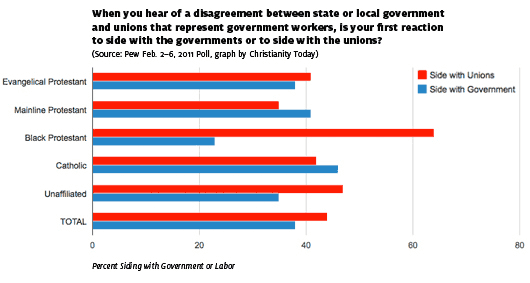
Both sides in the public labor stand-off in Wisconsin often wrap their arguments in moral and religious rhetoric. Most Americans, however, may want to avoid bringing up the issue at church. A February poll by Pew Research Center for People and the Press finds that evangelicals are split over fights between state and local governments and public labor unions.
Four in ten evangelicals say that their first reaction is to back labor unions when there is a disagreement between state or local governments and unions. Statistically, this is the same as the percentage who said their gut reaction would be to support governments. The only religious tradition to overwhelmingly support one side or the other is African-American Protestants, who favor labor two-to-one over governments.
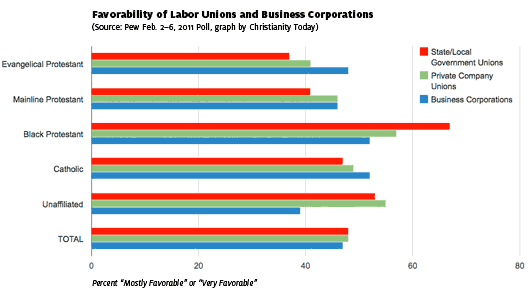
When Pew asked whether people were favorable toward government employee unions, private company unions, and business corporations, it found that each was favored by around the same percentage of Americans. Just under half of Americans felt favorable toward each group.
Among religious traditions, however, there were differences. Evangelicals have the lowest favorability toward government employee unions of any religious group. Only 37 percent said they were favorable to unions that represent state and local government employees. This is lower than evangelical favorability toward unions that represent employees at private companies (41 percent). Views toward business corporations were the most positive, with roughly half of evangelicals saying they felt favorable toward business.
Mainline Protestants and Catholics showed a similar pattern, but the differences between the favorability of business versus government unions were not as stark as for evangelicals.
Other groups were more pro-union. Two-thirds of African-American Protestants felt favorable toward public sector unions, and a majority favored private unions (57 percent). Those who practiced no religion also leaned more toward unions than business, but they favored both private and public unions at about the same level.
One reason for this low view of unions may be that evangelicals are less likely to see unions as protecting workers. Pew asked which best represented their views of labor unions: do they “ensure union workers are treated fairly” or “give union workers unfair advantages”? While each religious tradition had more people choosing “treated fairly” than “unfair advantages,” this difference was smallest among evangelicals. Indeed, evangelicals were the only religious tradition to have less than a majority believe that labor unions ensure that their workers are treated fairly.
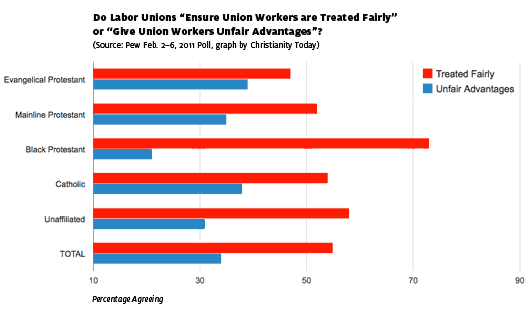
With such relatively low views of unions, it may be surprising that evangelicals are so evenly split rather than siding with state and local governments more. There are three possible reasons that they are not more anti-union in disagreements.
First, the conflict is between government and labor unions, not business and labor. While not all evangelicals hold negative views of unions, those that do may also be suspicious of government. Much like watching a football game between two teams you don’t like, evangelicals may be split over which side to root against.
Second, evangelicals often have personal experiences with labor unions. Nearly half of evangelical households have members who are currently in a union (13 percent) or have been in a union in the past (33 percent). This is more than any other religious group. Around 40 percent of African-American Protestants and Catholics have been in a union. Those with no religion are the least likely to live in a union household, with only 27 percent currently or previously in a union. Evangelical experiences in unions may temper some of their views in disagreements between state and local governments and unions.
Finally, evangelicals may live in areas where public employee unions are well-liked. Patchwork Nation analyzed the Pew study and found that people living in counties with high evangelical populations (the so-called “evangelical epicenters“) had some of the highest favorability ratings of public employee unions. Even if evangelicals hold more negative views of government unions, many live in areas where those unions are viewed positively.
Editor’s Note: The Pew Research Center for People and the Press (Pew) provided Christianity Today with a religious breakdown of questions from the poll. However, CT is responsible for all analysis and interpretation of the results. Pew identifies evangelicals as white, non-Hispanic Protestants who described themselves as “born-again or evangelical.” Around 18 percent of Americans are evangelicals by this definition. The margin of error for this subsample is around seven percentage points. The results are descriptive; religious differences could be due to partisanship, ideology, income, or other factors.
Copyright © 2011 Christianity Today. Click for reprint information.
Related Elsewhere:
Christianity Today also recently looked at how evangelicals view budget cuts. CT covers other political developments on the politics blog.