Red Riding Hood is a movie of a sort that I would very much like to see if anyone could make it, which is another way of saying that it is not that sort of movie at all. A real Hollywood fairy tale is the rarest thing in the world. Hollywood is more comfortable with myth and legend. Partly, I think, it’s a matter of scale: Mythology provides the sort of sweeping, epic scope that lends itself to big-screen Hollywood feature filmmaking. Fairy tales are smaller and more intimate, and require a lighter touch.
Catherine Hardwicke, on the rebound from Twilight (she only directed the first of those films), doesn’t bring that touch, instead blending fairy-tale imagery with overtly Stephenie Meyer-esque dark romantic fantasy. How overt? There’s a romantic triangle with a teenaged heroine and two brooding suitors, one of whom may be a fearsome predator—a werewolf, in fact.
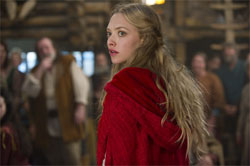
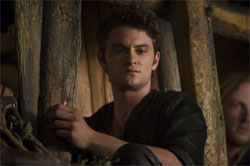
Amanda Seyfried (Mamma Mia!, Letters to Juliet) gets the Bella role as the titular red-caped heroine, here called Valerie. Shiloh Fernandez, whom Hardwicke almost cast as Edward in Twilight, plays Peter, the dark-haired bad boy who has the heroine’s heart but tries to break it off for her own good. Max Irons is Henry, the less-exciting rival whose love for the heroine is unrequited. Would you believe Billy Burke, Bella’s dad in the Twilight films, shows up as Valerie’s dad?
 RRH-03381
AMANDA SEYFRIED as Valerie in Warner Bros. Pictures' fantasy thriller "RED RIDING HOOD," a Warner Bros. Pictures release.
RRH-03381
AMANDA SEYFRIED as Valerie in Warner Bros. Pictures' fantasy thriller "RED RIDING HOOD," a Warner Bros. Pictures release.In spite of all the Twilightery, the movie shows just enough interest in its fairy-tale inspiration to make its failure frustrating. Though certainly not for children, the violence and sexuality resonate with the psychological roots of the source material. Screenwriter David Leslie Johnson (Orphan) makes some potentially interesting decisions, Julie Christie’s freespirited, hardly doddering grandmother being one of them. The filmmakers’ postmodern, semi-feminist take manages to acknowledge the contradictory aspects of the wolf archetype as menacing and evil, yet also sexualized.
A postmodern fairy tale is one thing; a fairy tale with a postmodern heroine is another. Red Riding Hood takes place in a stylized, pseudo-medieval forest village, yet Valerie is a sexually liberated heroine whose physical responsiveness to Peter is as unconflicted as any modern-day Bella’s might be. In a prologue voiceover Valerie confesses that Peter has always made her “want to break the rules,” yet she hardly seems aware of rules to be broken. Clinching after their first clandestine kiss, Peter puts some aggressively physical moves on Valerie, whispering, “I could eat you up!” Yet less than a minute later, with Valerie on her back in the hay and Peter astride her, he hesitates (Edward-like), prompting her to ask, “Don’t you want me?” Who’s devouring whom?
 RRH-03442
SHILOH FERNANDEZ as Peter in Warner Bros. Pictures' fantasy thriller "RED RIDING HOOD," a Warner Bros. Pictures release.
RRH-03442
SHILOH FERNANDEZ as Peter in Warner Bros. Pictures' fantasy thriller "RED RIDING HOOD," a Warner Bros. Pictures release.Valerie’s sexual readiness seems problematic on multiple levels. It makes no sense in the world in which she supposedly lives—a world of arranged marriages and repressive religious fervor where suspicion of witchcraft or adultery can easily lead to death. Embodying everything wrong with this world is the ruthless Father Solomon (Gary Oldman), an aristocratic, monster-hunting cleric whose prestige overawes Lukas Haas’s pathetic village priest (“One of only three silver swords blessed by the Holy See!” the latter chortles), though his Torquemadaesque methods include broiling suspects alive in an immense iron elephant.
Despite the movie’s evident Roman Catholic milieu, Father Solomon travels with two daughters, and refers openly to his late wife. Are there married Catholic priests in this world? Was Solomon perhaps a late vocation? Or is he simply that dissolute? I’m not sure the movie answers the question.
Valerie’s availability also undermines the potency of the beast motif. Peter may or may not be the big bad wolf, but if Valerie isn’t at least somewhat afraid of him—afraid of sex—then the whole premise of a fearsome predator trying to get the young virginal heroine alone in the forest loses a lot of its punch. To put it the other way around, given a heroine this available for a roll in the hay, how bad can the big bad wolf really be?
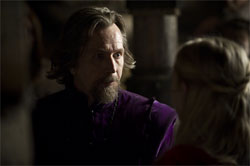 RRH-11465
GARY OLDMAN as Father Solomon in Warner Bros. Pictures' fantasy thriller "RED RIDING HOOD," a Warner Bros. Pictures release.
RRH-11465
GARY OLDMAN as Father Solomon in Warner Bros. Pictures' fantasy thriller "RED RIDING HOOD," a Warner Bros. Pictures release.Of course, this is the Twilight era of vampire dreamboats and unrequited werewolf puppy love. Who says the wolf has to be big and bad? He is, though. Lots of people are killed, and when the wolf’s secret is finally revealed, it makes better sense of various plot points than I suspected it would. (For the record, I didn’t see it coming, even though I made some effort to keep track of who was or wasn’t around when the wolf attacked.) It makes some sense of plot points, but it would have taken braver filmmaking to make it work thematically.
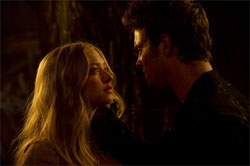 RRH-28432
(L-r) AMANDA SEYFRIED as Valerie and SHILOH FERNANDEZ as Peter in Warner Bros. Pictures fantasy thriller, RED RIDING HOOD, a Warner Bros. Pictures release.
RRH-28432
(L-r) AMANDA SEYFRIED as Valerie and SHILOH FERNANDEZ as Peter in Warner Bros. Pictures fantasy thriller, RED RIDING HOOD, a Warner Bros. Pictures release.In the climactic scene, the filmmakers write themselves into a corner. Having followed so closely in Twilight‘s footsteps, Red Riding Hood comes down to an inevitable choice between an obviously “correct” ending blatantly stolen from the Twilight saga, and a lame attempt not to rip off Twilight to the bitter end. I’m not saying I would have liked it either way, but for what it’s worth I think the filmmakers made the wrong choice.
Talk About It
Discussion starters- How did you hear the story of Little Red Riding Hood growing up? Did Grandmother escape the Wolf or was she eaten—and, if she was eaten, was she later rescued alive from the Wolf’s belly? Were Red Riding Hood and Grandmother rescued by a Huntsman, and if so did he kill the Wolf? Or was the Wolf killed by Red Riding Hood and Grandmother? Which is your favorite version of the story?
- Are traditional fairy tales too scary for children? Should they be sanitized—or might sanitizing them somehow be a mistake? Do children like scary stories? Why do grownups tell children scary stories?
- The overt message of the traditional fairy tale was a warning against talking to strangers. Does this version have one or more messages? If so, what? What do you think of the message(s)?
- Do you like any of the characters? Did your perceptions of any of the characters change during the film? How so?
- What other movies can you think of with priest characters? How do Father Solomon and Father August compare with other movie priests you can think of?
The Family Corner
For parents to considerRed Riding Hood is rated PG-13 for violence and creature terror, and some sensuality. The wolf, a dark CGI monster, attacks and kills several people, with minimal bloodiness; a severed hand is the worst of it. A character is also apparently killed while being tortured in a large Dutch oven-like device. There’s an abortive sex scene in which the characters are interrupted before much happens, but it’s clear where things were going. Another scene depicts a desperate girl offering herself sexually to a powerful man in exchange for a favor. There are also references to a character’s illegitimate origins from an adulterous liaison.
Photos © Warner Bros.
Copyright © 2011 Christianity Today. Click for reprint information.