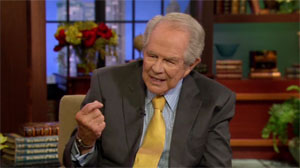
Pat Robertson advised a viewer of yesterday’s 700 Club to avoid putting a “guilt trip” on those who want to divorce a spouse with Alzheimer’s. During the show’s advice segment, a viewer asked Robertson how she should address a friend who was dating another woman “because his wife as he knows her is gone.” Robertson said he would not fault anyone for doing this. He then went further by saying it would be understandable to divorce a spouse with the disease.
“That is a terribly hard thing,” Robertson said. “I hate Alzheimer’s. It is one of the most awful things because here is a loved one—this is the woman or man that you have loved for 20, 30, 40 years. And suddenly that person is gone. They’re gone. They are gone. So, what he says basically is correct. But I know it sounds cruel, but if he’s going to do something he should divorce her and start all over again. But to make sure she has custodial care and somebody looking after her.”
Co-host Terry Meeuwsen asked Pat, “But isn’t that the vow that we take when we marry someone? That it’s For better or for worse. For richer or poorer?”
Robertson said that the viewer’s friend could obey this vow of “death till you part” because the disease was a “kind of death.” Robertson said he would understand if someone started another relationship out of a need for companionship.
Robertson gave the example of a friend who faithfully visited his wife every day even though she could not remember his visits to illustrate the difficulty of caring for someone with the disease.
“It’s really hurtful because they say crazy things,” Robertson said. “Nevertheless, it is a terribly difficult thing for somebody. I can’t fault him for wanting some kind of companionship. And if he says in a sense she is gone, he’s right. It’s like a walking death. Get some ethicist besides me to give you an answer because I recognize the dilemma and the last thing I’d do is condemn you for taking that kind of action.”
Robertson’s advice stands in stark contrast with most theologians and ethicists who would advise fidelity. The decision would not be easy.
Robertson McQuilkin faced a similar situation two decades ago. He decided to step down and end his 22 year tenure as president of Columbia Bible College and Seminary. Instead, he helped care full-time for his wife Muriel. She died in 2003 after suffering for 25 years with the disease. During the last decade, Muriel could not recognize her husband caregiver.
In a CT article written after his resignation from Columbia, McQuilkin explained his decision.
“When the time came, the decision was firm. It took no great calculation. It was a matter of integrity. Had I not promised, 42 years before, ‘in sickness and in health . . . till death do us part’?
This was no grim duty to which I stoically resigned, however. It was only fair. She had, after all, cared for me for almost four decades with marvelous devotion; now it was my turn. And such a partner she was! If I took care of her for 40 years, I would never be out of her debt,” McQuilkin wrote.
In an interview in 2004, McQuilkin said he made the right decision. “Some people sort of resent the imposition, but those thoughts never came to me,” McQuilkin said. “I thought it was a privilege to care for her. She had always cared for me. So it was not a burden. In fact, if it had been a burden, maybe there wouldn’t be so much grief now, that sense of loss.”
The video of the segment from the September 13 700 Club can be found around the 50:45 mark of yesterday’s show.
Update: See also today’s op-ed from Russell Moore, “Pat Robertson Repudiates the Gospel.”
Further reading:
“Living by Vows,” by Robertson McQuilkin, October 8, 1990
“Muriel’s Blessing” by Robertson McQuilkin, Feb. 5, 1996
“The Gradual Grief of Alzheimer’s” an interview with Robertson McQuilkin, Feb. 1, 2004