The ground beneath our feet can often seem to be the one constant in the human experience. We even use the term “grounded” to describe people who seem to be particularly stable. Yet, the Earth is in fact always changing as the result of a number of processes and influences. Geologists seek to study the Earth and its influencing factors to understand what brought it to be what it is at this time and predict what it will be in the future, work that holds immense importance for our ability to be good stewards of the planet and all its resources. Doug MacDougall, in Why Geology Matters: Decoding the Past, Anticipating the Future , argues that some background in the geosciences is important for all of us. In doing so, he illustrates that the study of geology is made up of many supporting players and employs techniques of analysis from several different fields, making it one of the most broadly interdisciplinary fields of study. MacDougall’s many references to physicists, chemists, and other scientists as critical to advancing geological knowledge is to be expected, given that the Earth has formed according to geological processes governed by the laws of physics and chemistry and have affected or been influenced by biological entities. The methodologies of geology glean much from the fields of physics, chemistry, and biology—so much so, in fact, that the players in this field are not just geologists, but are described as geophysicists, geochemists, and geobiologists.
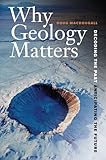
Why Geology Matters: Decoding the Past, Anticipating the Future
University of California Press
304 pages
It is clear that MacDougall delights in taking his readers through a sample of the widely ranging kinds of questions that geologists have addressed, usually in close conference with the other sciences. He does not just argue that we should know about geology; he makes good on that claim by walking the reader through several areas of geological study, including earthquakes, the geological historical record found in rocks, and volcanic activity. He uses examples of several questions that have been asked of the Earth, such as how the magnetic polarity stripes in the seafloor formed or what factors led to a steep decrease in biodiversity at the Ordovician-Silurian boundary, and describes what tools and information were used to answer them, at all times giving due credit to the influences of the other sciences.
One intriguing area of discussion is found in Chapter 3, entitled “Close Encounters.” Here MacDougall details how the study of meteorites that have fallen to the Earth from outer space support knowledge of how the Earth and the surrounding members of the solar system came to be. Astronomers lend insight into star and planet formation, suggesting possible theories to explain what we observe. Geologists give back, as studies of lunar rocks have given evidence that outer part of Moon had at one time been molten, early in its history. Thus, the fields work in tandem. MacDougall also weaves in the human side of these developments. For example, he notes that in the study of Barringer’s Crater in Arizona, a significant motivation was Daniel Barringer’s goal of mining the earth for entrepreneurial gain. He, along with Grove Karl Gilbert, chief geologist for the U.S. Geological survey, worked to unearth the ore contained in the depression to better understand how the crater came to be (and, in Barringer’s case, to make money). However, their theories were not accurate until the site’s beginnings were thought of in terms of the physics of impacts. Knowledge gleaned from physics also shows up in other important analysis tools used for radiometric dating of rocks in order to sort out the geological age of the Earth.
Required coursework in the geosciences would be a vehicle for students to be able to integrate the knowledge gained from individual courses in physics and chemistry, especially. But doing so may not be practical, nor can those past college age always go back to take a course. Reading Why Geology Matters would be a fine investment in learning more about the marvels of geology and how it is supported by the sciences at large.
Heather M. Whitney is assistant professor of physics at Wheaton College.
See also Why Geology Matters, Part 1, by Davis A. Young, and Part 2, by Kane Barker.