

News

Supreme Court’s Health-Care Ruling Could Weaken Charity Tax Breaks

Why some religious nonprofits’ worries aren’t about the contraception mandate.

Supreme Court's Health-Care Ruling Could Weaken Charity Tax Breaks

Supreme Court's Health-Care Ruling Could Weaken Charity Tax Breaks

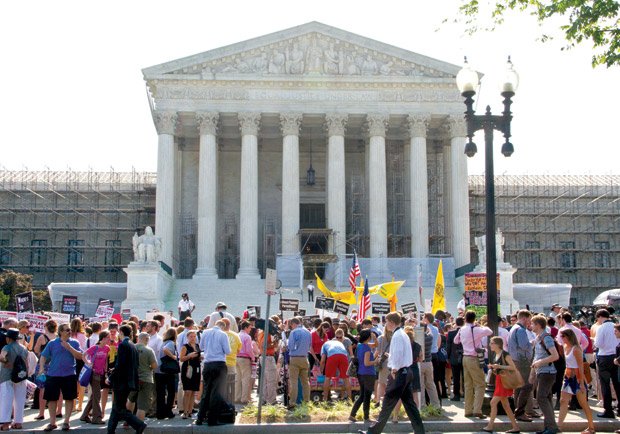
Photo by Stephan Boitano / Polaris / Newscom

The U.S. Supreme Court's ruling upholding the Affordable Care Act—or "Obamacare," as some have dubbed it—has advocates of faith-based nonprofits concerned about potential unintended "collateral damage" to their bottom lines.

The worry: Chief Justice John Roberts's nod to lawmakers' wide discretion to impose taxes—and to condition taxes to influence behavior—could pose threats both to charities' tax exemptions and to donors' tax deductions.

"It's an issue that's definitely on our radar," said Rhett Butler, government liaison for the Association of Gospel Rescue Missions.

W. Scott Brown, vice president of the Christian Leadership Alliance, echoed Butler: "We are following this issue closely."

Stanley Carlson-Thies, president of the Institutional Religious Freedom Alliance, said he'd be surprised if the health-care decision doesn't spark "new activism" on the tax front.

"There's no reason to say the sky is falling before it's falling," he said. "But if it's getting darker, we ought to pay attention."

In a recent piece for

The Chronicle of Philanthropy

, nonprofit experts Suzanne Garment and Leslie Lenkowsky maintained that Roberts's majority opinion "makes it clear that if lawmakers voted to impose restrictions on tax-deductibility or tax exemption, they would not face any constitutional obstacles."

In the decision, Roberts wrote that "taxes that seek to influence conduct are nothing new."

Some advocates fear that the ruling could embolden efforts to limit exemptions to only nonprofits that serve the poor and minorities, or to only those that provide services the government cannot.

Any reduction in deductions for charitable contributions would "negatively impact churches and many other exempt organizations that depend on such contributions to carry out their respective missions," said Dan Busby, president of the Evangelical Council for Financial Accountability.

Two forces contribute heavily to these concerns, advocates said:

• Lawmakers at all levels of government are seeking ways to increase revenues and balance budgets amid trying economic conditions. In May, New Hampshire's Supreme Court ruled that cities can tax churches on portions of their property deemed not to be used for religious purposes.

"On both sides of the [political] aisle, everything is on the table," said Butler.

• Certain activists are eager to place more conditions and rules on tax-exempt groups—efforts aimed variously at limiting what counts as charitable activity or fighting mission statements and hiring practices deemed discriminatory.

Given how readily many activists label as discrimination "many of the religiously rooted practices of faith-based organizations," Carlson-Thies said, the Supreme Court's ruling could be seen as a "flashing danger signal."

For rescue missions across the nation, recent years already have brought budget crunches, Butler said. The missions, most of which rely on private giving for half to three-quarters of their income, have trimmed overhead and operating costs.

"Any drops in private giving from donors would go straight to frontline services for the hungry and homeless, the abused and addicted," he said.

But he's preparing for a fight. "I think the Supreme Court decision could embolden some people who want to take control of the money that goes to charities," Butler said. "I think that's a very serious problem."

Correction: The print version of this article incorrectly named the state whose Supreme Court recently ruled on church property. It was New Hampshire, not New Jersey.


Also in this issue

The CT archives are a rich treasure of biblical wisdom and insight from our past. Some things we would say differently today, and some stances we've changed. But overall, we're amazed at how relevant so much of this content is. We trust that you'll find it a helpful resource.

Against the Stream

What Galileo's Telescope Can't See

James K. A. Smith

Review

A Jerusalem Lost

Robert Joustra

Getting to Know Him

Philip Harrold

Taste the Soup

News

Teaching the Dragon

Andrew Thompson

Excerpt

The Awakening of Hope

Jonathan Wilson-Hartgrove

Caught Between the Spouse and the Spirit

Deborah Swerdlow in Icapuí

A New Age of Miracles

Tim Stafford

News

Should Pastors Be Required to Sign a Code of Ethics?

Compiled by Allison J. Althoff

Review

Will America Keep the Faith?

Thomas Kidd

My Top 5 on Books on Motherhood

Jennifer Grant

None Like Him

Interview by Joe Carter

What's His Is Ours

Sarah Hinlicky Wilson

Deep Impact

Morgan Feddes

Wilson's Bookmarks

John Wilson

'God's Double Agent'

Interview by Tim Morgan

Asian American Religiosity

Editorial

The Evangelical Jesus Prayer

A Christianity Today Editorial

News

Church Graduations Ruled Unconstitutional, Pastor Accused of Diverting Funds to Wife, State Will Catalogue Secularized Icons, and More

Review

Review: Who Is Jesus?

Michael McGowan

News

Quotation Marks

News

Go Figure

Letters to the Editor

Review

Review: A Short History of Global Evangelism

Matt Reynolds

Review

Review: Community Is Messy

News

Nigeria's Deadly Deployments

Sunday Oguntola

News

Food Fights: Homeless Ministries Respond to Restrictions

Allison J. Althoff

Is There Anything Wrong With Voting for a Mormon for President?

Stephen Mansfield, Mollie Ziegler Hemingway, and Richard Mouw

News

Eastern Orthodox Lose Two Evangelical Bridges

Weston Gentry

Monitoring Controversy

The Second Coming Christ Controversy

Ted Olsen and Ken Smith

Review

Lost in Transition

Robert Ham

View issue

Our Latest

The Bulletin

Sunday Afternoon Reads: The Case for Kids

Leslie Leyland Fields reads her piece about being the mom of six kids amidst our country’s declining birth rate.

Come, Thou Long-Expected Spirit

W. David O. Taylor

The Holy Spirit is present throughout the Nativity story. So why is the third person of the Trinity often missing from our Christmas carols?

The Bulletin

Brown University Shooting and The Last Republican

Mike Cosper, Clarissa Moll

Violence at Brown, and former Rep. Adam Kinzinger talks about Jan 6, courage, and global affairs.

News

Amid Fear of Attacks, Many Nigerians Mute Christmas

Emmanuel Nwachukwu

One pastor has canceled celebrations and will only reveal the location of the Christmas service last-minute.

A Time of Moral Indignation

CT reports on civil rights, the “death of God” theology, and an escalating conflict in Vietnam.

A Heartwarming Book on Sin

Three books on theology to read this month.

Analysis

Bondi Beach Shooting Compels Christians to Stand with Jews

The Bulletin with Josh Stanton and Robert Stearns

Jewish-Christian friendships offer solace and solidarity after antisemitic violence.

Who Writes History When There Is No Winner?

Lebanon’s civil war is a taboo subject. A group of Christians and Muslims is broaching it.

Apple PodcastsDown ArrowDown ArrowDown Arrowarrow_left_altLeft ArrowLeft ArrowRight ArrowRight ArrowRight Arrowarrow_up_altUp ArrowUp ArrowAvailable at Amazoncaret-downCloseCloseEmailEmailExpandExpandExternalExternalFacebookfacebook-squareGiftGiftGooglegoogleGoogle KeephamburgerInstagraminstagram-squareLinkLinklinkedin-squareListenListenListenChristianity TodayCT Creative Studio Logologo_orgMegaphoneMenuMenupausePinterestPlayPlayPocketPodcastRSSRSSSaveSaveSaveSearchSearchsearchSpotifyStitcherTelegramTable of ContentsTable of Contentstwitter-squareWhatsAppXYouTubeYouTube





