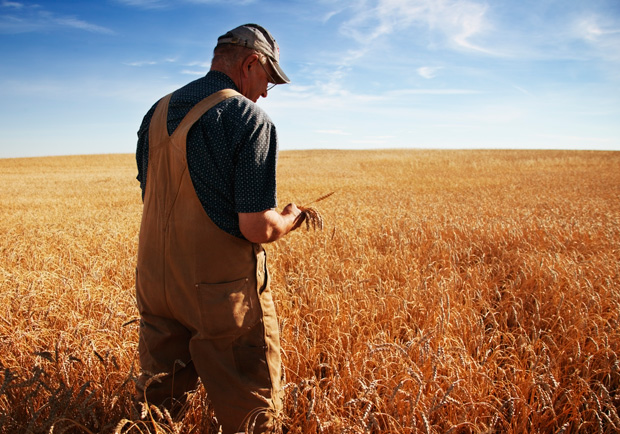
According to a popular Super Bowl commercial for Dodge Ram trucks, on the eighth day, God made a farmer. The commercial's still, muted photos and steady narration won over many viewers, with Mark Driscoll, Ed Stetzer, and Steve McCoy among the Christian leaders declaring it "best Super Bowl commercial of all time."
When I see an ad like this one, and I hear the powerful narration from Paul Harvey, that vision of life resonates with me, a lifelong Nebraskan. The people in that ad are my people. My great-grandfather Carl Fredstrom came to northeast Nebraska almost 120 years ago to farm alongside his wife Elise. Together they raised eight children on their small farm in Oakland, who in turn had large families of their own.
The scenes in "God Made a Farmer" stand in stark contrast to the skylines, highways, and cityscapes of other ads. Most of the dominant, culture-shaping institutions are exclusively urban and are often staffed by people who either left their small towns or have never lived in a small town to begin with. During this particular cultural moment, one of the temptations is for us to look down on small towns and the people that love them. It's rare to celebrate rural America during a time when the only stories we hear are from people who ran away screaming, and not those who stay and love their rural homes.
It's easy for us look with scorn at the hardworking farmers that have made up the bulk of this nation, considering them and their rural towns to be no more than backwards, repressive, and dying. Following the Super Bowl, the Awl whipped out a heaping helping of scorn, mocking the ad and the modern-day farmer himself. Other parodies followed, like "God Made a Factory Farmer." Wendell Berry was exactly right when he wrote 20 years ago, "Quit talking bad about women, homosexuals, and preferred social minorities, and you can say anything you want about people who haven't been to college, manual workers, country people, peasants, religious people, unmodern people, old people, and so on." Though few of us will go so far as President Obama did in his notorious "guns and religion" comments, some of us will be caught up in the same spirit in thinking about rural Americans and farmers.
As the evangelicals-in-the-city movement grows, the church in particular needs to be weary of the temptation to look down on small towns and farms. Though many "metro evangelicals" leaders (Tim Keller and Jared Wilson, most notably) have pushed back against an anti-rural mentality, there's always a risk in such an urban-centric movement for an anti-rural spirit to sneak in through. It's wonderful for us to see such high-quality storytelling that portrays rural life in such noble, beautiful terms. We need more of that, and if Christians can continue to be at the forefront—as we already have been through the writings of Wendell Berry and Marilynne Robinson—so much the better.
But the state of the American farm isn't as picture-perfect as the filtered photos of the "God Made a Farmer" ad portrayed. There is a romanticization that we need to be leery of. Many of the farming methods used by the men and women lionized in that commercial clip have contributed to the degradation of American land. Monoculture farming and large scale industrialized farming—the sort enabled by the combine that the ad lingers over in one shot—have been very hard on farmland and have put us in a place where, when combined with the effects of climate change, we in the Midwest are well-positioned for a sequel to the Dust Bowl, less than 100 years after our region was devastated by the first one. This indirectly hints at one of the greatest problems facing so much Americana storytelling: The tendency to romanticize American staples while ignoring their cost to the land and marginal communities. As the cliche goes, those who forget the past are doomed to repeat it. In the Midwest we're facing that prospect in the most literal way possible.
Overall, I'm grateful for ads like "God Made a Farmer," though I can't help feeling a twinge of doubt and regret about it as well. We shouldn't demean farmers and rural people, but we also shouldn't romanticize the very difficult reality of today's American farm. Farming, it seems, has always been difficult. While the narration nobly positioned the farmer in the creation story, a commentary in The American Conservative entitled "Would Cain Drive a Dodge?" compares this to the plight of Cain in Genesis. Samuel Goldman wrote:
… it does appear that the labor of farming is a punishment for Cain's crime. Here's how God describes the condition of the farmer: "When thou tillest the ground, it shall not henceforth yield unto thee her strength; a fugitive and a vagabond shalt thou be in the earth" (Genesis 4:12). That's hardly a ringing endorsement…. This misreading of Scripture didn't interfere with the ad's success. That's because, like other products designed to flatter our populist instincts, it has little to with the Biblical sources whose authority it claims. Rather, "God Made a Farmer" reflects the blend of American civil religion, Jeffersonian idealism, and corporate capitalism that has long defined America's public culture. The power of the ad suggests the formula still sells, even to consumers who regard themselves as too sophisticated for such a cloying brew.
Jake Meador blogs at Notes From a Small Place.