The dead know where you are, and they are hungry.
The runaway success of AMC's "The Walking Dead" highlights the recent potency of zombie stories. Once wholly a genre for horror/grind house cinema, zombie media has made the tough crossover from "pulp" to "pulpular." "Zombie walks," including thousands of participants shuffling in gore makeup, are a global trend, bringing flash mob energy to raise money for charities—usually to combat brain disease. Zombie games are routinely on top lists in app stores, and longer video games, including "Dead Space," bring the apocalypse into our living rooms. The list goes on, and gets an addition today with the zombie love story movie Warm Bodies.
For a theme with such diverse expression, the zombie genre's conventions are surprisingly rigid. Most stories follow a strict formula: The dead rise and eat, the living flee and fight, and the credits roll. Some tales end well for the living, more end poorly, but these essentials are present in all, marking the limits of a traditional zombie tale as inflexibly as any folk story.
For all the screams and splatter, these common story elements provide a backdrop for filmmakers to talk candidly about the human condition. The first three entries in seminal zombie director George A. Romero's "Dead" series are fine examples of this, using the cannibal corpses to skewer major cultural issues such as racism, consumerism, and abuse of human power.
For all the screams and splatter, these common story elements provide a backdrop for filmmakers to talk candidly about the human condition.
Romero's Dawn of the Dead is a classic example, featuring a small band of well-armed survivors safely hiding in an abandoned shopping mall. With abundant food, ammunition, and consumer goods, they are living the American dream as the outside world crumbles. But the dream turns into a nightmare as the hollow nature of consumerism saps their will to live, pits them against each other, and eventually leads to a tragic end. Such films can be poignant, and the ideas leave a deep impression long after the flesh-hungry revenants have faded from the screen.
The true villains in such stories are not the dead, but the broken living. Zombies serve as an elemental force in the plot, like a flood or a hurricane in disaster movies. The dead force the true conflict—humanity's inability to be truly human. One key scene in Romero's Day of the Dead flips the role of man and monster, showing Bub, an unusually intelligent zombie, weeping over the body of the scientist who had been studying him. His grief expressed in his sluggish manner, Bub then picks up a pistol and tracks down his friend's treacherous murderer. We're impressed with Romero's point as clearly as if he'd written it out for us in blood: A heartbeat alone isn't what makes us human.
The concern with gnawing, existential questions is common in a zombie film. We're invited to ask how we'd respond if we were forced to choose between our safety and the good of our neighbor. Would we risk our own necks to save a friend? What about a stranger? What about a traitor? We're afraid of ourselves here, afraid of our friends, afraid of so many things, least of which are the sea of decaying corpses lapping at the walls of whatever fortress we've found to hide in.
In zombie films, we also see our cultural hopes. We sense that even in the total collapse of human society, we can hope for not only survival, but for community, for beauty, for something more than the Western dreams of brainless consumption and the cannibal exploitation of our neighbors. We long to find a sense of belonging, of basic human dignity.
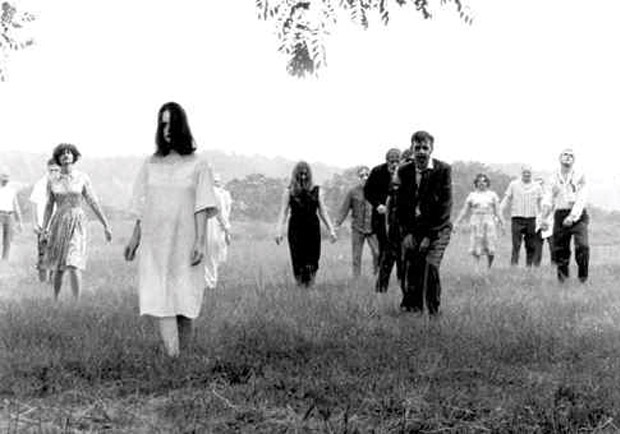
In Night of the Living Dead, Ben, the central character, is committed to cooperation and trust, even among total strangers. As those around him succumb to denial, cowardice, stupidity, and guilt, he works to rally and inspire, to protect his companions and try to get to safety. In a dark film, Ben represents active hope. As we watch, we long for a satisfying level of self-sufficiency, for friends that we could trust our life with, for a sense of clear purpose, however bleak that might be. At its best moments, the zombie apocalypse offers that to us.
Christians, of course, can find many familiar images here. With a little allegorical stretching, we can talk about the church as a community of the risen dead, of zombie cannibalism as a perverted Eucharist, of the church's perilous existence as a community out of place in the world as analogous to the band of survivors in a good zombie flick. But we don't need to dig very far at all to find deep meaning in the zombie myths of our culture. Really, the films are about us, about all of us, in this time and place in history, and about our hopes and fears. And those truths, while hard to swallow, give us a whole lot to chew on.
Paul Pastor is assistant editor for Church Law & Tax Group and Global Publishing at Christianity Today.