News

Why Christian Groups Oppose America’s Anti-Prostitution Stance

As the Supreme Court prepares to weigh in, faith-based organizations say ‘no’ to loyalty oaths.

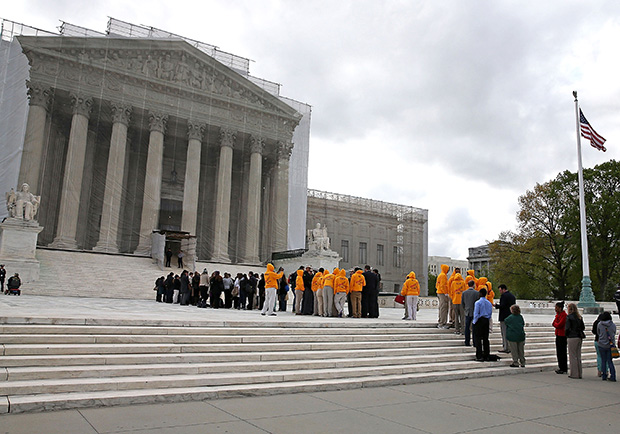
Mark Wilson / Getty

Women who visit crisis pregnancy clinics want options. But they usually don't want to talk about abortion or the morning-after pill—and Heartbeat International intends to keep it that way.

That's why the pro-life group, which represents more than 1,300 pregnancy help centers, is urging the United States Supreme Court to overturn a federal pledge against prostitution. The Becket Fund for Religious Liberty and the Christian Legal Society are doing the same.

Their position may seem counter-intuitive, since all three organizations oppose prostitution. But the case boils down to whether or not the government can require groups to adopt its views before it gives them funds.

At issue: a Bush-era program to fight HIV/AIDS that requires grant winners to "explicitly [oppose] prostitution and sex trafficking."

Evangelical interest in the case is largely unrelated to prostitution per se, said Stanley Carlson-Thies, president of the Institutional Religious Freedom Alliance. "A government policy that can require private groups to commit to its ideological orthodoxy will increasingly margin- alize faith-based services."

Some fear that the antiprostitution policy could inspire the government to attach loyalty oaths to other federal benefits. It could require an organization like Heartbeat to tell clients about abortion, or a religious nonprofit to affirm the government's views on gay marriage or contraception, to retain tax-exempt status. Many believe such oaths violate the First Amendment and its promise of freedom of speech.

Walter Weber, senior litigation counsel with the American Center for Law and Justice (ACLJ), counters that the right to freedom of association outweighs the right to free speech in this particular case. He says the government is not showing unconstitutional bias, but using bias the way any employer would: to see if potential partners will be a good fit.

But even the ACLJ believes the government's power to attach conditions to funds should be limited to groups who apply for funds on their own, said Weber. "We don't want [courts] to say the government can do whatever it wants."

He said the situation would be different if faith-based groups were being forced to agree with the government in order to receive widely available public benefits. Similarly, the ACLJ would not support loyalty oaths that were unrelated to the purpose of a program. One hypothetical example is requiring churches to support the Affordable Care Act before receiving federal tax breaks.

Discriminating against faith-based groups in that way would be "impermissible," Weber said. He hopes the Supreme Court's ruling will draw a line between the two types of discrimination—the helpful kind and the coercive kind.

Yet Ellen Foell, legal counsel for Heartbeat International, says she wants the antiprostitution policy struck down. Although the policy does not affect pregnancy centers directly, she said, "The U.S. Constitution does not allow the government to determine … what [groups] shall say, and how it should be said."

Also in this issue

The CT archives are a rich treasure of biblical wisdom and insight from our past. Some things we would say differently today, and some stances we've changed. But overall, we're amazed at how relevant so much of this content is. We trust that you'll find it a helpful resource.

Cover Story

Want to Change the World? Sponsor a Child

Bruce Wydick

Cover Story

A Better World For Kids

Timothy C. Morgan

Cover Story

Sponsoring a Movement

Ken Walker

You Probably Won't Be Sent to Egypt…

Editorial

Planting Deep Roots

Is Interfaith Marriage Always Wrong, Given that the Bible Teaches Us Not to Be 'Unequally Yoked'?

Mark Regnerus, Naomi Schaefer Riley, Russell Moore

A Fractured and Beautiful Faith

Patrick Stafford

Review

You Only Die Once

Brett McCracken

Finding the Right Words for God's Word

Interview by Lindsay Olesberg

My Top 5 Books on Evangelism

Paul Louis Metzger

The Whole Gospel in One Word

Craig Bubeck

News

Marriage Help Comes to Capitols

Sarah Eekhoff Zylstra

A Flood of Arks

The Fitness-Driven Church

The Baptist Bearing Robes and Incense

William E. Yoder in Moscow

Review

Sidelining the Stigma of Mental Illness

Michael Mangis

Excerpt

It's the Thoughts That Count

Steve Turner

The Secret to Why Sponsorship Works

News

Can a Christian Family Ever Be Too Big?

Compiled by Ruth Moon

Love the Lord with All Your Voice

Steven R. Guthrie

Our Francis, Too

Testimony

The Golden Fish

Eric Metaxas

News

After Turning Theological, Christian Hip-Hop Turns Critical

Owen Strachan

A Terrifying Grace

News

Go Figure: June 2013

News

Quotation Marks: June 2013

News

Gleanings: June 2013

News

The Forgotten Millennials

Catherine Newhouse

New & Noteworthy Books

Matt Reynolds

Wilson's Bookmarks

John Wilson

Letters to the Editor

View issue

Our Latest

News

Influential Chinese House Church Faces New Crackdown

Joy Ren

Leaders of Early Rain Covenant Church had prepared for the roundup, which saw 9 leaders and staff detained.

We Are Risking the Legacy of the Civil Rights Generation

All is not lost. But Christians must regain our distinctiveness and reclaim our moral clarity.

The Bulletin

Iranians Speak Up, Jerome Powell Stands Strong, and Grok Under Scrutiny

Mike Cosper, Clarissa Moll, Russell Moore

Iranians’ courage amidst deadly protests, the Federal Reserve’s independence in question, and explicit images in Elon Musk’s AI.

Through a Storm of Violence

In 1968, CT grappled with the Vietnam War and the assassinations of Martin Luther King Jr. and Robert F. Kennedy.

Authority Is Good. But Whose Authority?

Three books on theology to read this month.

News

The Christian Curriculum Teaching Civil Rights to a New Generation

We Have Not Read MLK Enough

Americans have strong opinions about the civil rights leader but often simplistic notions of who he was.

News

Texas Law Aims to Stop Abortion Drugs at the State Line

Neighbors can now sue each other over mail-order drugs. Pro-life advocates are divided on the tactic.

Apple PodcastsDown ArrowDown ArrowDown Arrowarrow_left_altLeft ArrowLeft ArrowRight ArrowRight ArrowRight Arrowarrow_up_altUp ArrowUp ArrowAvailable at Amazoncaret-downCloseCloseEmailEmailExpandExpandExternalExternalFacebookfacebook-squareGiftGiftGooglegoogleGoogle KeephamburgerInstagraminstagram-squareLinkLinklinkedin-squareListenListenListenChristianity TodayCT Creative Studio Logologo_orgMegaphoneMenuMenupausePinterestPlayPlayPocketPodcastRSSRSSSaveSaveSaveSearchSearchsearchSpotifyStitcherTelegramTable of ContentsTable of Contentstwitter-squareWhatsAppXYouTubeYouTube