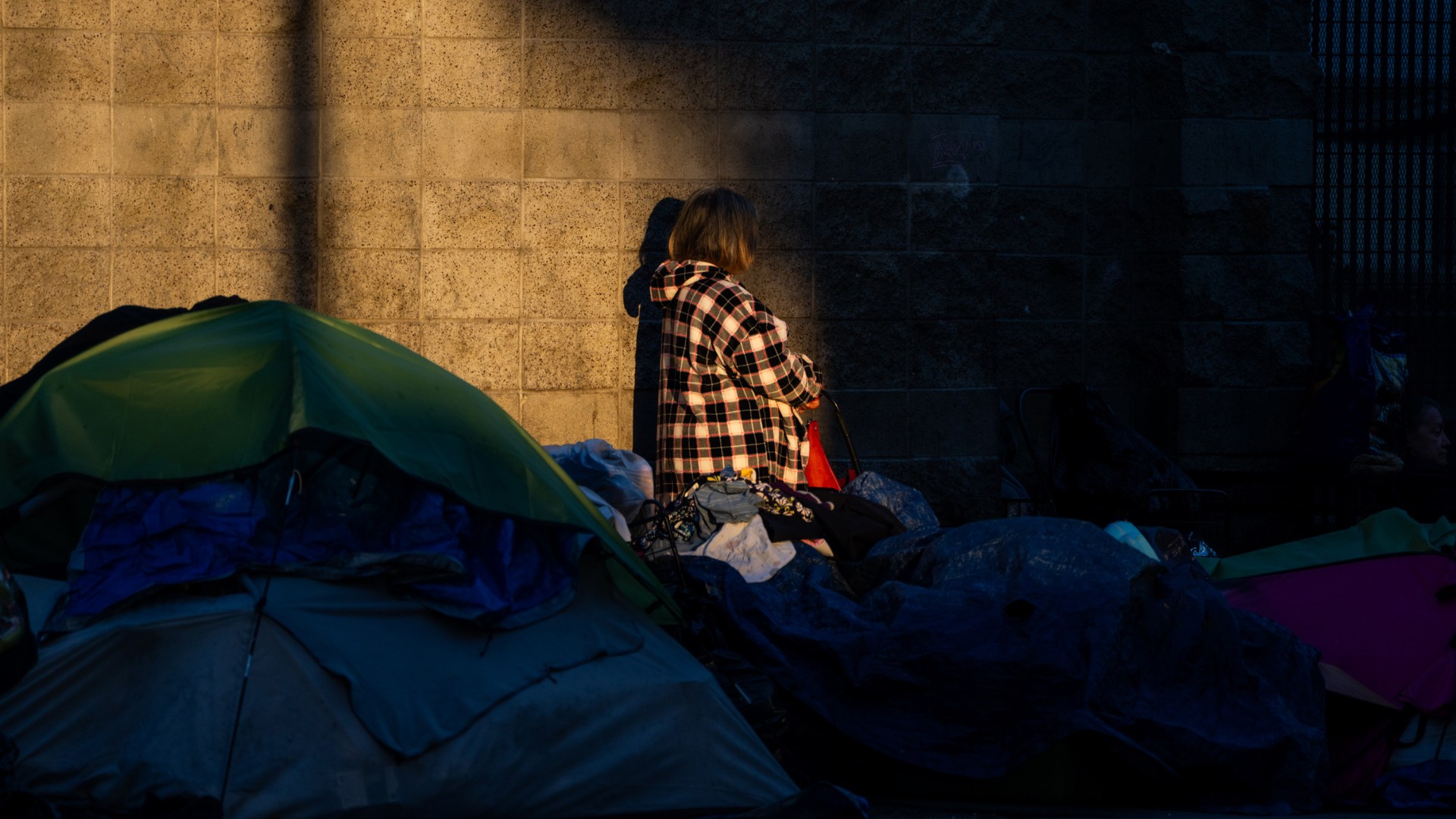
California Governor Gavin Newsom regularly repeats his mantra: “Shelter solves sleep; housing solves homelessness.” Hmm. From 2022 to 2025, I wrote weekly columns about homelessness and gained insight by living for three weeks in shelters. Based on that I can say: In general, it is not true that housing solves homelessness.
Maybe it solves homelessness for people who are not addicts, alcoholics, mentally ill, or victims of abusive childhoods, but most homeless people are in one or more of those four categories. Maybe housing solves homelessness if the rest of us don’t like to see homeless people: Get them out of sight and they can be out of mind.
Invisibility benefits those who have homes. Unseen homeless folks don’t ask us for money, so we are free from giving what often goes to buy drugs or alcohol, or from not giving and feeling heartless. But for those who are out of theirminds for various reasons, housing does not solve homelessness.
Augustine 1,600 years ago famously said regarding God, “Our hearts are restless until they rest in you.” The earthbound equivalent is “Our bodies are restless until they reside in a home.” For many, though, walls and a roof alone do not make a home.
Instead, hiding away addicts or alcoholics inside an apartment leaves many apart from everything except a needle or a bottle. Hiding away the severely mentally ill leaves them apart from everything except walking nightmares. People who are desperately ill need to be together with someone who can offer compassionate help.
That’s one reason a chart used at the Orange County Rescue Mission (OCRM) in Tustin, California, impressed me. It’s one of the places I lived at for a few days in January to gain some street-level understanding of these issues. Instead of using one marker to assess progress in coming out of homelessness—a signed apartment lease, say—OCRM evaluates a more holistic list of ten, including: “spiritual … sobriety/substance abuse (if applicable) … mental health … shelter/housing … social/family relationships … income and employment … physical health, food, and nutrition.” (This quotation and those that follow are from the OCRM “Outcome Assessments,” and I’ve seen that actions back up those words.)
OCRM calls its residents “students” and helps them move from freshman to senior status during what is often a two-year stay until graduation. To move from one class to another, students need to make progress in the various areas, going from “stuck” to “accepting help” to “believing” to “learning” to “thriving.”
The “believing” is most clearly applicable to spiritual formation. Some homeless people might avoid discussions about faith and Christianity or aggressively dismiss opportunities to participate or learn more. However, when they enter OCRM, they need to be “willing to attend Bible studies/church events and engage in discussions about Christianity.” The big change comes with attending church, involvement in church community, and—in God’s mercy—coming to faith.
For those contending with sobriety/substance abuse, “stuck” means a life of alcohol, drugs, and unwillingness to discuss that or get support. That often accompanies a belief that change won’t happen and a tendency to miss appointments. A move to “accepting help” begins with the realization that “I’m fed up with the negative impact of alcohol or drugs.”
“Believing” comes with understanding that change is essential and the willingness to access support to maintain sobriety, set goals, and keep appointments. To graduate, participants need to understand what triggers them to drink or take drugs and to find new ways to cope with the causes. They thrive when faith, family, friends, and support groups, plus their own strategies, help them maintain sobriety. The compassionate help that begins at OCRM radiates out in these community connections to support the still vulnerable, yet newly focused, graduates.
A typical pre-OCRM social or family life is often described like this: “I am always alone or with people who exploit me, and I will not discuss this.” Through ongoing relational care at OCRM, students begin to articulate a shift. “I want to find more positive relationships. … I am talking to one or more people I can trust. … I’m recognizing that my relationships revolved around alcohol, drugs, or negative behavior.” Then comes “I need support to maintain/build positive contacts but am learning,” and “I feel connected and supported. … If I am in contact with my family, the relationship is healthy.” New, trusting relationships developed in the shelter give students confidence to try new skills and take wise relational risks as they rebuild social and family connections outside the shelter’s walls.
Crucially, OCRM’s ten steps out of homelessness are not vague wishes but measurable outcomes. Regarding “income and employment,” a first step is often starting work on a GED or high school diploma, as necessary, and starting a volunteer work assignment. Then comes more learning and training, completing a job readiness workshop, gaining a diploma, developing a personal budget, meeting with a financial accountability partner, and starting and continuing full-time employment.
On legal matters, pre-entrants often combine missed court appearances with denial of responsibility. Eventually they learn “how to avoid high-risk people situations. I’m learning my triggers and how to manage my behavior. … I have no outstanding issues with the police or courts.” Each step equips a student with the skills necessary to succeed long-term when housing becomes a viable option.
Regarding “physical health, food and nutrition,” the movement being fostered is from bad health and risky behavior to action for improvement, including taking daily prescribed medications, seeking nutritious food, and visiting doctors and dentists as needed.
Students receive evaluations at months 3, 9, 13, and 19. It’s hard: Most who enter head back to the streets during those first 3 months, but 7 out of 10 who stick around past that go all the way to graduation. According to OCRM, in 2025, 100 percent of graduates secured full-time employment and housing, and since 2018, 85 percent of alumni have maintained sobriety and employment. One-fourth of entrants do not have a high school diploma, but graduates have one or the GED equivalent. The hardest thing is that OCRM works for some but not for others.
The work of organizations like OCRM reveals the oversimplification embedded in Newsom’s mantra. For most, the journey from homeless to homed is a long and winding one that only reaches its end with the compassionate help of many trained supporters. Solving homelessness requires far more than available housing units and a way to cover the monthly rent. OCRM’s practical program readies homeless men and women for not a temporary tent but a permanent home on earth and perhaps in heaven.