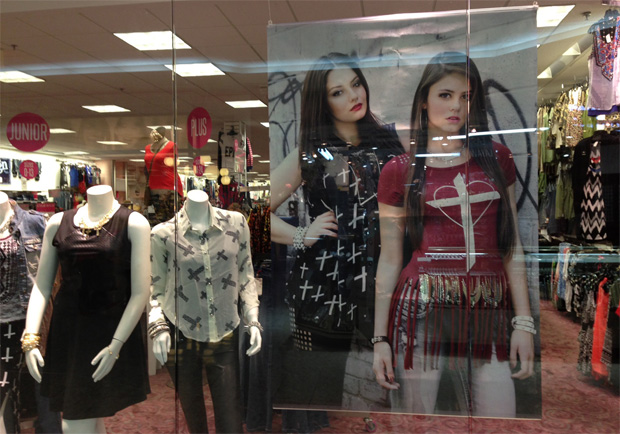
Justin Bieber, Lady Gaga, and Pope Francis share very little wardrobe-wise, apart from one very significant, very trendy item: the cross.
The cross has been frequently recycled as a fashion element since becoming a staple of the rock glam and punk looks of the '80s. Over the past few decades, the Christian symbol has shown up on countless celebrities and in the collections of respected designers like Versace and Dolce and Gabbana—often with little apparent regard for the symbol's religious import.
Despite any frustration I may feel as a Christian over the commodification of the cross, I find fashion's tendency to pull from religious imagery unsurprising and even inevitable. Like most creatives, fashion designers draw inspiration from wherever they can find it, and the church's rich history of symbolism and aesthetic excellence make it a prime source. Plus, most nominal Christians or unbelievers wearing the cross often do so without ill intent—adopting the symbols into their style for aesthetic or even sentimental reasons.
Recently, the cross's place in fashion has shifted. Influential Internet style stars wear Christian imagery with attitude. Their stylistic use of the cross transcends indifference, landing squarely in the territory of irony or even mockery. Juxtaposing a cross-emblazoned cardigan with a "Cute as F#%K" T-shirt or wearing a cross ring while flipping off the camera, for example, results in plenty of Internet hype from fashion-lovers on sites like Tumblr, Lookbook.nu, and We Heart It.
Creative and cutting-edge, fashion bloggers love to break the rules and subvert convention. Blatant disrespect for the cross, which used to mostly reside in small subcultures like the goth music scene, increasingly appears in their style mashups. Since these online trendsetters wield real influence in an industry that turns to street style for inspiration, even mainstream retailers have begun to follow their leads.
As a result, Christian imagery has begun showing up on the clothing of well-established fashion retailers like Topshop. And it's not just crosses anymore, either. Religious imagery has proliferated in every stratum of the fashion hierarchy. Nordstrom carries a pair of leggings adorned with stained-glass iconography. The religious paintings of Hieronymus Bosch inspired a recent designer collection by Carven. (And if Carven's dress depicting the Garden of Eden isn't edgy enough for you, what about leggings showing off Creation or a swimsuit with hell imagery?)
Why did fashion's street style elites start using Christian symbols with such aggression? Las Vegas-based fashion blogger Bebe Zeva told me in an e-mail, "Teenagers and young adults prided themselves in the cross because it seemed disrespectful to take it out of context. Disrespecting religion and God has been an extremely chic idea for most of the digital age… Irony is at the core of most trends post-1980."
Zeva, age 20, started wearing the cross in 2010 because she viewed it as "a symbol of allegiance to a 'cool' hedonistic subculture, not of allegiance to the Christian religion." In posts documenting her outfits, Zeva shows off a cross sweater studded with spikes and pairs a chain full of dangling crosses with a rocker-skeleton tee.
While the average shopper at Forever 21 may not view that cross-print blouse as a sign of "cool hedonism," the influential attitudes of Zeva and her peers nonetheless present a troubling question for Christian shoppers: How do we respond to this commodification of our faith's most central symbol?
We start by considering how we wear, display, and treat Christian imagery ourselves. The fact that I spend my Sundays in church doesn't necessarily mean I'm wearing the cross any less flippantly than a nonbeliever who does so because it's trendy. If the proper use of images was serious enough to spark the Byzantine iconoclastic controversy, isn't it also important enough to make me consider the appropriateness of leggings that stretch the Madonna's face over my rear?
We might also need to examine the other symbols tucked into our own closets and wardrobes. Bebe Zeva pointed out that "the same companies that appropriated Native American motifs… are now appropriating Christian icons."
Urban Outfitters was sued last year by the Navajo Nation for marketing products like the "Navajo Hipster Panty." American Indian Sasha Houston Brown wrote to Urban Outfitters' CEO, "There is nothing honorable or historically appreciative in selling [such] items," adding that they "make a mockery of our identity and unique cultures." If Christians want to see our own symbols treated with respect, we must consider the difference between cultural appreciation and appropriation in our own styles.
Ultimately, Christians should enjoy and appreciate our freedom to wear the cross, even if it means sharing that freedom with unbelievers. Recent legal battles have been fought in the UK by employees denied the right to wear the cross in their workplaces. These lawsuits should serve as a reminder that the liberty to visibly express one's belief is indeed a privilege—and one that has been denied to countless Christians throughout the ages.
The appreciation of this fact, combined with the awareness that the "coolness" of disrespectful fashion will likely fade as quickly as most trends do, ought to make any believer think twice before tucking their crucifix away.
As author Marie von Ebner-Eschenbach noted, "So soon as a fashion is universal, it is out of date." Let's give thanks that the fickle status of the cross as a fashion icon will never change the relevance of the incredible act of redemption that took place on that cross 2,000 years ago.
Whitney Bauck is a freelance writer and photographer who blogs regularly about the intersection of fashion and faith at Unwrinkling.com. She currently studies photography in the Chicago area, but still considers Manila, Philippines her hometown.