During a talk I gave this fall on the psalms, I confessed: I am, in fact, just like King David. Though I acknowledged that many major details of our lives (gender, epoch, occupation, sling-shot skills, number of spouses, and current sex partners, for instance) are as different as different can be, the more of David's psalms I read, the more I realize much of our internal lives are same-same.
We're both walking contradictions.
I ran through the paradoxes that define both me and King David: We're both at times scared and yet overly confident, desperate and thankful, strong but humbled, misfit yet uniquely called, total messes and totally beloved by God. I scanned the room hoping to connect with understanding, nodding heads. While there were a few gazes that met mine and few heads that bobbed in agreement, I met more confused faces, noticed several sideways What is that woman talking about? glances than I'd like.
Apparently, being a walking contraction, a living paradox is not normal. If I'm just like David, then according to the looks I got that day, I'm odd like David. Fair enough.
While being Contradiction Personified may be odd among the general population, it is not so among creative folks. In "Why Creative People Sometimes Make No Sense," Matthew Schuler cites nine examples of the "contradictory traits" often present in creative people, as apparently offered by Mihaly Csikszentmihalyi in his book, Creativity.
A few of Csikszentmihalyi's assertions are that creative people are "smart and naïve" at the same time; combine "playfulness and productivity;" "alternate fluently between imagination and fantasy and a rooted sense of reality; are both "rebellious and conservative;" and are passionate and yet objective about our work.
While his conclusions indicate that indeed creative people make no sense (like, the story of the atheist photographer who takes pictures of churches and holy places…), for me, this list makes perfect sense. It confirms something I've long suspected and that is: those of us who find comfort in contractions, who are at ease with our own internal devil's advocates, have a leg of up on this faith of ours, this faith that is nothing short of paradoxical and nonsensical.
In a recent article about the popularity of Leonard Cohen's song "Hallelujah," Ashley Fetters writes:
Cohen has always been ambiguous about what his "Hallelujah," with its sexual scenery and its religious symbolism, truly "meant."
"This world is full of conflicts and full of things that cannot be reconciled," Cohen has said. "But there are moments when we can … reconcile and embrace the whole mess, and that's what I mean by 'Hallelujah.'"
Indeed. Most of us tend reject ideas that don't fit neatly into boxes and cringe at paradox, but those moments of paradox-reconciliation are more abundant for creatives. They're certainly blessings for those who recognize Jesus as the Great Reconciler, yet embrace a faith and live in a world so often irreconcilable. At least, to our limited understanding.
After all, we believe the Bible—written by fallible human hands and translated by fallible human minds, published by fallible, profitable human companies, to be the infallible Word of God. We believe in a God of the Universe who yet spoke to Hagar, a terrified slave girl, and allowed himself to be named by her. We believe that same God of the universe continues to speak—through his Word, through his Creation, through his booms and whispers. This makes no sense.
We believe in a God who came down from heaven (wherever that is), in human form. Fully human, fully divine. This makes no sense. We believe God the Father sent Jesus the Son via the Holy Spirit—all the same!—to be born in a backwater town. To a virgin. This makes no sense.
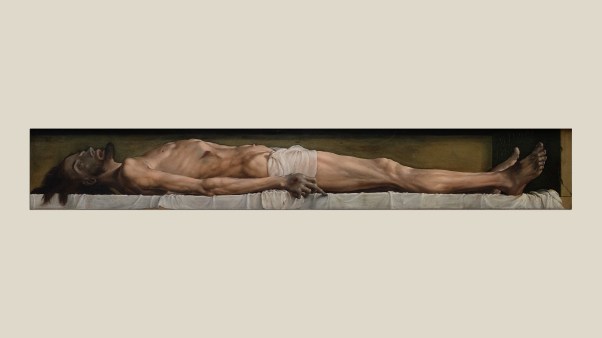
We worship a Baby whose birth was heralded by angels, but whose only visitors were lowly shepherds. That is, until the astrologers arrived. This is crazy talk. We believe this boy Jesus would grow to be "Christus Paradox," as the hymn says: both "lamb and shepherd," "pilgrim and guide," and, my favorite, "the everlasting instant."
We believe this Jesus would grow to preach loving our enemies (who?!), to turn the other cheek, to render unto unpopular governments. Jesus would say the poor and persecuted were blessed (huh?) and that rich folks have a hard time getting right with God (what?!).
Ultimately, we believe that Jesus—Son of, and yet somehow Same As, our Eternal God, was crucified, died, and rose again. People, this makes no sense.
And yet I believe.
To be a Christian—whether a "creative" one or not—is to embrace these (and the many others) paradoxes of this faith, of our lives; it is to live with the often disconcerting, to hope in the midst of doubt, to find peace in paradox.
And this is why I maintain I'm just like David. Because he saw these things too, whether finding God with him in the darkest valleys or praising God from in his miry pit.
In fact, of Csikszentmihalyi's confusing characteristics of creative people, the one I love best says, creative people's "openness and sensitivity exposes [us] to a large amount of suffering and pain, but joy and life in the midst of that suffering."
And though this makes no sense this side of heaven, this is what the Christian life is about. It's what our Christus Paradox offers us in this world. It's our hope and gift.