
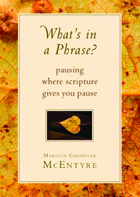
Marilyn Chandler McEntyre's many books show a concern for fostering careful habits of reading and writing among Christians. In her new title, What's in a Phrase? Pausing Where Scripture Gives You Pause (Eerdmans), McEntyre, professor of English at Westmont College, offers brief meditations on biblical phrases that, for one reason or another, have stopped her short and occasioned further reflection. Laura Turner, a Her.meneutics contributor, spoke with McEntyre about the value of dwelling on passages of Scripture that grab our attention.
How should we react when a Scripture passage gives us pause?
For me, it is rooted in lectio divina, the practice that Benedict taught his monks in the fifth century. It's slow reading of very short passages of Scripture, listening for the word or phrase that addresses you. You're listening for something that invites the Spirit to open doors of association, memory, and feeling.
Say you encounter a phrase like "is my shepherd." On the second reading you might ask, "What is this about? Where I am being summoned? Why did this touch me in some way?" Then you could give those thoughts some silence. On the third reading, you can open up further and ask what the invitation might be, and how this might be giving you specific direction.
You talk about memories that arise while pondering a phrase in Scripture. Is there power in reexamining them?
Allowing a phrase to work as a trigger can create little moments of summoning. Those moments say, "Just walk through this door and see what comes up."
We all have a repository of memories that we can unearth and put to new purposes as life continues. Flannery O'Connor said that if you've lived through eighth grade, you have got enough writing material to last a lifetime. Our memories provide a personal foundation, and as a poet friend of mine put it, the past keeps changing. Or, as William Faulkner said, "The past isn't dead. It isn't even past."
Can certain phrases offer a kind of sustenance we can return to time and again?
Jesus uses the image of scattering seed. I think about what happens to seed, how even some of the seed that fell on rocky ground may have been washed by the rain into the ground. Storytelling, like Jesus' parables or accounts of Israel's history, offers a way of gathering seed for later use.
Stories are not mere propositions. They invite ongoing interpretation. So much of the gospel is story material that you can keep revisiting and opening up in new ways. Instead of providing the closure of a rulebook, it invites you into a process and into a way, and you need to keep coming back and looking again. To ask, "What is this saying now? How am I being spoken to?"
What broader philosophy of reading should we bring to Scripture?
I hope to contribute to the long conversation about what it means that Scripture is the living Word and, by extension, a living tradition. I'm troubled when people take possession of Scripture and read it with hardcore theological agendas. This tends to ignore Scripture's subtlety, its malleability, and the way it summons you into encounter, which is how Jesus was. He met people at very different moments in their lives, with different needs.
Scripture invites us to imagine. When it comes to the story of the rich young ruler, who went away sorrowing because he couldn't sell all his possessions, you get the feeling that this isn't the end of the story. It's the same way with the Prodigal Son: there's more to the story than meets the eye, and the passage allows us to imagine our way into it.
This kind of reading is not necessarily about being faithful to the plot line of a particular story. It's about being faithful to the way the Spirit works, which is that you drop your nets and follow its leading. In so many of the Gospel stories, Jesus allows himself to be interrupted, like by the diseased woman who touches the hem of his garment. He's on his way to the house of a synagogue leader, and she touches him, and he just stops and says, "Who touched me?"
I take that as a model for reading Scripture—to read until you find you've been touched, and say, "Who touched me? What was that about? Let me stop here, and not feel compelled to go on."