In this series




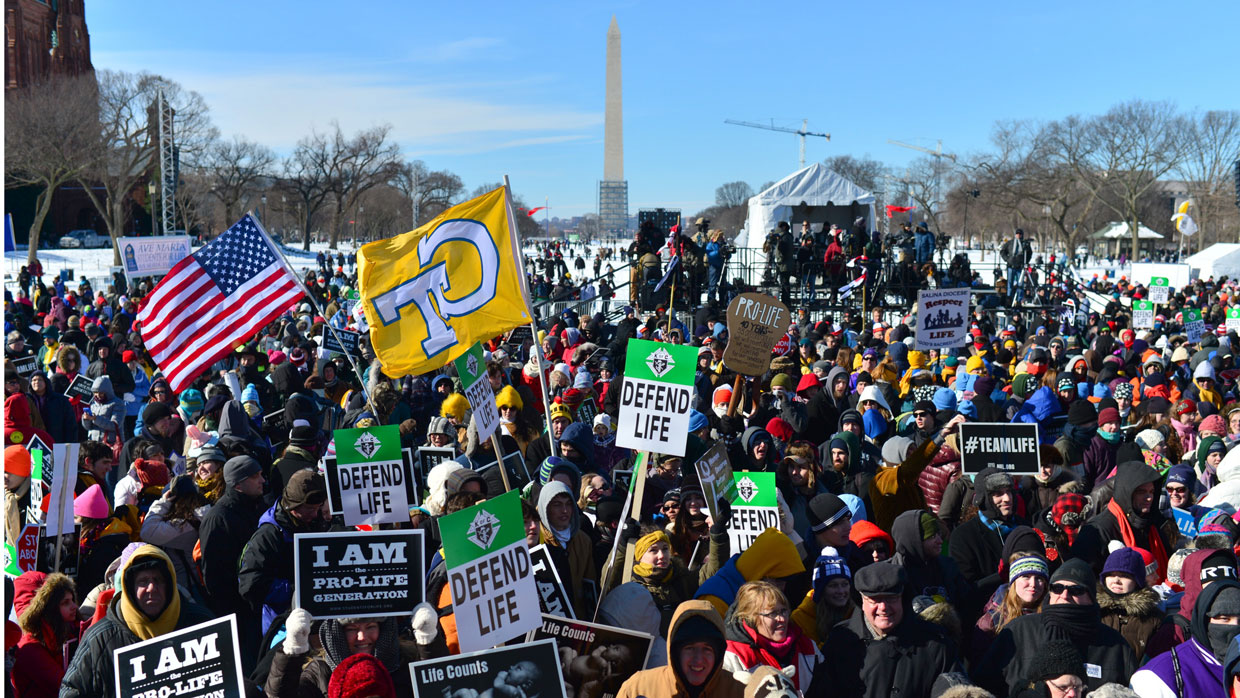
Pro-life advocates ended 2014 with much to cheer about. America’s abortion rate fell to the lowest level since Roe v. Wade. More than 70 abortion clinics closed. And states passed more limitations on abortion (230+) in the last four years than the entire preceding decade combined.
The majority of those laws were passed shortly after a tidal wave of pro-life politician victories in the 2010 mid-term elections. Given a similar wave in November’s mid-terms, with the GOP now controlling two-thirds of state legislatures and 31 governors' offices, 2015 appears just as promising to pro-life groups.
However, abortion laws in some states may now be as restricted as possible. In November, the Fifth Circuit Court of Appeals in New Orleans ruled a Mississippi law was unconstitutional because it effectively closed the last clinic in the state. The ruling raises new questions about the limits of regulating abortion at the state level.
At issue: Requiring abortion clinic doctors to have admitting privileges at hospitals. The Fifth Circuit had previously found constitutional a virtually identical Texas law, which closed nearly half of Texas’s abortion clinics.
But in Mississippi, such a requirement would close the state’s only abortion clinic, requiring women to cross state lines to obtain an abortion. So a different three-judge panel, in a 2-1 split decision, declared Mississippi’s law unconstitutional.
Citing a 1938 segregation case (Gaines v. Canada), the court applied new logic to abortion restrictions, determining that crossing state lines for abortions creates an undue burden, making the law unconstitutional.
“Mississippi may not shift its obligation to respect the established constitutional rights of its citizens to another state,” wrote Judge E. Grady Jolly in the decision. “Such a proposal would not only place an undue burden on the exercise of the constitutional right, but would also disregard a state’s obligation under the principle of federalism—applicable to all fifty states—to accept the burden of the non-delegable duty of protecting the established federal constitutional rights of its own citizens.”
Mississippi attacked the district court’s conclusion by pointing out that there is no reason that traveling a given distance is made more burdensome by simply crossing a state line during the trip. Crossing a state line, it argues, does not increase the time or money required for a trip of a given length.
The court tried to narrow the scope of the ruling by denying that it is establishing any per se rule, writing, "The majority professes to leave open the possibility that some law, such as the 'hypothetical sanitation regulation' discussed in the State’s briefing, could cause the closure of all abortion providers within a state and yet still be constitutional."
The ruling has been cited to strike down abortion regulations in Alabama and Louisiana.
Currently, four states and the District of Columbia lead the way in "abortion tourism," performing about 1 in 4 abortions on out-of-state residents (DC: 52.4%; Kansas: 49.8%; North Dakota: 31.2%; Tennessee: 24.5%: Delaware: 23.8%). Mississippi’s northern neighbor, Tennessee, is among those leaders. The national average is 8.1%.
Earlier this month, the Fifth Circuit began to hear arguments on the Texas law.
More than half the country—26 states—have 6 or fewer abortion clinics. Six states have only one clinic: Arkansas, Mississippi, Missouri, North Dakota, South Dakota, and Wyoming. While clinics are not the only providers of abortions, they’re the largest share: 2 in 3 abortions are performed in abortion clinics.
It puts the pro-life movement at a crossroads: Should pro-lifers be content with chipping away at Roe v. Wade on the state level until the abortion clinic count is one per state? Or should they redirect their focus to changes at the federal level?
Analysts from both sides point to the midterm elections in 2010 as the turning point for the pro-life movement. Republicans controlled the legislature and governor’s seat in 21 states; it was 9 before.
“We weren't going to go on a kamikaze mission,” Charmaine Yoest, president of Americans United for Life, said. “You know when you're not going to win on the federal level. State activity offers another avenue.”
The 2014 elections fell short of 2010 numbers for Republicans, but was still a strong wave of seats gained. Republicans took control of 24 states, holding the governor’s seat as well as both chambers. Democrats now only control six states.
More than 70 percent of the pro-life candidates running in last year's midterms were elected at the state and federal level, according to the National Right to Life Committee. On the first day of the new Congress earlier this month, House Republicans reintroduced legislation that would federally ban abortion after 20 weeks of pregnancy. (A vote originally scheduled for today has been postponed.)
The US Supreme Court is another potential avenue for federal change. Legal experts predict the court will eventually weigh in on the Texas restrictions that reduced the number of abortion clinics in the state from 41 in 2013 to just 8. The Supreme Court later stepped in with an unsigned order that allowed 13 clinics to reopen while the case went back to the Fifth Circuit for additional proceedings.
Another avenue for the Supreme Court would be ultrasound "show-and-tell" laws where the Fourth Circuit Court of Appeals created a direct split with the Fifth and Eight Circuit courts by ruling that the law required heightened scrutiny and created unconstitutional compelled speech.
The significant progress in regulating abortions at the state level has prompted changes from pro-choice organizations. A recent New York Times article described a shift away from the term “pro-choice” as a way to rebrand and resonate with a new generation.
Along with rebranding, Planned Parenthood is “going on the offensive” at the federal level with The Women's Health Protection Act. (Senate hearings can be seen here.) Described by some as the “Pro-Abortion Agenda on Steroids,” the bill would “invalidate nearly all of the [state] pro-life legislation enacted,” says Mary Harned, staff counsel with Americans United for Life.
Only 26 abortion provisions in 15 states were enacted in 2014. And Planned Parenthood reported 327,653 abortions in fiscal year 2014, up almost 500 from the previous year.
Yesterday, the National Right to Life Committee released its second report on the state of abortion in America.
Related:
CT regularly reports on abortion regulations and progress in the pro-life movement, including the strategy that's dividing the pro-life movement, a recent Supreme Court buffer zone decision, the Texas abortion bans that brought Wendy Davis to prominence, and how US abortions have fallen to the lowest rate since Roe v. Wade.