





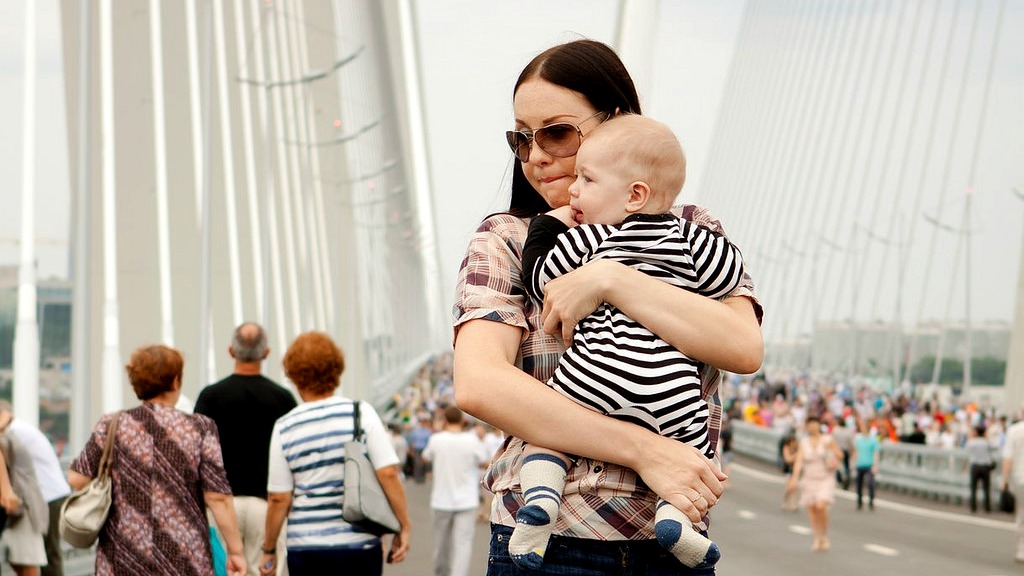
A few months after our son was born, the three of us were taking a walk when my husband confessed to me something about our journey into parenthood, “I wasn’t prepared for how fearful you’ve become.”
I don’t consider myself an anxious person. My friends say I’m “laid-back,” and I like that. But, with a wobbly and whimpering newborn in my arms, I found myself going down the well-worn path that most, if not all, women take: imagining worst-case scenarios, getting worked up about future unknowns, losing sleep over things I couldn’t control. I was ambushed by fear.
Concerns for our children are among many fears that waylay women. In her book Fear and Faith: Finding the Peace Your Heart Craves, Trillia Newbell also explores our fear of other women, fear of tragedy, fear of not measuring up, and fear of sexual intimacy, among others. The list is not short.
Why are we as women so susceptible to fear? Some of the answer lies in the way women are wired. By a combination of nature and nurture, women grow more attuned to the needs of others. New moms, for example, describe a physical reaction to their babies’ cries. Their heart rate goes up, their breath quickens, sometimes their milk lets down. Somewhere deep inside us, women’s bodies (and brains) sense our children’s needs. We are also often the ones in the church who bring casseroles to the sick, check up on the elderly, and sew mittens for the homeless—our sense of hospitality often motivated by worry for the people around us.
Of course, men also live in a world where they care for loved ones and face situations beyond their control. But women respond to fear differently than men, physiologically and sociologically prompted to emote openly. One study of men in mixed martial arts showed that men aren’t necessarily less fearful than women, but tend to channel that fear into bravado, whereas women “tend-and-befriend,” gathering together to share our feelings and worry. (As we recently discussed on Her.meneutics, our emotions and fears can get dismissed as irrational and even pathological, and women need new ways to understand our emotions not just as an affliction, but as a God-given ability.)
Social imbalances of power between men and women may also account for women’s propensity to fear. Historically, women were dependent on their fathers, brothers, and husbands for provision and protection. Men acted. Women followed. In many contexts today, women still come against institutions and social structures that contribute to their sense of helplessness. One blogger observed that fear is a position we adopt when there is nothing else for us to do. It makes us feel that we are at least doing something.
Thankfully, society is changing in a way that allows women more freedom, but these changes have also fueled our fears. Are we enough for our kids, our husbands, our work, our church? Are we too much? Did we miss some memo that all the other women received? In Fear and Faith, Newbell suggests that all our frenzied activity in trying to be superwomen is driven by the familiar fear of not measuring up.
Similarly, one couple in Jennifer Senior’s book All Joy and No Fun epitomizes the difference between men and women in the face of heightened societal expectations. Angie and Clint are working parents with two young boys. Both put in grueling hours at home with the kids and at their respective jobs, but Angie also carries around a sense of guilt and self-reproach, believing that she “is not doing enough, can never do enough, and that she should be doing everything all the time.” Even when she catches a break, Angie worries that she should be engaging the kids. Clint, on the other hand, is perfectly fine taking “me time” and does not compare himself to any sort of unattainable ideal. “I am the standard,” he says.
Men still have their own fears and insecurities. Women’s fears, though, seem to have compounded in this age when societal expectations for women are unclear, shifting, and often ridiculous. A friend told me that the hardest thing about mothering wasn’t sleep deprivation, but always second-guessing everything she does. The same could probably be said for many other roles women take on in their careers, churches, and communities.
Newbell’s words to women who fear not measuring up are solid: “The sweet cure for our failure fear is the gospel, which reminds of our limitations and weakness and our need for a Savior.” When we start to fear others passing judgment on us, she urges, “Forget about yourself,” and remember your wise, sovereign, good, and loving God.
Perhaps, though, we also need to remember ourselves – our true selves hidden in Christ. To live as a genuine and faithful woman today requires going back to that still and silent part of us where eternity dwells. Where other voices fade and we hear God’s voice calling us “Beloved” with a love that casts out all fear.
It also requires community. We need other women with whom we can be honest about our fears and struggles. Confession, Newbell writes, releases us from the stranglehold of fear to grow in fear of the Lord. In community, we also experience the freedom of being truly seen and heard. I loved reading the first-person stories in Fear and Faith of women who struggled with all kinds of fear issues and some who had their worst fears come true. I am not alone. Though I am prone to fear, I walk with women who know my struggles, toward a God who leads us out of fear and into trust.







