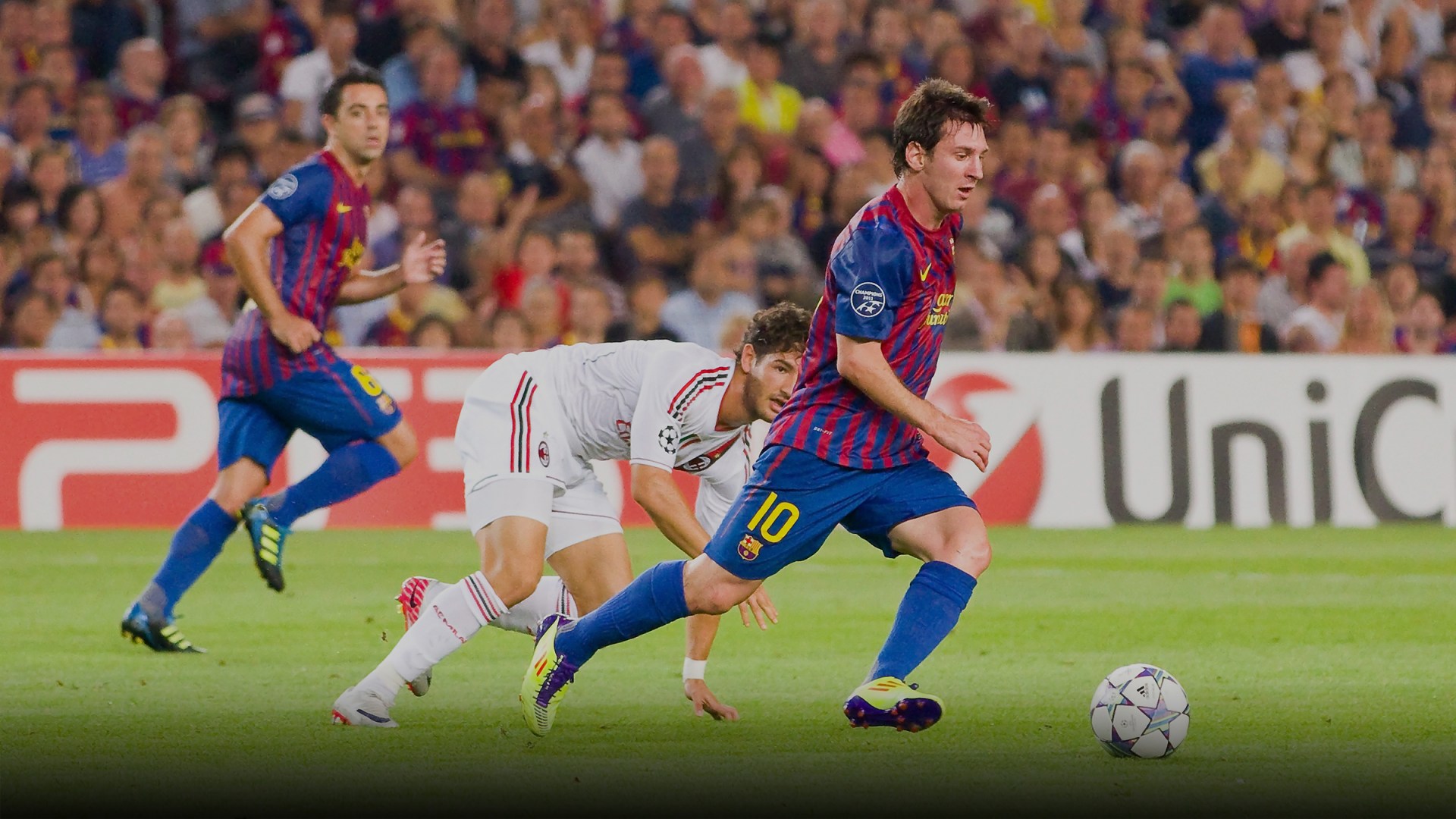

British soccer announcer Ray Hudson once called him a “riot in our hearts.” Most soccer fans think of him as the greatest player of his generation and quite possibly the greatest of all time. Opposing defenders try not to think of him. His name is Lionel Messi, and on May 6 he set the world alight with a goal scored in the semifinals of the Champions League against the European giants Bayern Munich.
Here’s what happened: Messi got the ball as he was at a full sprint, running toward the opposition goal. It’s not unusual, of course, for a forward player in soccer to get the ball in this position. It’s not unusual for a forward to score from this position. It’s unusual for one to seem to run in two directions at once.
Charging toward Jerome Boateng, one of the world’s best defenders, Messi initially feinted to the inside. He pushed the ball ever so slightly toward the center of the field, prompting Boateng to shift his body in that direction as he ran. It’s a simple move, really, but it was done with such speed that no one quite knew what was happening.
Then, once Boateng was off balance, Messi pushed the ball back outside. He ran past Boateng as if he wasn't there. And in a moment, Boateng’s body seemed to seize up. It was as if his eyes couldn't relay to his brain what he was seeing, and his brain was thus unable to tell his body what to do. And so he fell to the ground as if Benny Hinn had just slapped him across the forehead.
Twitter’s denizens had a wonderful time with Boateng, immediately posting memes of him falling into a hole, collapsing into bed, and being knocked out by a professional wrestler. But while the Internet laughed, Messi kept running. He pushed forward, charging at goalkeeper Manuel Neuer, who is by some margin the best goalie in the world. And as Neuer closed on him, Messi took one look up and flicked his foot through the ball, delicately lofting the ball over Neuer and into the net.
As I watched the goal happening, I was slowly drawn closer to the screen, as mystified by what I was seeing as Boateng and Neuer were. Then the net rippled and Messi wheeled away in triumph. I leaned back, laughed, and closed my eyes. I was still rhapsodic, seemingly passed out with a vague smile playing across my face, when my wife found me minutes later.
Sports can do that for us. Getting to see an athlete do something that wouldn't even register as possible in the mind of a normal person can flatten us in a way similar to the effect of seeing a natural beauty at one of our nation's parks. This is, perhaps, why two of documentarian Ken Burns’s best-known works have focused on the parks and baseball.
What’s particularly marvelous about sport is how it can elevate ordinary things into something miraculous. One of the difficulties in talking about awe and wonder in the United States in 2015, at least for me, is that less and less seems to exist completely outside our understanding of the world. When we look at something we don’t understand, we assume this is simply because we haven’t got the right tools, language, or resources. Everything is within our grasp, everything can be quantified or labeled, provided we have the right equipment. This, of course, causes everything we encounter to exist in what Canadian philosopher Charles Taylor calls an “imminent frame.” The wonders of the cosmos are near to us in a way that, according to Taylor, they were not for pre-modern man. It may not be true that every answer to our questions is a Wikipedia search away, but it feels like it is.
We have learned a great deal about the workings of the physical universe and, perhaps just as important, we have over time acquired the linguistic tools needed to talk about it intelligibly. What was once only discernible to the naked eye as a far-off point of light in the ether about which we made up stories now exists in our minds as a defined entity whose distance and size can be measured. In many cases we can even learn its temperature and stage in its “life." In one sense, that’s a great gift to us. It opens up possibilities about how we can relate to and, when necessary, manipulate creation to achieve some desired end.
And yet in another sense this ability has had a stultifying effect on how we view the world. Armed with only empirical observation and what we can see in controlled environments, we have often shown a regrettable tendency to empty the cosmos of its life. What was once the heavens, the realm of the gods, is now “space.” The earth itself has become, in C. S. Lewis’s phrase, “the silent planet.” Or, to borrow from Lewis’s friend Tolkien, we might say that while the rest of the sons of heaven sing for joy, we struggle to find the tune as we fumble with our instruments and calculations. Or, worse still, perhaps we (like Tolkien’s great villain Morgoth) introduce our own music, interrupting the chorus that God’s other children would sing.
It’s fitting, then, that one of the chief means through which we are amazed today is not what was once incomprehensible but now appears within our reach, but instead the elevation of things that have never been outside humanity's reach. If we have lost some of our capacity to be amazed by stars, perhaps we might regain that same capacity with the ordinary means of our body and a ball.
Jake Meador is an editor at Fare Forward and Mere Orthodoxy and the creator of The Inside Channel, a daily soccer newsletter.