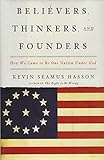
When Americans pledge allegiance to “one nation, under God,” non-Christians often see an unwelcome imposition of Christian faith. For Kevin Seamus Hasson, founder of the Becket Fund for Religious Liberty, it’s a mistake to view “under God” as a divisive theological statement. In Believers, Thinkers, and Founders: How We Became One Nation Under God (Image), Hasson suggests an alternative reading of the pledge based on the concept of the “Philosophers’ God.” CT associate editor Matt Reynolds spoke with Hasson about how this God can serve to unite a religiously diverse people.
How is the Philosophers’ God distinct from the God of Abraham, Isaac, and Jacob?
The Philosophers’ God and the biblical God are not different beings. The distinction is between faith and reason. Ever since Aristotle, philosophers have held that there is a limited amount we can know about God through reason alone—that he exists, that he is one, that he is good, that he is just. By contrast, the God of Abraham, Isaac, and Jacob reveals himself in a much fuller way.
What’s at stake in affirming that America is “under” this Philosophers’ God?
When government acknowledges that it is “under God,” it acknowledges that it is not the source of our rights and therefore cannot deny them to us. Our rights come from a source higher than and prior to the government—from the Creator himself. A government that declares this is humbler and safer than one that imagines itself to be the source of all our freedoms.
To edit “under God” out of the Pledge of Allegiance, or the Creator from the Declaration of Independence, would change far more than the wording of two famous utterances. It would shift our entire understanding of where our rights come from.
What difference has belief in the Philosophers’ God made in American history?
Strictly speaking, no one believes in the Philosophers’ God. There is no church of the Philosophers’ God. No ministers, no hymnals, and thankfully, no collection plates. Nevertheless, since the founding, a great many leading Americans have been prepared to agree that God exists, even as they disagreed profoundly on who he is.
The Founders are a great example. Some were Christians, some were deists, and some were in-between. But Christians and deists formed a coalition of theists who could agree that we are “endowed by our Creator with certain inalienable rights,” and that literally changed the world. Similar alliances of theists opposed slavery and fought for civil rights.
Why not say that the “God” invoked in the pledge really is the biblical God (while leaving atheists and other dissenters free to disagree)?
It all depends on who’s saying it. The important thing is not that individuals affirm a Creator as the source of our rights. It’s that the government does this. Now, we don’t want the government telling us who God is. These are, after all, the same people who brought us the IRS and the DMV. What are the odds they are going to get theology right?
The solution to this conundrum is the distinction between faith and reason. The government can’t and won’t tell us who God is; that is in the domain of faith. But the government can and most certainly should affirm what is in the domain of reason—that there is a good and just God who endows the people with rights that the government must respect.
What if, at some point in our future, the vast majority of American citizens and government officials no longer believe in any sort of God? Could our belief in a higher authority than government endure under such circumstances, even if “under God” were still included in the Pledge of Allegiance and in other official capacities?
The short answer is: maybe. But I hope we never have to find out.
I once asked a friend from Eastern Europe whether it was true that 90 percent of his country’s citizens were atheists. He replied, “Yes, and no. They may not think there’s a God, but that doesn’t make them atheists. I prefer to call them Something-ists. While they don’t think God exists, they’re convinced that ‘Something is out there.’ ” Something-ism might suffice to ground our rights in an environment where the overwhelming majority of people are unconvinced of God’s existence. But again, I hope we never have to find out.