This Halloween, millions of Americans will carve pumpkins, dress up in costumes, decorate their yards, and gobble down the candy they get while trick-or-treating.
America’s preachers also hope they’ll consider coming to church, according to a new phone survey of 1,000 Protestant senior pastors from LifeWay Research.
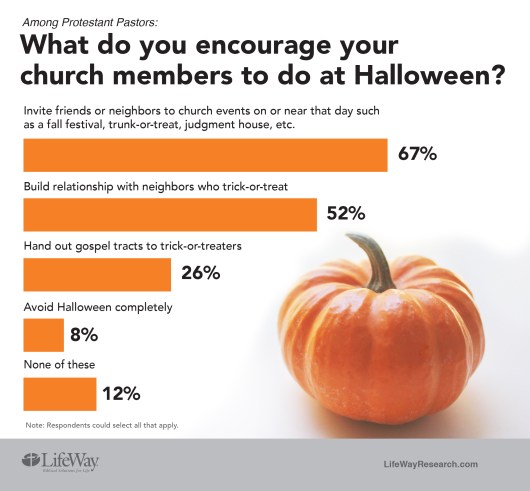
While a minority (not quite 1 in 10) of Protestant pastors tell church members to skip Halloween altogether, two-thirds say they encourage church members to ask their neighbors to a church-related event like a fall fair or trunk-or-treat.
Half tell their church members to befriend those who trick-or-treat at their doors.
Most pastors see Halloween as an opportunity to reach out, says Scott McConnell, executive director of LifeWay Research.
“This is a time when your neighbors literally come to your doorstep,” he says. “Pastors don’t want their church members to waste that chance to make a connection or invite someone to church.”
Halloween has become a major social and retail event in American culture. Seven out of 10 Americans (69%) plan to celebrate Halloween this year, according to the National Retail Federation. The average American consumer will spend about $83 on candy, decorations, and other goodies. That’s up from $74 in 2015.
Most pastors want church members to take part in the season’s activities as well.
Two-thirds (67%) encourage church members to invite friends and neighbors to a fall festival, trunk-or-treat, or judgment house. Pastors at bigger churches (those with 250 or more in attendance) are most likely to ask church members to invite their neighbors (86%) to an event at the church. Those from small churches (50 or fewer in attendance) are least likely (48%).
Holiness (82%), Baptist (77%), Pentecostal (75%) and Methodist (73%) pastors are more likely to ask their members to invite friends to an event. Lutheran (56%) and Presbyterian/Reformed pastors (55%) are less likely.
About a quarter of pastors encourage church members to hand out gospel tracts at Halloween. [Editor’s note: The most prolific creator of tracts, Jack Chick, died on Sunday.]
But pastors are twice as likely to encourage members to befriend neighbors who trick-or-treat (52%) than to tell members to hand out gospel tracts (26%). Pastors at larger churches (63%) are more likely to want their members to build relationships with trick-or-treaters than those at smaller churches (42%).
Mainline pastors (15%) are less likely to ask church members to hand out tracts than evangelical pastors (32%). Baptist pastors (47%) are most likely to want church members to hand out gospel tracts.
Few pastors (8%) want church members to skip Halloween completely. Older pastors (those 65 and over) are more skeptical of Halloween (13%) than pastors under 45 (4%). African American pastors (23%) are most likely to want church members to avoid Halloween. White pastors (7%) are least likely.
A 2015 LifeWay study found about 6 in 10 Americans say Halloween “is all in good fun.” But about a third say they either skip Halloween altogether (21%) or avoid its pagan elements (14%).
Self-identified evangelicals are mostly likely to either skip Halloween (28%) or skip its pagan elements (23%).
The more people go to church, the more skeptical they are of Halloween. Less than half (44%) of those who attend religious services at least once a week say Halloween is all in good fun. Most Americans who only go to church on religious holidays say Halloween is all in good fun (82%.)
Most Christians tend to embrace the fun side of Halloween—dressing up in costumes, handing out candy, or carving pumpkins—while avoiding its darker elements. So it’s not surprising some churches have turned it into a chance to invite people to church, McConnell says.
“With so many people celebrating Halloween, this one day has more interaction among neighbors across America than any other day,” says McConnell. “People actually want to see each other at their doors. So it’s only natural that pastors encourage their congregations to invest in these relationships.”
Methodology: The phone survey of Protestant pastors was conducted August 22 to September 16, 2016. The calling list was a stratified random sample, drawn from a list of all Protestant churches. Quotas were used for church size. Each interview was conducted with the senior pastor, minister, or priest of the church called. Responses were weighted by region to more accurately reflect the population. The completed sample is 1,000 surveys. The sample provides 95 percent confidence that the sampling error does not exceed plus or minus 3.2 percent. Margins of error are higher in sub-groups.