The American Medical Association has described physician-assisted suicide as a serious risk to society and “fundamentally incompatible with a physician’s role as healer.”
Millions of Americans disagree.
Two-thirds say it is morally acceptable for terminally ill patients to ask their doctors for help in ending their lives, according to a new survey from Nashville-based LifeWay Research. A similar number says doctors should be able to help terminally ill patients die.
Scott McConnell, executive director of LifeWay Research, says Americans want more say over how they die. That’s especially true if facing a painful, terminal illness, he says.
“If they are facing a slow, painful death, Americans want options,” he says. “Many believe that asking for help in dying is a moral option. They don’t believe that suffering until they die of natural causes is the only way out.”

Widespread support
Physician-assisted suicide first became legal in the US in 1997 under Oregon’s “Death with Dignity” law. Since then, 991 patients in Oregon have ended their lives using medications prescribed by a doctor under the law, according to that state’s reports.
Today six states allow physician-assisted suicide. The latest is Colorado, where voters approved Proposition 106, which allows a terminally ill patient to request a fatal dose of sleeping medication, by a two-to-one margin in November. Washington, California, Vermont, and Montana also allow physician-assisted suicide. The city council in the District of Columbia recently approved a measure allowing the practice—a decision that must be reviewed by Congress.
In LifeWay Research’s survey, 67 percent of Americans agree with the statement, “When a person is facing a painful terminal disease, it is morally acceptable to ask for a physician’s aid in taking his or her own life.” Thirty-three percent disagree.
Where there are differences among demographic groups, most still agree. For example, Americans age 18 to 24 (77 percent) and those 35 to 44 (63 percent) and 55 to 64 (64 percent) agree. So do white Americans (71 percent) and Hispanic Americans (69 percent). Those with some college education (71 percent) or with graduate degrees (73 percent) and those with high school diplomas or less (61 percent) also agree.
Among faith groups, more than half of all Christians (59 percent), Catholics (70 percent), Protestants (53 percent), Nones (84 percent) and those of other religions (70 percent) agree. Most of those who attend religious services less than once a month (76 percent) also agree.
A few demographic groups are skeptical. Fewer than half of those with evangelical beliefs (38 percent), African-Americans (47 percent) or those who attend religious services at least once a month (49 percent) say physician-assisted suicide is morally acceptable.
“Traditional Christian teaching says God holds the keys to life and death,” says McConnell. “Those who go to church or hold more traditional beliefs are less likely to see assisted suicide as morally acceptable. Still, a surprising number do.”
Few want restrictions on doctors
Researchers also found widespread support for removing restrictions on physician-assisted suicide.
Many Americans (69 percent) say physicians should be allowed to assist terminally ill patients in ending their lives. Thirty-one percent disagree.
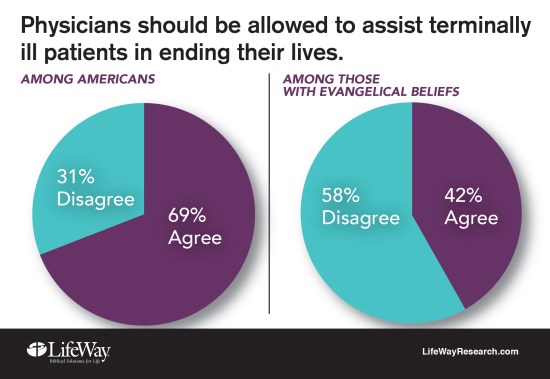
Those in the Northeast (73 percent), Catholics (70 percent), white Americans (73 percent), those with graduate degrees (77 percent), Nones (88 percent) and those who skip religious services (78 percent) are among those most likely to agree.
More than half of Southerners (64 percent), African-Americans (53 percent), Protestants (53 percent), those with a high school diploma or less (64 percent) and those who attend services at least once a month (52 percent) also agree.
Again, those with evangelical beliefs (42 percent) do not.
LifeWay Research’s findings echo those of other studies. A 2015 Gallup survey found 68 percent of Americans said physician-assisted suicide should be legal, up from 53 percent in 2013. Gallup also found that support for legalized physician-assisted suicide has wavered over the past 20 years. It previously peaked at 68 percent in 2001 before declining to 53 percent.
The debate over physician-assisted suicide is unlikely to go away, says McConnell, and it raises troublesome questions.
“Such requests are asking doctors to betray one of their most sacred oaths—which admits, ‘It may also be within my power to take a life,’ but concludes, ‘I must not play at God,’” says McConnell. “To ask physicians to turn from their task of healing is not a decision to make lightly.”
Bob Smietana is senior writer for
Facts & Trends
magazine