





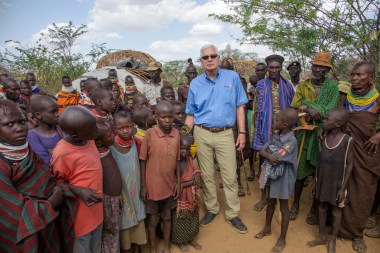
“Many people come here and take pictures,” the elder told me as he leaned on his walking stick, his slender frame swathed in heavy cloth despite the heat. “Then they go away and never help.”
This is the moment that haunts me from my recent visit to Turkana, a region in northwestern Kenya crippled by drought and sliding inexorably into widespread hunger.
I’d stepped out of a small plane into a sweltering landscape of dry riverbeds and desiccated animal bones jutting out of the earth—a place so quiet without traffic and technology that a child’s plaintive wail seemed to carry for miles. A month later, as I recall this sobering scene, the elder’s words play over it like a soundtrack, telegraphing doubt that my visit would mean anything more than a photo op.
It’s not surprising that Westerners have a reputation here for capricious compassion. But it pains me that Christians would.
If anyone should be known for not just showing up to help but for following through with real hope for suffering people, it should be followers of Christ. We are the ones commissioned by Jesus to go into the hard places, the hostile places, the ragged edges of our world, not just to proclaim the good news but to be the good news of God’s love in action.
The hunger crisis spreading across East Africa, affecting more than 20 million people, is yet another opportunity to show who we are and whom we love.
 Jon Warren / World Vision
American Christians are generous when confronted with dire need. But is our goal merely to pull people back from the brink of catastrophe?
That’s not enough. We should strive for nothing less than God’s vision for his people described in Isaiah 65: “No more shall there be in it an infant who lives but a few days … They shall build houses and inhabit them; they shall plant vineyards and eat their fruit” (ESV).
When this isn’t our focus, we are prone to “cause ADD,” lurching from one crisis response to another. Fueled by media coverage and critical mass on social media, we embrace Kony 2012 and child soldiers one day and “Bring Back Our Girls”—the release of Nigerian schoolgirls from Boko Haram—the next. We care about refugees when there’s an atrocity in Syria and child trafficking when movie stars champion it. And all causes fade when a big earthquake hits.
Just over the border from Turkana, South Sudan was also once a cause célèbre. American evangelicals were highly engaged when believers in the South fought for independence from the Muslim-majority North. Now that the new country is beset by factional fighting—displacing 7.5 million people and creating a man-made hunger crisis—that support has waned. But today’s malnourished children in South Sudan are no different than those who suffered in the region’s 1998 famine. We didn’t follow through.
Being the hands and feet of Christ in our troubled world requires that we both pay attention and then stay intentional over the long haul. That means rushing forward in an emergency and remaining focused until we help repair, restore, and redeem every dimension of human life, achieving Isaiah 65 transformation.
The East Africa hunger crisis is our latest chance to prove that Christians can have a long attention span for compassion. To the Turkana tribesman, the starving South Sudanese child, and the wider world, we can be the people who always care, always give, and always follow through.
Richard Stearns is president of World Vision US and author of The Hole in Our Gospel and Unfinished. Follow him on Twitter @RichStearns.








